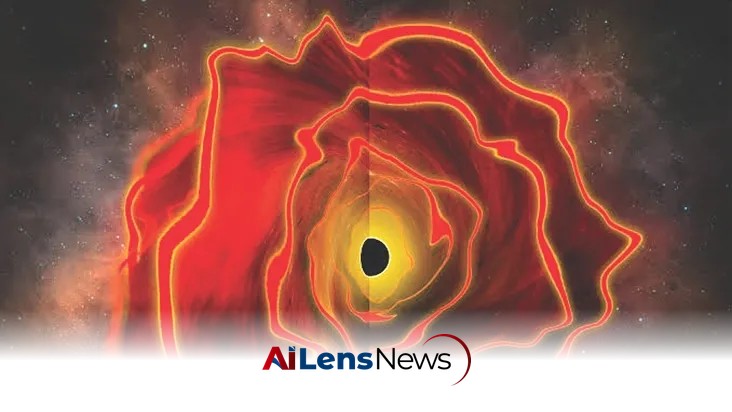



A groundbreaking discovery by astronomers reveals a new type of astrophysical object, dubbed a 'black hole star', emitting unprecedented energy levels.
New Delhi, India Aug 17, 2026 ALN: Astronomers at MIT and various other institutions have made a groundbreaking discovery in the field of astrophysics, identifying an extremely bright red spot in the early universe that challenges existing paradigms of stellar formation and black hole characteristics. This object, which has been described as resembling an enormous star roughly the size of our solar system, is emitting an astonishing amount of energy—100 billion times more than any known star can physically produce. Such an extraordinary energy output is more akin to that generated by a black hole, leading researchers to propose that this red spot represents an entirely new category of astrophysical source, tentatively referred to as a "black hole star."
The discovery was made possible through the advanced capabilities of NASA’s James Webb Space Telescope (JWST), which has been instrumental in examining the cosmos in unprecedented detail. The telescope identified this bright red dot in the early universe, dating back to a mere few hundred million years after the Big Bang, a time when the universe was still in its infancy. This period is critical for understanding the formation of the first stars and galaxies, as well as the evolution of cosmic structures.
In their paper published in the prestigious journal Nature, the research team elaborates on their analysis of this unusual object. They propose that the red spot is likely a highly dense cloud of gas that is not powered by the standard nuclear fusion processes that characterize typical stars. Instead, they suggest that a central black hole might be at the heart of this object, providing the energy necessary to produce the extraordinary luminosity observed.
According to lead author Rohan Naidu, who is a NASA Hubble Fellow and Pappalardo Fellow at MIT’s Kavli Institute for Astrophysics and Space Research (MKI), the team's understanding of this object is rapidly evolving. Naidu posits that there exists a central black hole that is approximately 100,000 times as massive as our sun, surrounded by an extensive envelope of gas that gives the appearance of a star the size of the solar system. This description suggests a complex and dynamic interplay between the black hole and the surrounding gas, which could have significant implications for our understanding of stellar and black hole formation.
If the bright red dot is indeed confirmed to be a black hole star, it could provide crucial insights into the identity of other mysterious "little red dots" that have been observed in nearly every deep-space image captured by JWST to date. These elusive objects have sparked considerable debate among astronomers, as they seem to be prevalent in the early universe but largely vanish in the later cosmic timeline. Naidu emphasizes that understanding these little red dots has been one of the most discussed topics in the JWST era, highlighting the importance of this discovery in the broader context of cosmic evolution.
The implications of identifying a black hole star are profound. It could reshape our understanding of how black holes and stars co-evolve in the early universe, offering new perspectives on the processes that govern star formation and the growth of black holes. Furthermore, this discovery could lead to a reevaluation of existing models of cosmic evolution, particularly concerning the formation of the first galaxies and the role of dark matter and dark energy in shaping the universe.
Additionally, the study's findings contribute to the ongoing research into the nature of black holes, which have long been one of the most enigmatic components of astrophysics. Black holes are typically understood as regions of space where gravity is so strong that nothing, not even light, can escape their pull. However, the concept of a black hole existing in conjunction with a gas cloud that mimics a star blurs the lines between these two distinct astrophysical entities, suggesting that the universe may host a wider variety of objects than previously thought.
The co-authors of this study from MIT include MKI Director Robert Simcoe, who holds the Bruno B. Rossi Professorship of Experimental Physics, and Wendy Sun, a student researcher. The collaborative nature of this research, which also includes contributions from multiple other institutions, underscores the importance of interdisciplinary efforts in advancing our understanding of the universe.
As astronomers continue to analyze the data collected by JWST, the discovery of the black hole star may serve as a pivotal moment in astrophysics, prompting further investigations into the mysteries of the early universe. The evolution of this field is likely to accelerate as more observations are made, potentially leading to new theories that could redefine our comprehension of the cosmos and our place within it.
To learn more about the latest developments in Environment & Climate, stay updated with our exclusive reports and analyses on AILensNews.

