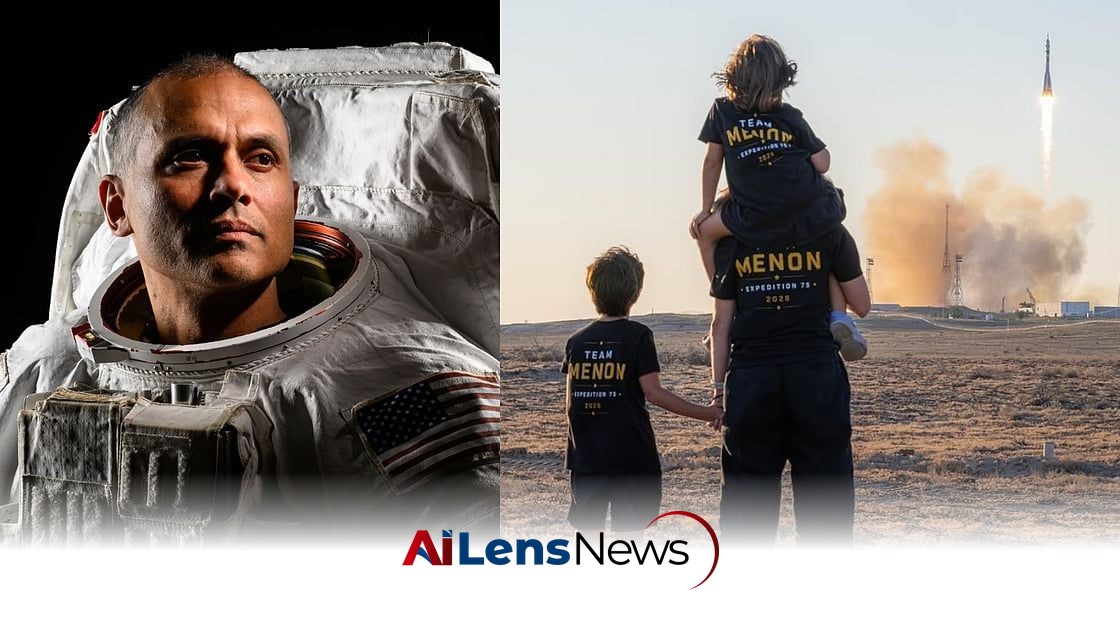


Indian-origin NASA astronaut Anil Menon embarks on his first mission aboard the Soyuz MS-29 spacecraft, conducting vital experiments on the ISS.
New Delhi, India Jul 17, 2026 ALN: Indian-origin NASA astronaut Anil Menon and two Russian cosmonauts lifted off aboard a Soyuz MS-29 spacecraft from Kazakhstan on July 14, embarking on an eight-month mission to the International Space Station (ISS). This mission is significant not only as Menon's inaugural spaceflight but also for the array of scientific experiments he will conduct, which are aimed at studying the physiological toll of long-duration spaceflight on the human body. As space exploration continues to push boundaries, understanding the effects of microgravity on health becomes increasingly critical.
Anil Menon is an emergency medicine physician and a Colonel in the US Space Force, reflecting a unique blend of medical expertise and military experience. His background includes a tenure in the US Air Force, where he was deployed to Afghanistan during Operation Enduring Freedom. This experience not only showcases his commitment to service but also highlights the diverse skill set he brings to NASA. In addition to his military service, Menon has volunteered with the Himalayan Rescue Association, providing crucial medical care for climbers on Mount Everest, further emphasizing his dedication to emergency medicine and humanitarian efforts.
Born in Minneapolis to Ukrainian and Indian immigrants, Menon pursued neurobiology at Harvard University, laying a strong foundation in the sciences. His academic journey continued with a master’s degree in mechanical engineering and a medical degree from Stanford University, where he specialized in emergency medicine and aerospace medicine. This combination of disciplines is particularly relevant to his role as an astronaut, as it equips him with the necessary skills to handle medical emergencies in space and understand the engineering challenges associated with space travel.
Menon's professional trajectory took a significant turn when he joined NASA as a flight surgeon in 2014. In this role, he supported astronauts on the ISS, ensuring their health and safety during missions. His expertise in aerospace medicine was further recognized when he became part of NASA's medical program in 2018, contributing to the development of the Starship, a spacecraft designed for deep-space missions. His selection as a NASA astronaut in December 2021 marked a culmination of years of hard work, dedication, and a commitment to advancing human space exploration.
Menon’s heritage is notable, as he is the first NASA astronaut of Malayali descent. His father, KP Shankaran Menon, hails from Ottapalam, Palakkad, India, while his mother, Elizabeth, is an immigrant from Ukraine. This diverse background enriches Menon’s identity and reflects the global nature of space exploration. His great-grandfather, Sir Chetur Shankaran Nair, was a notable lawyer and freedom fighter, indicating a family legacy of service and dedication to societal advancement. Menon’s journey is not just a personal achievement but also a source of inspiration for many, particularly in the Indian diaspora and among those pursuing careers in science and technology.
During his time on the ISS, Menon will conduct experiments that are critical for understanding the physiological effects of long-duration spaceflight. One of the primary focuses of his research will be on how microgravity influences blood flow, vein structure, and blood composition in astronauts. These studies are vital as they contribute to our understanding of how extended periods in space can affect human health, which is particularly important as NASA and other space agencies plan for future missions to Mars and beyond.
Additionally, Menon will assist in testing technologies for producing intravenous fluids using the station's potable water system. This capability could prove essential for deep-space missions where medical supplies are limited and the ability to provide immediate medical care is crucial. The implications of this research extend beyond the ISS, potentially informing medical practices in remote locations on Earth and enhancing our preparedness for future exploration missions.
Menon’s work on the ISS represents a significant step forward in the ongoing quest to understand the human body’s response to space travel. As humanity looks toward longer missions, including potential manned missions to Mars, the findings from Menon’s experiments could help ensure the health and safety of astronauts during these journeys.
Overall, Anil Menon’s mission is a testament to the collaborative spirit of international space exploration and the importance of diverse backgrounds in advancing our understanding of science and technology. His contributions as a physician, engineer, and astronaut are paving the way for future generations of explorers, and his journey serves as an inspiration to many aspiring scientists and engineers around the world.
With inputs from PTI
To learn more about the latest developments in Space & Astronomy, stay updated with our exclusive reports and analyses on AiLensNews.

