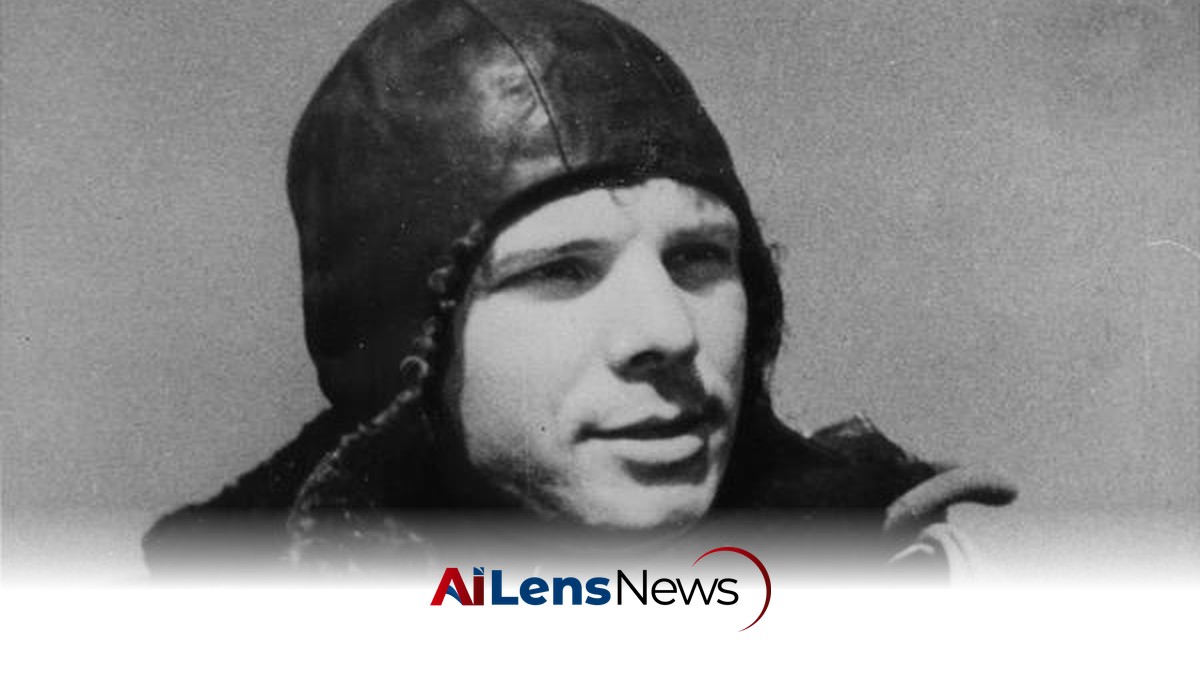


Yuri Gagarin's historic flight marked a pivotal moment in space exploration, making him an enduring symbol of human achievement.
Moscow, Russia Apr 12, 2021 ALN: Crushed into the pilot’s seat by heavy G-forces, Soviet cosmonaut Yuri Gagarin saw flames outside his spacecraft and prepared to die. His voice broke the tense silence at ground control: “I’m burning. Goodbye, comrades.” Gagarin didn’t know that the blazing inferno he observed through a porthole was a cloud of plasma engulfing Vostok 1 during its re-entry into the Earth’s atmosphere, and he was still on track to return safely.
It was his quiet composure under pressure that helped make him the first human in space 60 years ago. Gagarin’s steely self-control was a key factor behind the success of his pioneering 108-minute flight. The April 12, 1961, mission encountered glitches and emergencies — from a capsule hatch failing to shut properly just before blastoff to parachute problems in the final moments before touchdown.
Crowd of Gagarins to celebrate the cosmonaut
From the time 20 Soviet air force pilots were selected to train for the first crewed spaceflight, Gagarin’s calm demeanor, quick learning skills and beaming smile made him an early favorite. His selection was not just a matter of technical prowess; it stemmed from a comprehensive evaluation of personality traits that included resilience, adaptability, and an ability to remain composed under extreme pressure. These qualities would prove essential as he faced the unknowns of space travel.
Two days before blastoff, the 27-year-old Gagarin wrote a farewell letter to his wife, Valentina, sharing his pride in being chosen to ride in Vostok 1 but also trying to console her in the event of his death. “I fully trust the equipment, it mustn’t let me down. But if something happens, I ask you Valyusha not to become broken by grief,” he wrote, using a nickname for her. This poignant letter highlights the emotional weight of his historic mission and the personal sacrifices made by those involved in the space race.
Authorities held onto the letter and eventually gave it to Gagarin’s widow seven years later after he died in an airplane crash. She never remarried, a testament to the profound impact Gagarin’s life and untimely death had on her and the nation.
From the Archives (March 29, 1968) | Gagarin killed in test flight
Gagarin’s pioneering, single-orbit flight made him a hero in the Soviet Union and an international celebrity. After putting the world’s first satellite into orbit with the successful launch of Sputnik in October 1957, the Soviet space program rushed to secure its dominance over the United States by putting a man into space. This urgency was fueled by the Cold War, where technological superiority was equated with national power and prestige.
“The task was set, and people were sleeping in their offices and factory shops, like at wartime,” Fyodor Yurchikhin, a Russian cosmonaut who eventually made five spaceflights, recalled. The pressure to succeed was immense, and the Soviet Union was determined not to fall behind its American rivals in the burgeoning field of space exploration.
As the Soviet rocket and space program raced to beat the Americans, it suffered a series of launch failures throughout 1960, including a disastrous launch pad explosion in October that killed 126 people. Missile Forces chief Marshal Mitrofan Nedelin was among the victims. This tragedy underscored the risks associated with the nascent space program and the lengths to which the Soviet Union was willing to go to achieve its goals.
Like Gagarin, Soviet officials were prepared for the worst. No safety system had been installed to save the cosmonaut in case of another rocket explosion at blastoff or after. This lack of contingency planning reflected the urgency of the mission and the belief in the infallibility of the technology being developed. Authorities drafted three versions of a bulletin about Gagarin’s flight for the official TASS news agency: one announcing a successful flight, another in case of problems, and the third one for a mission ending in disaster, illustrating the precarious nature of human spaceflight at that time.
Apart from potential engine failures and other equipment malfunctions, scientists questioned an individual’s ability to withstand the conditions of spaceflight. Many worried that a pilot could go mad in orbit. The psychological and physiological effects of space travel were largely uncharted territories, and the Soviet space program was venturing into the unknown.
Soviet engineers prepared for that situation by developing a fully automatic control system. As an extra precaution, the pilot would receive a sealed envelope containing a secret code for activating the capsule's manual controls. The theory was that a person who could enter the code must be sane enough to operate the ship. This innovative approach showcased the ingenuity of the Soviet engineers, who were determined to mitigate risks in an untested environment.
Everyone in the space program liked Gagarin so much, however, that a senior instructor and a top engineer independently shared the secret code with him before the flight to save him the trouble of fiddling with the envelope in case of an emergency. This camaraderie among the team members not only reflected Gagarin’s popularity but also highlighted the collaborative spirit that was essential in overcoming the challenges of space exploration.
Problems began right after Gagarin got into Vostok 1, when a light confirming the hatch’s closure did not go on. Working at a frantic pace, a leading engineer and a co-worker removed 32 screws, found and fixed a faulty contact, and put the screws back just in time for the scheduled launch. This last-minute fix was a testament to the dedication and resourcefulness of the ground crew, who were equally invested in the success of the mission.
Sitting in the capsule, Gagarin whistled a tune. “Poyekhali!” — “Off we go!” — he shouted as the rocket blasted off. His exuberance and optimism during the launch were infectious, inspiring not just his fellow cosmonauts but also millions around the world who were watching the event unfold.
As another precaution, the orbit was planned so the spacecraft would descend on its own after a week if an engine burn failure stranded the spaceship. Instead, a glitch resulted in a higher orbit that would have left Gagarin dead if the engine had malfunctioned at that stage. This incident illustrated the unpredictability of space travel and the need for meticulous planning and execution.
While the engine worked as planned to send the ship home, a fuel loss resulted in an unexpected re-entry path and a higher velocity that made the spaceship rotate wildly for 10 agonizing minutes. Gagarin later said he nearly blacked out while experiencing G-forces exceeding 10 times the pull of gravity. “There was a moment lasting two or three seconds when instruments started fading before my eyes,” he recalled. This harrowing experience underscored the physical toll that space travel could take on the human body, raising questions about the limits of human endurance.
Seeing a cloud of fiery plasma around his ship on re-entry, he thought his ship was burning. A soft-landing system hadn’t been designed yet, so Gagarin ejected from the module in his spacesuit and deployed a parachute. While descending, he had to fiddle with a sticky valve on his spacesuit to start breathing outside air. A reserve chute unfolded in addition to the main parachute, making it hard for him to control his descent, but he landed safely on a field near the Volga River in the Saratov region. His successful landing was a remarkable conclusion to a mission fraught with danger and uncertainty.
Gagarin was flown to Moscow to a hero’s welcome, hailed by Soviet leader Nikita Khrushchev and greeted by enthusiastic crowds cheering his flight as a triumph on par with the victory in World War II. His achievement became a symbol of Soviet technological prowess and national pride, marking a significant moment in the Cold War rivalry with the United States. In the years before he died at age 34, he basked in international glory, visiting dozens of countries to celebrate his historic mission. Gagarin’s legacy endures, not only as the first human in space but as a beacon of hope and inspiration for future generations of explorers and scientists.
To learn more about the latest developments in Space & Astronomy, stay updated with our exclusive reports and analyses on AiLensNews.

