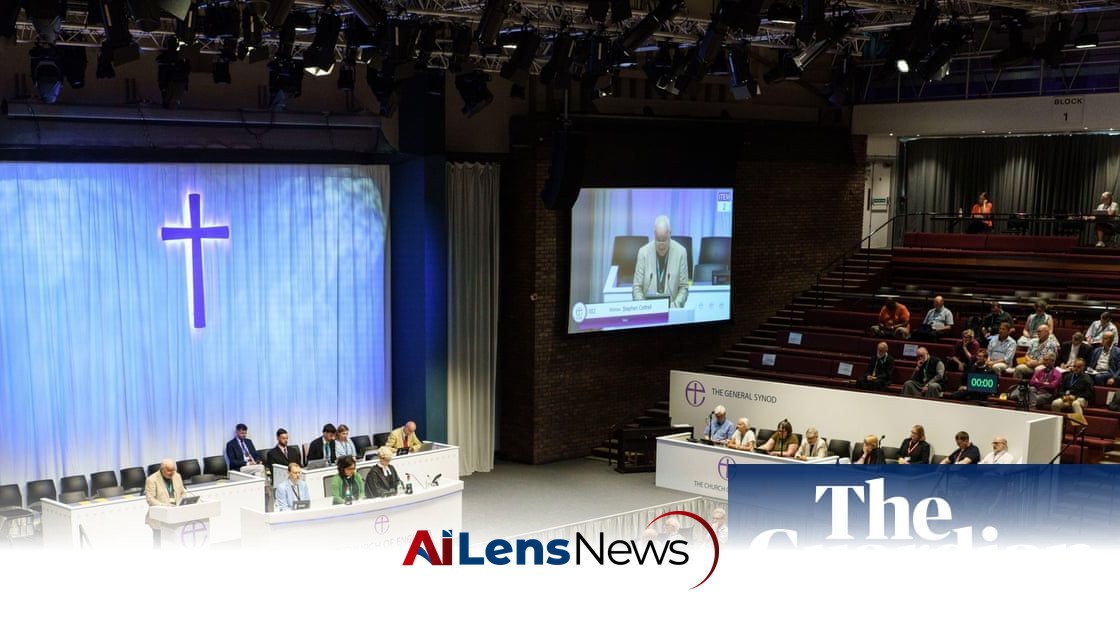


The Church of England's General Synod voted to hear a document addressing the plight of Palestinian Christians, sparking debate over its implications for Jewish-Christian relations.
London, United Kingdom Jul 19, 2026 ALN: Father Fadi Diab, a prominent Palestinian Anglican priest from Ramallah, watched quietly as the Church of England debated whether to formally hear a document describing Israel as a “colonial enterprise” that had inflicted a “genocidal war on Gaza”.
The motion passed overwhelmingly among bishops, clergy, and laity – all three houses of the General Synod – last week.
Diab, who helped write the document at the center of the debate, described the moment as “surreal”.
“It was very moving and very emotional,” he said. “I think members of synod wanted to say: ‘We hear your voices, we feel your pain, and we want to stand with you in your struggle.’”
For many Palestinian Christians, the vote marked a significant shift in the Church of England’s engagement with their community. However, the moment came amid warnings from Jewish leaders that the language at the heart of the report risked straining decades of Christian-Jewish dialogue.
The motion centered on Kairos Palestine II (A Moment of Truth: Faith in a Time of Genocide), a report published last year by Palestinian Christian leaders drawn from across denominations calling for an urgent global Christian response to the war in Gaza and Israel’s occupation of the West Bank. Co-written by Diab, it describes Israel’s actions using terms including genocide, apartheid, and settler colonialism.
Originally drafted to ask synod to “receive” the report, the motion was amended during the debate so members instead agreed to “hear” it.
Speaking during the debate, Sarah Mullally, the archbishop of Canterbury, acknowledged concerns raised by Jewish organizations and explained that hearing Palestinian Christians’ experiences did not mean endorsing every aspect of the report.
“It does mean that we listen with compassion, and stand in solidarity with them amidst the many injustices they face,” she said.
Before the debate, the Board of Deputies of British Jews urged synod to reject the report, releasing its own briefing that said it “directly undermines the struggle against antisemitism”. The UK’s chief rabbi, Sir Ephraim Mirvis, and the co-chairs of Progressive Judaism warned that it risked harming Christian-Jewish relations.
Jewish leaders argued the report went beyond criticizing the Israeli government and its military campaign in Gaza, instead questioning Zionism and what they described as core elements of Jewish history, including the longstanding Jewish connection to the land.
Rabbi Charley Baginsky, a co-chair of Progressive Judaism, expressed understanding that the Church of England must grapple with the experiences of Palestinian Christians who feel unheard.
“We recognize that as well, and we absolutely do not want to play any part in stopping those voices from being heard,” she said.
“Where we’d be very strong is that this is not the vehicle by which to do that because of the entrenchment of antisemitic tropes within it [the document], and within the nature of wiping out the experiences of what it means for Jews and Israelis to be in relationship with the land.”
Baginsky did, however, welcome the continued engagement by the church on the matter, adding: “As always, the challenge for all of us in faith relationships is: how do we stay in the room and hear things that are difficult? How do we make sure the parameters around conversation are ones that are open to conversations?”
Georgina Bye, a co-director of the Council of Christians and Jews (CCJ), the oldest interfaith charity in the UK, said that while she understands the document comes from a place of trauma and distress, she was concerned by the “lack of nuance” with some of the terms used, stating that “the document disparages dialogue”.
“For us, it’s a balancing act,” Bye added. “We want to uplift and hear the voices of Palestinian Christians, amplify their distress and stand with them, while also being aware of the context we’re living in here in the UK.”
Bye expressed gratitude that the amendments changed “receive” to “hear”, and noted that several people stood up during the debate to advocate for a more holistic approach to the issue.
“Ultimately, Kairos II is presenting a perspective,” she said. “If we really want to understand and grapple with something as complex as what’s going on in the Middle East, we have to expose ourselves to lots of different perspectives and narratives so we can better understand how we move forward and build peace.”
Richard Sewell, the Residentiary Canon of St George’s Cathedral in Jerusalem, who functions as a link between the church in England and the Anglican community in Palestine, described the report as “a cry for help from our brothers and sisters in Palestine and Israel”.
He insisted the Church of England had a duty to directly hear the voice of the suffering church in Palestine, Israel, and the wider region.
“People ask: ‘Why are you raising these painful issues which are going to cause so much distress?’ Because our brothers and sisters in the Diocese of Jerusalem and across different denominations are pleading with the wider church to engage with them,” Sewell said.
The debate marked one of Mullally’s first significant interventions as leader of the church. The motion was first introduced several years earlier, and according to Sewell, there had been growing frustration over repeated delays before it reached the synod floor.
Weeks earlier, Mullally had visited Diab’s congregation in Birzeit, in the occupied West Bank. Sewell noted that the Palestinian Christian community had been “delighted” by her visit.
“It would have been easy for her to say: ‘Actually, the time’s not quite right, so we won’t come.’ But I was deeply encouraged that she was not put off by the circumstances,” he said.
Reflecting on the visit during the synod debate, Mullally remarked that she had seen settlements expanding “at unprecedented rates”, and that Palestine, including Christian villages such as Taybeh, was “on the brink of disappearing”.
“Against this desperate backdrop we are called to a new and active solidarity,” she said.
Diab stated that Kairos II had been born out of “the existential threats facing the Christian community” caused by the war in Gaza and decades of military occupation. He described conditions in the occupied Palestinian territories as the worst they had ever been.
He defended the language in the report, including the terms genocide and apartheid, asserting that they reflected the findings of human rights organizations. “The reality is that the state of Israel continues to confiscate occupied Palestinian land and build settlements on it.”
“We are not inventing words. We are describing what is happening on the ground.”
Diab urged more people to visit the occupied territories. “Many simply do not know what is happening,” he said. “We know many people whose views changed after visiting because once you experience crossing checkpoints, once you experience humiliation, you begin to understand what it means to live under military occupation for nearly 60 years.”
“That is why Palestinian theologians produced this document: to say we cannot remain silent any longer, and that the world needs to hear our cry because the situation is extremely serious.”
To learn more about the latest developments in Christianity, stay updated with our exclusive reports and analyses on AiLensNews.

