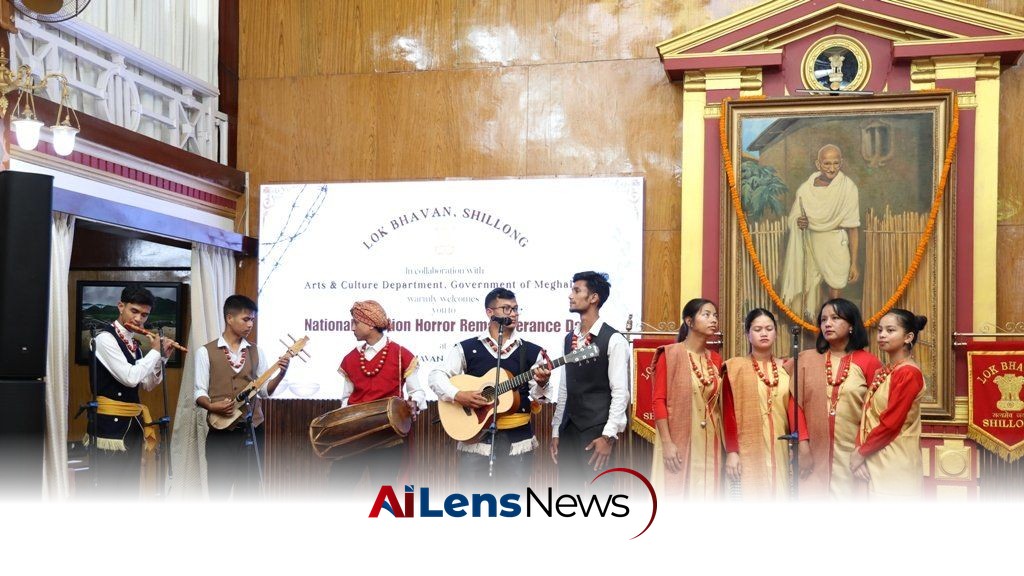


Shillong observed Partition Horrors Remembrance Day, highlighting the impact of the 1947 Partition on the North East, with cultural programs and discussions on its lasting effects.
Shillong, India Aug 14, 2026 ALN: Lok Bhavan Shillong, in collaboration with the Arts and Culture Department, observed Partition Horrors Remembrance Day today to commemorate the victims and survivors of the Partition of India in 1947. This day is marked annually to reflect on the immense suffering and upheaval that millions endured during one of the largest mass migrations in human history, which was precipitated by the end of British colonial rule in India.
The Partition of India was a complex event that led to the division of British India into two independent dominions: India and Pakistan. This division was accompanied by widespread communal violence, resulting in the displacement of approximately 15 million people and the deaths of an estimated one to two million individuals. The ramifications of this event are still felt today, as it not only altered the political landscape of the subcontinent but also had profound social and cultural implications.
The programme commenced with the hoisting of the national flag by Governor CH Vijayashankar, symbolizing unity and remembrance. Following the flag-hoisting ceremony, the gathering moved to the Durbar Hall, where cultural programmes were presented by students. These performances served as a poignant reminder of the rich cultural tapestry of India, which has been shaped by its diverse communities and histories. The event concluded with an address that highlighted the human cost and lasting impact of Partition on the lives of ordinary people.
Speaking on the occasion, David Arnold Kharchandy, Assistant Professor at Synod College, emphasized that Partition should not be understood merely as a political development that marked the end of British rule and the creation of India and Pakistan. He articulated that for millions of ordinary people, Partition meant much more than the drawing of the Radcliffe Line on a map. It resulted in the loss of homes, separation of families, disruption of communities, and the beginning of uncertain journeys for people who were forced to leave behind everything familiar. This perspective is crucial for understanding the enormity of the human suffering that accompanied the political changes of 1947.
Kharchandy stressed that remembering Partition is important because history must go beyond statistics and political boundaries and recognize the experiences of the people who lived through the tragedy. He argued that while it is essential to acknowledge the political dimensions of Partition, it is equally vital to understand the personal stories and collective memories that define the experiences of those who suffered. This approach allows for a more nuanced understanding of history, one that honors the memories of the victims and survivors.
In his address, Kharchandy also cautioned against turning the suffering of Partition into a comparison between communities. He highlighted that people from different religious and social backgrounds suffered during this tumultuous time, and reducing the tragedy to “our people versus their people” would prevent future generations from learning the real lessons of history. This statement underscores the importance of fostering empathy and understanding among diverse communities, particularly in a country as multifaceted as India.
Drawing attention to the North East, Kharchandy noted that Partition had significant consequences for the region, particularly following the creation of the border with what is now Bangladesh. Migration increased, trade routes changed, and families and communities found themselves separated by newly created political boundaries. The North East's unique geographical and cultural context means that its experiences of Partition differ from those of other regions, such as Punjab or Bengal, which are often more prominently featured in historical narratives.
“Partition is not merely the story of Delhi, Punjab, or Bengal. It is also part and parcel of the history of the North East,” he said, urging students to explore the regional experiences of Partition more closely. This call to action reflects a growing recognition of the need to include diverse perspectives in the retelling of historical events, ensuring that the narratives of all affected communities are acknowledged and preserved.
Kharchandy urged students to remember the victims and survivors of Partition, study history from different perspectives, question rumors and stereotypes, verify information, and reject communal propaganda. Education plays a pivotal role in shaping attitudes and fostering a sense of shared humanity. By encouraging critical thinking and open-mindedness, educators can help students navigate the complexities of history and its implications for contemporary society.
He also called upon them to respect people belonging to different religions, communities, castes, classes, and linguistic backgrounds. This emphasis on respect and understanding is particularly relevant in today’s context, where social divisions and communal tensions continue to pose challenges to national unity. By promoting inclusivity and dialogue, society can work towards healing the wounds of the past and building a more harmonious future.
The observance of Partition Horrors Remembrance Day serves not only as a memorial for those who suffered but also as a reminder of the ongoing challenges of communal harmony and social cohesion in India. As the nation continues to grapple with its diverse identities and histories, events like this play a crucial role in fostering awareness and understanding among its citizens. The lessons drawn from the past can guide future generations towards a more peaceful coexistence, emphasizing the importance of empathy, dialogue, and collective memory in shaping a unified national identity.
The Partition of India in 1947 is a pivotal moment in the subcontinent's history, often characterized by its violence and human tragedy. The decision to partition British India was made hastily, with the British government aiming to withdraw from India while ensuring that the newly formed nations would be stable. However, the consequences were catastrophic. The mass migration that ensued saw families torn apart, communities destroyed, and a legacy of mistrust that has persisted for generations.
In the years following the Partition, many survivors carried the scars of their experiences. The stories of loss, trauma, and resilience became woven into the cultural fabric of both India and Pakistan. The narratives of those who lived through this period are crucial for understanding the complexities of identity, belonging, and the ongoing challenges of communal relations in the region.
In contemporary India, the lessons of Partition remain relevant as the country faces various socio-political challenges. The need for tolerance, understanding, and a commitment to coexistence is more pressing than ever. Initiatives like Partition Horrors Remembrance Day serve as vital reminders of the past, encouraging dialogue about the importance of preserving communal harmony and fostering a sense of shared history.
Moreover, the observance of such days is not just about remembering the past; it is also about shaping the future. By acknowledging the pain and suffering caused by Partition, society can work towards reconciliation and healing. This process involves recognizing the diverse narratives that exist within the collective memory of the nation, ensuring that no voice is marginalized or forgotten.
As educational institutions, community organizations, and governmental bodies come together to commemorate Partition Horrors Remembrance Day, they contribute to a broader movement aimed at fostering a more inclusive and empathetic society. The role of education in this context cannot be overstated; it is through education that future generations can learn about the past, understand its implications, and develop the critical thinking skills necessary to navigate complex social realities.
In conclusion, the commemoration of Partition Horrors Remembrance Day in Shillong is a significant event that highlights the importance of remembering the past while working towards a more inclusive future. By honoring the victims and survivors of Partition, society reaffirms its commitment to understanding the complexities of its history and the necessity of building a more cohesive and harmonious nation. The observance of this day serves as a powerful reminder that the lessons of history must inform our actions today and guide us toward a more peaceful coexistence in the future.
To learn more about the latest developments in Interfaith, stay updated with our exclusive reports and analyses on AiLensNews.

