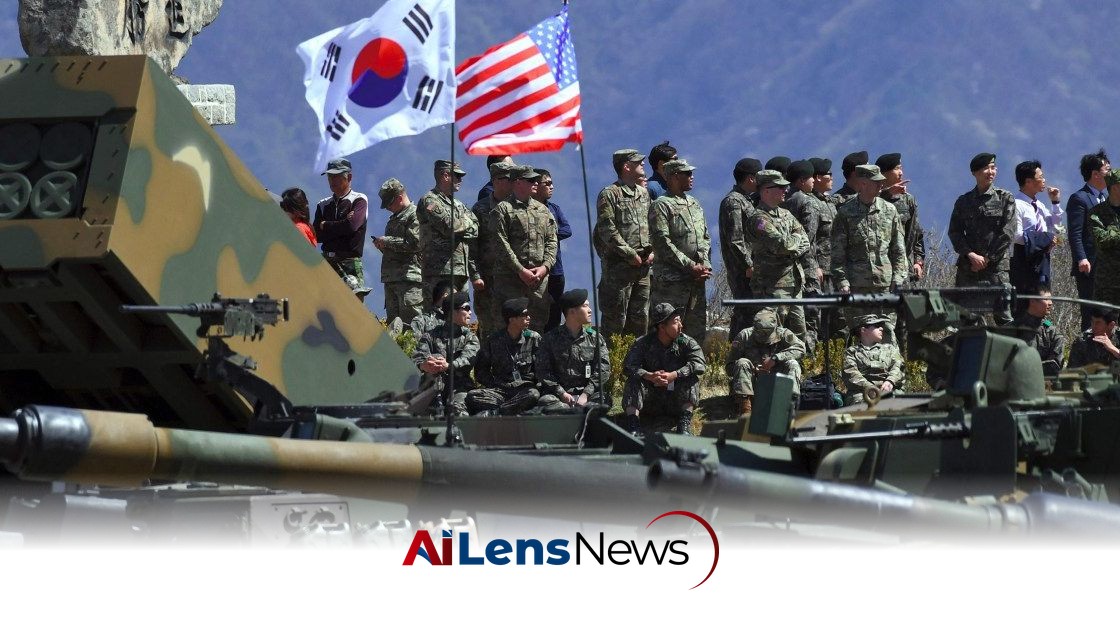


President Trump has ordered a significant reduction in military exercises with South Korea, citing the country's refusal to participate in the Iran conflict and his relationship with North Korea's leader.
Washington DC, United States Aug 17, 2026 ALN: President Donald Trump announced on Sunday that he has directed the Defense Department to scale down joint military exercises with South Korea. This decision marks a significant shift in U.S. military policy in the region and comes in light of South Korea's refusal to join the U.S. in the ongoing conflict in Iran. The announcement reflects Trump's assertion of a "very good" relationship with North Korean leader Kim Jong Un, a relationship that has been a focal point of Trump's foreign policy.
Historically, joint military exercises between the U.S. and South Korea have been a cornerstone of the military alliance that has existed since the Korean War. These exercises are intended to enhance the readiness and interoperability of U.S. and South Korean forces in the face of potential threats from North Korea. However, Trump criticized the large, annual military drills, stating they send a "signal that is totally inappropriate and hostile" to North Korea. This sentiment aligns with Trump's broader strategy of seeking diplomatic engagement with North Korea, which has included unprecedented summits between the two leaders.
Despite the lack of formal diplomatic ties, Trump claims that North Korea has been "unthreatening and respectful" during his presidency. This assertion stands in contrast to the historical context of U.S.-North Korea relations, which have been fraught with tension, particularly in light of North Korea's nuclear weapons program. The ongoing missile tests by North Korea have raised alarms globally, leading to calls for a more unified international response.
“Based on the fact that it is too late to cancel, I have instructed Secretary of War, Pete Hegseth, to substantially reduce the Joint Military Exercises!” Trump stated in a message. The specifics of what a scaled-down version of the training would entail remain unclear, especially since the exercises were set to commence just hours after Trump's announcement. The ambiguity surrounding the nature and extent of these reductions raises questions about the future of U.S.-South Korea military cooperation.
Trump also highlighted South Korea's refusal to support the Iran war, mentioning, “While somewhat unrelated (?), I recently asked the President of South Korea if they would like to join us in the Denuclearization of the Islamic Republic of Iran, and they said, ‘No thanks!’” This comment underscores the complex geopolitical dynamics at play, as South Korea navigates its own national interests while being a key ally of the United States. The refusal to join the U.S. in Iran could reflect South Korea's desire to maintain a focus on its immediate security concerns, particularly regarding North Korea.
The upcoming Ulchi Freedom Shield training was scheduled to involve 18,000 South Korean soldiers, according to the South Korean military. These exercises aim to enhance the combined defense posture and improve alliance response capabilities against various security threats. However, North Korea has previously condemned these drills as a "war rehearsal" and has threatened retaliation, which raises concerns about the potential for increased tensions on the Korean Peninsula.
Trump's announcement follows North Korea's recent ballistic missile launch toward the sea, which may have been a protest against the impending U.S.-South Korea military drills. This missile launch is indicative of North Korea's ongoing efforts to demonstrate its military capabilities and assert its position in the region. The timing of these events suggests a calculated response from North Korea, which has historically used missile tests to signal its discontent with U.S. military activities in the region.
This decision also comes a day after the U.S. repositioned its last aircraft carrier in Asia, with the USS George Washington replacing the USS Abraham Lincoln in the Persian Gulf amid scrutiny over conditions aboard the latter. The movement of naval assets in the region is a crucial aspect of U.S. military strategy, serving both as a deterrent and as a means of projecting power. The repositioning of the carrier underscores the fluid nature of military readiness and the necessity for the U.S. to adapt to changing geopolitical circumstances.
In the broader context, Trump's directive to reduce joint military exercises with South Korea reflects his administration's ongoing efforts to reshape U.S. foreign policy, particularly concerning North Korea. The implications of this decision could be far-reaching, potentially affecting not only U.S.-South Korea relations but also the stability of the entire region. As North Korea continues to develop its nuclear capabilities, the U.S. and its allies must navigate a complex landscape of military readiness, diplomatic engagement, and regional security concerns.
The future of U.S.-South Korea military cooperation remains uncertain as both nations grapple with the implications of Trump's announcement. Analysts will be closely watching for responses from both North Korea and South Korea in the coming days, as the situation continues to evolve. The effectiveness of reduced military exercises in fostering a more peaceful dialogue with North Korea will hinge on the actions and reactions of all parties involved, making this a pivotal moment in the ongoing saga of U.S.-North Korea relations.
To learn more about the latest developments in Elections, stay updated with our exclusive reports and analyses on AiLensNews.

