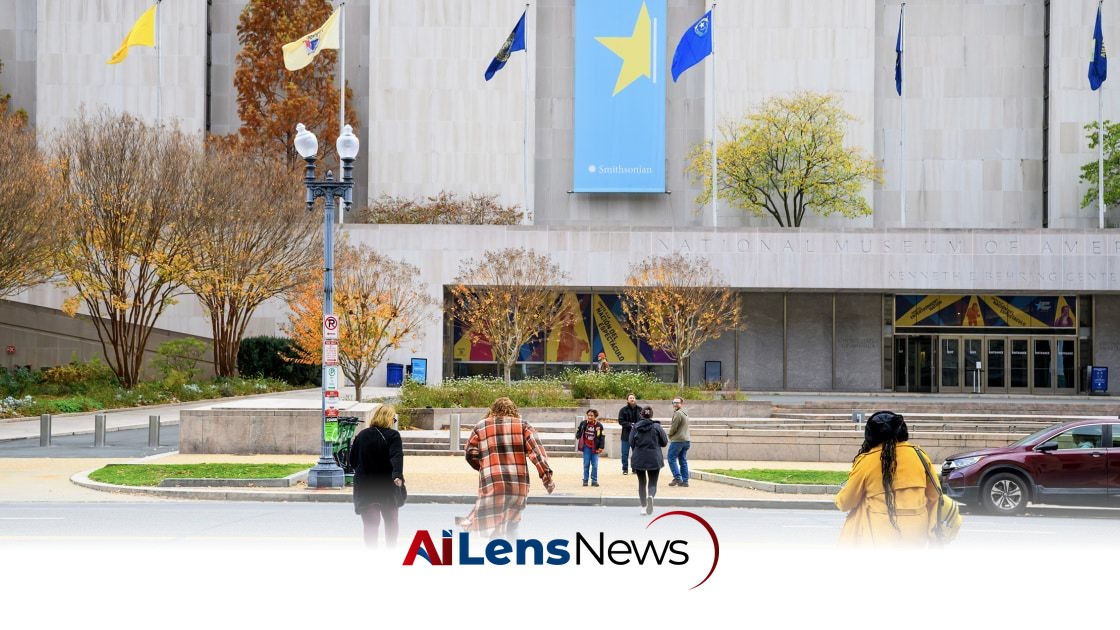


President Trump mandates signage at the Smithsonian's National Museum of American History to alert visitors about perceived inaccuracies in exhibits, following a controversial report.
Washington DC, United States Jul 25, 2026 ALN: In a significant development regarding the portrayal of American history, President Donald Trump has taken steps to reshape the narrative presented at the Smithsonian Institution, particularly at the National Museum of American History. This initiative reflects a broader trend in American politics where historical interpretation has become a contentious issue, often reflecting the ideological divides within the country.
The recent executive order issued by Trump mandates the placement of warning signs in front of the museum, aimed at alerting visitors to what he describes as "inaccurate information" presented within its exhibits. This directive was part of a series of actions initiated by the Trump administration to exert control over how American history is interpreted and presented in federal institutions.
The impetus for this order can be traced back to a report released by the White House on July 4, which criticized the museum for its portrayal of American history. The report alleged that the museum "cannot be trusted to tell America’s story honestly and in a way that is inspiring, unifying, and worthy of our great republic." Such claims resonate with a growing sentiment among certain political factions that view established historical narratives as biased or unrepresentative of a singular American identity.
In March 2025, President Trump had previously indicated his intention to implement changes at the Smithsonian Institution. At that time, he signed an executive order targeting federal funding for programs deemed to present "divisive narratives" or "improper ideology." This order laid the groundwork for the more recent actions, signaling a clear intent to influence the educational content of one of the nation’s most prominent cultural institutions.
In his latest order, Trump articulated a view that the leadership of the Smithsonian does not present American history as a collective heritage but rather utilizes it as a means to promote ideas associated with social justice and radical societal transformation. This perspective aligns with a broader conservative critique of how history is taught in American schools and institutions, suggesting that there is an ideological bias that skews the understanding of the nation’s past.
The directive to install signage near the museum is not merely a symbolic act; it is intended to provide visitors with alternative interpretations of American history, as outlined in the July 4 report. Trump’s assertion that the museum’s leadership "cannot be trusted to tell America’s story with honesty and gratitude" underscores a growing trend where historical narratives are increasingly viewed through a partisan lens.
Interior Secretary Doug Burgum has been tasked with overseeing the installation of this signage, which will be placed along the sidewalks and walkways managed by the National Park Service. The signs will reportedly inform visitors of the findings of the July 4 report and direct them to resources that allegedly provide a more accurate account of American history. This initiative raises questions about the implications of government intervention in historical interpretation and the potential for politicization of educational content.
In response to these developments, Smithsonian Secretary Lonnie Bunch has defended the institution’s commitment to scholarly rigor and accuracy. In a recent communication, he emphasized that the museum’s work is guided by a dedication to telling the "fullness of America’s story" and maintaining nonpartisanship and integrity in its exhibitions. Bunch's defense highlights the tension between the museum’s mission and the political pressures exerted by the current administration.
The implications of Trump’s actions extend beyond the Smithsonian, as they reflect a broader cultural battle over the interpretation of history in the United States. The use of federal authority to challenge established narratives raises concerns about academic freedom and the integrity of cultural institutions. Critics argue that such measures could stifle scholarly inquiry and promote a sanitized version of history that aligns with specific political ideologies.
This situation is emblematic of a larger national conversation regarding how history is taught and understood in the United States. In recent years, debates over curriculum content in schools, the portrayal of historical figures, and the interpretation of events such as slavery and civil rights have become increasingly polarized. The actions taken by the Trump administration may further entrench these divisions, as different factions within society seek to assert their narratives over others.
As the Smithsonian navigates this challenging landscape, it faces the difficult task of balancing its educational mission with the pressures of political influence. The institution has long been regarded as a bastion of historical scholarship and a repository of American cultural heritage, and its ability to maintain this status in the face of external pressures remains to be seen.
Ultimately, the president’s directive to place warning signs at the National Museum of American History raises fundamental questions about the nature of historical truth, the role of government in shaping cultural narratives, and the responsibilities of institutions tasked with preserving and interpreting the past. As this issue continues to unfold, it will likely provoke further discussion and debate about the future of historical education in America and the ongoing struggle over the nation’s collective memory.
In conclusion, while the immediate actions taken by President Trump may seem focused on a specific institution, they reflect a larger ideological battle that is playing out across the country. The outcome of this struggle will have lasting implications for how history is taught, understood, and remembered in the United States.
To understand the significance of this directive, it is essential to consider the broader context of how history is interpreted in America. The Smithsonian Institution, which encompasses a wide range of museums and research facilities, has long been seen as a custodian of American history and culture. Its exhibitions often aim to provide a comprehensive view of the nation’s past, incorporating diverse perspectives and experiences. However, the current political climate has led to increasing scrutiny of such institutions, with accusations of bias and misrepresentation becoming more prevalent.
This scrutiny is not limited to the Smithsonian; it reflects a nationwide trend where educational institutions, museums, and even public schools are facing pressure to conform to specific ideological perspectives. The debate over critical race theory, for instance, has become a flashpoint in discussions about how history and social issues are taught in schools. Proponents argue that it provides an essential framework for understanding systemic racism and its historical roots, while opponents claim it promotes division and a negative view of American history.
The implications of the Trump administration’s actions are multifaceted. On one hand, supporters may view the warning signs as a necessary corrective to what they perceive as a liberal bias in historical narratives. On the other hand, critics warn that such measures could undermine the integrity of educational institutions and lead to a homogenized version of history that overlooks the complexities and nuances of the American experience.
This ongoing struggle over historical interpretation is indicative of larger societal tensions. The way history is taught and understood can influence public perception, policy decisions, and even national identity. As different groups vie for control over historical narratives, the potential for conflict increases, with each side accusing the other of distorting the truth.
As the Smithsonian moves forward, it will need to navigate these challenges carefully. The institution has a responsibility to uphold its mission of education and preservation while also responding to the political realities of the current administration. The outcome of this situation may set a precedent for how cultural institutions across the country address similar pressures in the future.
In summary, the directive to install warning signs at the National Museum of American History is not just an isolated incident; it is part of a broader cultural and political struggle over the interpretation of history in the United States. As this debate continues, it will undoubtedly shape the landscape of historical education and the ways in which the nation reconciles its past with its present.
To learn more about the latest developments in Political Controversies, stay updated with our exclusive reports and analyses on AiLensNews.

