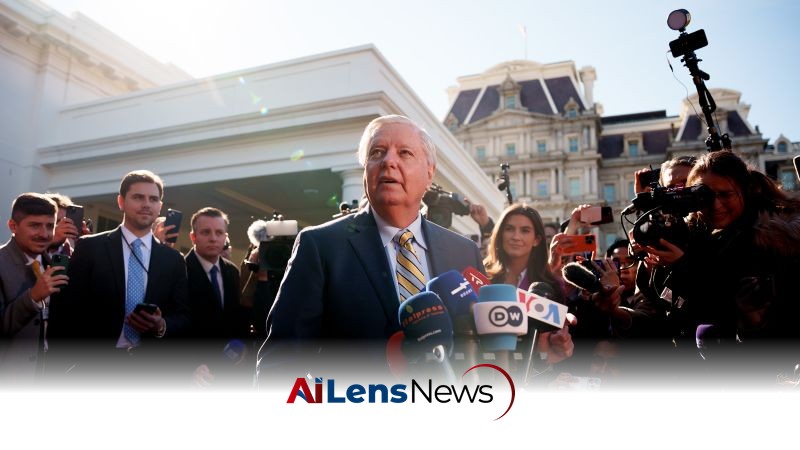


The late Senator Lindsey Graham's unique relationship with Donald Trump significantly shaped U.S. foreign policy, leaving a void in the Republican Party's approach to international relations.
Washington DC, United States Jul 28, 2026 ALN: Sen. Richard Blumenthal was stunned.
It was February 28, 2025, and he was watching on live television as a crucial bilateral meeting between President Donald Trump, Vice President JD Vance, and Ukraine President Volodymyr Zelensky descended into chaos.
Blumenthal knew he needed to call the only person he thought could put it all back together: Sen. Lindsey Graham.
Just hours before the meeting, Blumenthal, a Democrat, and Graham, a Republican, had met quietly with Zelensky at Blair House, just steps from the White House, to prepare the Ukrainian president for his high-stakes sit-down. No matter what happened in the Oval Office, Graham warned, Zelensky needed to remain composed, conciliatory, and calm.
That is not what happened.
As the Ukrainians were asked to depart the White House, Graham went to the mics and reprimanded Zelensky, saying the Ukrainian president “either needs to resign and send somebody over we can do business with, or he needs to change.”
But behind the scenes, Blumenthal said Graham, the senior senator from South Carolina, was already thinking about how to repair the damage and get a relationship he’d spent years helping build between Zelensky and Trump back on track.
“He just never gave up on this cause,” Blumenthal said.
In the weeks since Graham’s death, Republicans have confronted the reality that there will be no replacing Graham when it comes to foreign policy or as a conduit to Trump. And that has left many in the GOP grappling with the direction of their party’s foreign policy, with hawkish voices now far less common and a critical link between the White House and Capitol Hill gone.
Graham’s own hawkish views – shaped by his late mentor Sen. John McCain – and his close relationship with the president meant he was perhaps the last Republican interventionist able to permeate Trump’s non-interventionist, “America first” platform.
“It’s not about Graham’s views. It’s about that Trump-Graham chemistry,” Sen. Thom Tillis, a Republican from North Carolina, said. “I think that is a unique chemistry and not one that will likely be repeated.”
In more than a dozen interviews, lawmakers said Graham acted as his own State Department, international attaché, and, often, U.S. ambassador to whatever country he happened to land in that weekend, all while enjoying a direct line to the president. Sen. Mark Kelly, a Democrat from Arizona, said Graham traveled so often that he once saw his senate colleague unfurl a sleeping bag on the floor of a military aircraft.
“You could tell he knew what he was doing,” Kelly said.
Graham did not take many breaks – instead converting congressional recesses into opportunities to meet with foreign leaders. That meant his death was marked by just as many remembrances from global heads of state as it was by condolences from colleagues. Graham had spent his final days in Ukraine, hours before his death.
For likeminded Republicans, Graham’s position in Trump’s inner circle was key.
“I think he served as a counterbalance as some of the other people around the president that don’t share that view. So, I think that’s going to be the biggest loss for my perspective from a policy standpoint,” GOP Rep. Brian Fitzpatrick, who worked with Graham on Ukraine matters, told CNN.
Graham and the president weren’t always so close.
Graham bitterly campaigned against Trump in the 2016 presidential primary, saying the party should tell Trump to “go to hell,” and calling him the “most flawed nominee in the history of the Republican Party.” But when Trump won, Graham transformed into a strategic ally for the president on cable news, the golf course, and Capitol Hill.
In return for his loyalty, Graham was able to inject his own influence on one of the issues that mattered most to him – foreign policy.
“He was the linchpin in so many conversations and so many moments,” said GOP Sen. Katie Britt of Alabama. “I mean, his relationship with the president, with Democrats, with Leader Thune, with the conference as a whole, and then you add on that his relationship with world leaders. There’s just nobody like him, and he’s irreplaceable.”
Graham lobbied the president to act on Iran at a time when many in Trump’s inner circle were wary that military intervention would push the U.S. into an open-ended quagmire. Even as support waned, he continued to push the president to keep up his aggressive posture.
“I don’t trust Iran when it comes to enrichment, when it comes to the 900 pounds of highly enriched uranium, it needs to be in our control. Those are the bottom lines of the president. The Strait of Hormuz needs to be open without any future interference by Iran,” Graham told reporters in April, defending Trump’s post on Truth Social threatening to end the Iranian civilization. “I’m afraid they’re going to drag it out, and I would urge the president to stick to the deadline, and if they can’t reach a deal acceptable to him, then he should finish the job.”
Graham, who visited Ukraine 10 times since the 2022 Russian invasion, also used his relationship with Trump to lobby on another top priority: ending the war there.
GOP Rep. Don Bacon, who has sharply criticized Trump over Ukraine policy, suggested that Graham’s behind-the-scenes advocacy for the U.S. to help Ukraine played a critical role in steering the president.
“I always called him the Trump whisperer,” Bacon said.
Sen. Elizabeth Warren, a Democrat who once took a 10-hour train ride with Graham to get to Ukraine, said Graham was an expert on the conflict. She said he was able to walk her through the streets of Kyiv block by block, noting which buildings had been bombed and when.
“The Ukrainians had lined up all of the Russian burned out tanks in the center of the main road so that everyone walked past them and saw the humiliation of the Russians who thought they were going to waltz in to Ukraine and own it in a handful of weeks. Lindsey was delighted by every burnt out tank,” Warren recalled.
Graham’s influence and unique relationship with Trump have left a significant gap in the Republican Party’s foreign policy direction, with many now questioning how to navigate the future without his hawkish voice and connections.
To learn more about the latest developments in Elections, stay updated with our exclusive reports and analyses on AiLensNews.

