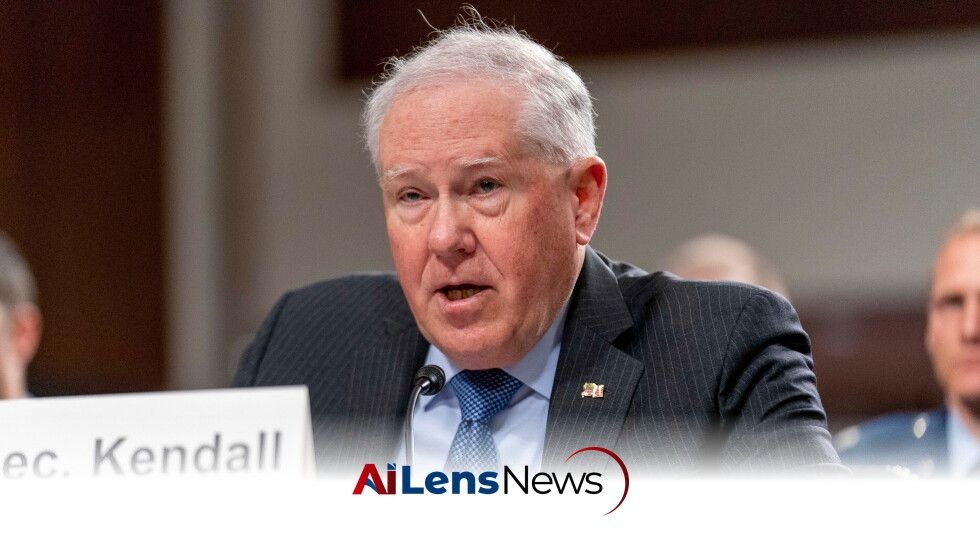


Frank Kendall, former Air Force Secretary, intends to sue the Trump administration to restore his revoked security clearance, claiming retaliation for his criticisms.
Washington DC, United States Aug 12, 2026 ALN: Former Air Force Secretary Frank Kendall has announced his intention to initiate legal action against the Trump administration, following the revocation of his security clearance. This decision, made public on Monday, comes in the wake of the administration's claims that Kendall disclosed sensitive information regarding a jet gifted by Qatar, which is currently being used as Air Force One.
Kendall, who is a graduate of the United States Military Academy at West Point, served as the Secretary of the Air Force under President Joe Biden. His announcement of a lawsuit was made during an appearance on CNN, where he expressed concerns over what he perceives as a pattern of retaliation by the Trump administration against critics. He stated, "As my mother taught me years ago, you stand up to bullies," emphasizing his denial of any wrongdoing regarding the disclosure of classified information.
In the context of national security, security clearances are crucial as they allow individuals access to classified information that is vital for the functioning of various government roles, especially in defense and intelligence sectors. The revocation of such clearances can have serious implications for an individual's career and reputation, as well as for the overall integrity of national security operations. Security clearances are typically granted after thorough background checks and assessments to ensure that individuals can be trusted with sensitive information, making their revocation a significant event.
Kendall's legal representation will be provided by Mark Zaid, a well-known national security attorney who has previously faced similar challenges. Zaid confirmed on the social media platform X that he has taken on Kendall's case. Zaid has a reputation for assisting both military and civilian clients in navigating the complexities of maintaining their security clearances amidst investigations or administrative actions that may seek to strip those clearances away. His experience in this field may bolster Kendall's case, as Zaid has a track record of advocating for the rights of those facing similar issues.
The history of security clearance revocations under the Trump administration has raised significant concerns among many in the national security community. In a notable instance in March 2025, an executive order was issued by Trump that named several individuals, including former Vice President Joe Biden and members of his family, as unsuitable to retain their clearances. This executive order claimed that their retention was "no longer in the national interest," a phrase that has been interpreted by critics as a politically motivated attack on perceived opponents of the administration. Such actions have prompted discussions about the politicization of national security and the potential misuse of power in determining who is deemed fit to hold security clearances.
Additionally, in August 2025, Trump revoked the security clearances of 37 more current and former national security officials. Many of these individuals had been involved in investigations or assessments that were critical of Trump, including the intelligence community's assessment that Russia had interfered in the 2016 presidential election to benefit him. This pattern of revocation has been viewed by many as an effort to consolidate power and silence dissent within the ranks of national security professionals. Critics have argued that such actions not only undermine the integrity of national security operations but also threaten the democratic principle of accountability and transparency in government.
The jet in question, which was gifted to Trump by Qatar, has been a subject of controversy. The aircraft is intended to serve as Air Force One for the remainder of Trump's term, yet it has faced scrutiny regarding its security capabilities. Reports have indicated that the jet lacks advanced anti-missile technology that is standard in other aircraft used for presidential travel. Concerns about the safety and security of the aircraft have been amplified by the administration's attempts to suppress media coverage related to these issues. The implications of using a potentially vulnerable aircraft for presidential travel have raised alarms among national security experts, who emphasize the importance of ensuring that all presidential transport meets the highest security standards.
In a related incident, the Justice Department under Trump took the unusual step of subpoenaing reporters from the New York Times who had written articles discussing the security concerns surrounding the Qatari jet. However, after facing criticism from a federal judge regarding the legality and appropriateness of the subpoenas, the government withdrew them, indicating a potential overreach in its efforts to control the narrative surrounding the aircraft. This incident highlights the tensions between the administration and the media, as well as the challenges faced by journalists in reporting on sensitive national security issues.
The implications of Kendall's lawsuit could be significant not only for his own career but also for the broader discourse around security clearances and political accountability in the United States. If successful, the lawsuit may set a precedent regarding the protection of individuals' rights to speak freely about national security matters without fear of retaliation. Furthermore, it could highlight the need for greater transparency and fairness in the process of granting and revoking security clearances, particularly in politically charged environments. The outcome of this case may influence how future administrations handle security clearances and the treatment of dissenting voices within the government.
This situation also underscores the ongoing tensions between the Trump administration and various sectors of the government, particularly those that are critical of its policies or actions. The politicization of security clearances raises questions about the integrity of national security operations and the potential for conflicts of interest when political considerations influence decisions that should be based solely on security assessments. The broader implications of such actions extend beyond individual cases, affecting the morale and trust of national security professionals and the public's confidence in government institutions.
As the legal proceedings unfold, the focus will likely remain on the broader implications of Kendall's case within the context of national security, the administration's treatment of dissent, and the ongoing debates about transparency and accountability in government. The outcome may influence not only Kendall's future but also the landscape of national security in the United States moving forward. Observers will be closely watching how this case develops, as it may serve as a litmus test for the balance between national security interests and the protection of individual rights in a democracy.
To learn more about the latest developments in Political Controversies, stay updated with our exclusive reports and analyses on AiLensNews.

