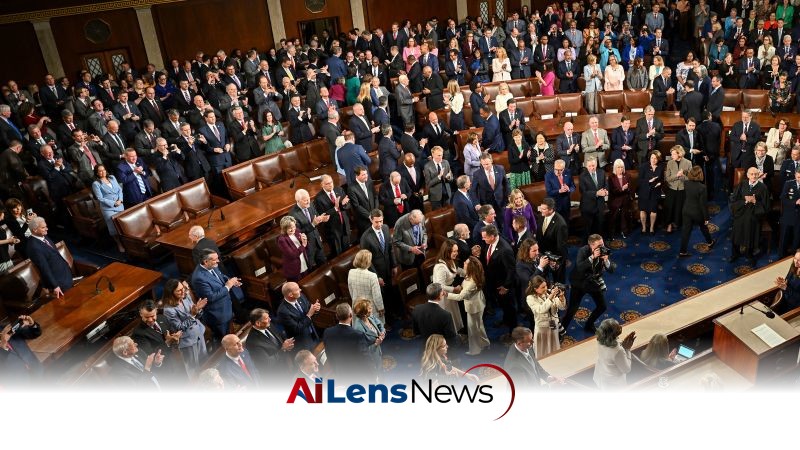


A recent CNN poll reveals that Democrats hold an 8-point lead over Republicans as voters express a desire for significant change in Congress ahead of the midterm elections.
Washington DC, United States Jul 31, 2026 ALN: As the midterm elections approach, voter sentiment in the United States is undergoing a significant transformation. With less than 100 days remaining before the elections, there is a palpable desire among voters for substantial change in Congress. This shift appears to favor the Democratic Party, which currently leads the Republicans by 8 points on the generic ballot among registered voters, as indicated by a recent CNN poll conducted by SSRS.
The Democratic Party's advantage is not limited to the generic ballot; it extends to voter enthusiasm as well. According to the same poll, Democrats enjoy a 20-point lead among those individuals who express extreme motivation to vote. This enthusiasm is crucial, as it often translates into higher turnout rates, which can significantly impact election outcomes. Furthermore, the poll reveals that more Americans believe the country would be better off if Democrats were to gain control of Congress this November, with 38% supporting this view compared to 33% who believe it would worsen the situation. The remaining 29% feel that a change in control would have no significant impact.
In a clear indication of the electorate's desire for a shake-up in Washington, a majority of voters expressed the belief that Congress would be better off if most of its current members were unseated in the upcoming election. This sentiment is notably stronger than it was prior to the Democratic wave election in 2006, which occurred during the Iraq War and was characterized by widespread dissatisfaction with the Republican-led Congress.
Voter frustration with the political landscape is evident, as both major parties and their congressional leaders are viewed negatively. There is a widespread perception that neither party is adequately addressing the economic concerns that have consistently occupied voters' minds. This is particularly relevant given the current economic climate, where issues such as inflation, job security, and rising living costs are at the forefront of many Americans' concerns.
Interestingly, the Republican Party appears to be faring worse in this regard. The poll indicates that 63% of Americans believe the GOP is focusing too little on cost-of-living issues, while 52% feel the same about the Democrats. This discrepancy could play a crucial role in shaping voter behavior as the elections draw nearer, particularly among undecided voters who prioritize economic issues.
Moreover, the perception of the two parties as vehicles for change is shifting. Currently, Americans view Democrats as more aligned with the concept of change, with a 10-point margin favoring Democrats over Republicans in this regard. This marks a notable shift from earlier in the year when the GOP held a 7-point advantage on the same metric. The Republican Party's previously modest edge in being perceived as the party that can get things done has also diminished over the past year. However, it is worth noting that roughly half of the public believes neither party deserves these labels, indicating a broader disillusionment with the political system.
Within the Democratic Party itself, there is a strong desire for change. Nearly 60% of Democratic-aligned adults express the belief that their party requires at least major changes, if not a complete overhaul. This sentiment reflects a growing awareness among party members that the current political dynamics may not be sufficient to address the challenges facing the country.
Interestingly, there has been a shift in how Democratic-aligned individuals view their relationship with the party. Compared to the beginning of President Donald Trump's second term, a greater proportion of Democrats now feel closer to the party, with 31% expressing this sentiment compared to just 23% in January 2025. This increase may be attributed to the party's response to the political landscape shaped by Trump's presidency, which has galvanized many Democrats to rally around their party in opposition to Republican policies and rhetoric.
Those who advocate for change within the Democratic Party tend to favor younger candidates and new leadership, alongside a more robust stance against Trump. Interestingly, there is a preference for reform that does not strictly lean either to the left or the center, indicating a desire for a more nuanced approach to governance. Some party members believe that moving in either direction could yield positive results, suggesting a willingness to explore various options for revitalizing the party's platform and appeal.
On the Republican side, the influence of former President Trump remains a contentious issue. While there has been some erosion in Trump's support among Republicans, 56% of Republican and Republican-leaning individuals still believe he has had a positive impact on the party. This figure represents a decline from 67% earlier in the year, indicating a potential shift in attitudes as the party grapples with its identity in the post-Trump era.
However, the desire for change within the Republican Party is not as pronounced as it is among Democrats. Only about one-third of Republicans feel that their party requires major changes. This sentiment is particularly strong among the non-MAGA wing of the party, where 46% believe an overhaul is necessary, compared to just 17% of those who identify with the Make America Great Again movement. This divide highlights the ongoing struggle within the GOP to reconcile its traditional base with the more populist elements that Trump has brought to the forefront.
MAGA Republicans are significantly more likely than their counterparts to view Trump positively, and they are also less likely to acknowledge the legitimacy of Joe Biden's 2020 election victory. This divergence in beliefs underscores the challenges the Republican Party faces as it seeks to unify its factions while appealing to a broader electorate.
Another area of notable change is in attitudes toward Israel among party-aligned voters. Most Democratic-aligned adults express openness to the idea of nominating a candidate who supports cutting aid to Israel, reflecting a shift in the party's base, particularly among younger voters. Conversely, most Republicans would be less comfortable with a GOP candidate advocating for a similar stance. This division highlights the evolving perspectives within both parties regarding foreign policy and international relations.
Age appears to be a significant factor in these attitudes. Democratic-aligned adults under the age of 45 are 22 points more likely than their older counterparts to express enthusiasm for a candidate who supports cutting aid to Israel. Similarly, younger Republican-aligned adults are 23 points more likely than older Republicans to express at least some comfort with such a candidate. This generational divide suggests that as younger voters become more influential, traditional party lines on foreign policy may continue to shift.
As the midterms approach, Democrats have attempted to position themselves as champions of anti-corruption, using various examples—including Trump's personal financial dealings while in office—to bolster their narrative. However, public perception on this issue is mixed, with nearly half of respondents indicating that neither party is effectively combating corruption. This lack of consensus could hinder the effectiveness of the Democrats' messaging strategy.
Meanwhile, the Republican Party has been focusing on culture war issues, yet Americans appear divided on this front as well. A significant portion of the electorate (31%) believes the GOP is too focused on race and gender issues, while a slightly higher percentage (36%) feels that Democrats are overemphasizing these topics. This suggests that while both parties are trying to leverage cultural issues to galvanize their bases, they may risk alienating moderate voters who are seeking solutions to more pressing economic concerns.
The CNN poll was conducted by SSRS from July 23-27 among a random national sample of 1,225 US adults drawn from a probability-based panel. Surveys were conducted either online or via telephone with a live interviewer. The results for the full sample carry a margin of sampling error of plus or minus 3.2 percentage points, underscoring the importance of understanding the nuances in voter sentiment as the midterms approach.
To learn more about the latest developments in Elections, stay updated with our exclusive reports and analyses on AiLensNews.

