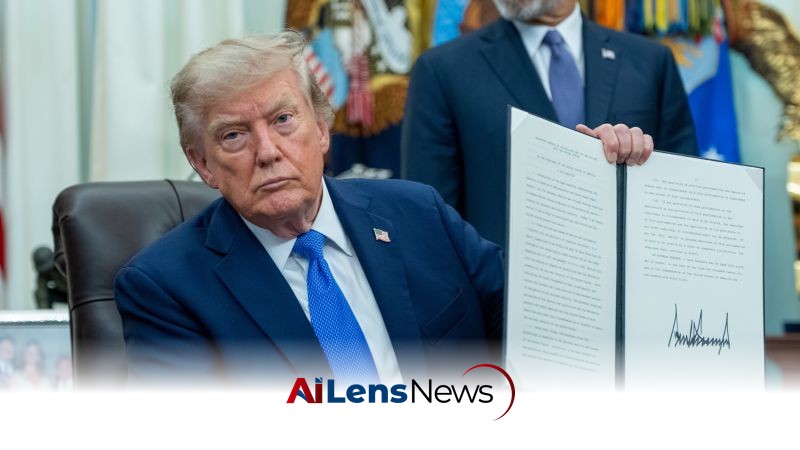


Civil rights organizations are urging a federal judge to block President Trump's latest executive order aimed at restricting birthright citizenship, citing constitutional concerns.
Washington DC, United States Aug 12, 2026 ALN: President Donald Trump’s latest effort to curb birthright citizenship is facing fresh skepticism in court, with immigrants who successfully fought his earlier bid to end the right asking a federal judge to stop the president’s new gambit. This legal challenge comes in the wake of a significant ruling by the Supreme Court in June, which declared that an executive order Trump issued after returning to office last year was unconstitutional. The Court's decision reaffirmed the Constitution’s guarantee of citizenship for nearly all babies born on US soil, a principle that has been a cornerstone of American immigration law since the passage of the 14th Amendment in 1868.
The 14th Amendment was enacted in the aftermath of the Civil War, primarily to ensure that newly freed slaves were granted full citizenship rights. Its Citizenship Clause states, "All persons born or naturalized in the United States, and subject to the jurisdiction thereof, are citizens of the United States and of the State wherein they reside." This clause has historically been interpreted to mean that anyone born on US soil, with very few exceptions, is automatically a US citizen, regardless of their parents' immigration status.
In response to the Supreme Court’s decision, Trump signed a new executive order last week that appeared to largely tighten laws already in place and narrow recognized exceptions. Among other things, the order stated that federal agencies would not recognize the citizenship of children whose parents are not citizens if either parent is classified as “an alien enemy,” a “foreign government employee,” or engaged in what is referred to as “birth tourism.” Birth tourism refers to the practice where non-citizens travel to the United States specifically to give birth, thereby granting their child US citizenship.
The implications of this new executive order have raised significant concerns among civil rights advocates. Lawyers with the American Civil Liberties Union (ACLU) and other civil rights groups have expressed that this order “purports to strip birthright citizenship” from immigrants belonging to a class they represent, despite the Supreme Court’s recent decision. This legal stance is rooted in the belief that the executive branch does not have the authority to unilaterally alter or negate the citizenship rights guaranteed by the Constitution.
“To avoid any doubt in this regard, the court should underscore that the government may not strip away class members’ citizenship through any executive orders or other similarly flawed assertions of Executive power over birthright citizenship,” the attorneys wrote in their filing. This statement underscores a fundamental principle of American governance: the separation of powers and the limitations of executive authority.
The request from these civil rights groups to US District Judge Joseph LaPlante marks the first direct challenge to Trump’s new executive order. In at least one other case, lawyers who previously challenged Trump’s 2025 executive order have asked a judge in Maryland to assess whether the president’s new effort could impermissibly deny citizenship to their clients. This indicates that the legal battles surrounding birthright citizenship are likely to continue, with various groups mobilizing to protect the rights of individuals they believe are at risk of losing their citizenship status.
Judge LaPlante, an appointee of former President George W. Bush, had previously ruled last July that Trump’s first order was unconstitutional and barred officials from being able to enforce it against anyone who may have been impacted by it. This ruling was significant, as it not only challenged the validity of the executive order but also highlighted the judiciary's role in upholding constitutional rights against executive overreach. The case subsequently went up to the Supreme Court, which upheld his ruling, further solidifying the position that the Constitution's provisions regarding citizenship are not subject to unilateral alteration by executive action.
The Supreme Court has long recognized some exceptions to the rule that anyone born in the US has a right to citizenship. These exceptions, however, are limited and historically rooted in specific legal contexts, such as children born to diplomats and those born to “enemies” during a “hostile occupation.” This narrow interpretation indicates that while there are some scenarios where birthright citizenship does not apply, they are not applicable to the broader categories that Trump’s new order seeks to address.
The ongoing legal challenges to Trump's executive orders on birthright citizenship are emblematic of a larger national debate regarding immigration policy, national identity, and the rights of individuals within the United States. As the country grapples with issues of immigration reform, the implications of these court cases could have far-reaching effects on the lives of countless families and individuals. The outcomes of these legal challenges could redefine the understanding of citizenship in America and may set precedents that influence future policies and executive actions.
Moreover, the discussions surrounding birthright citizenship tap into broader societal questions about inclusion, diversity, and the values that define the American identity. The principle of birthright citizenship has historically been viewed as a reflection of the nation’s commitment to equality and the idea that the United States is a land of opportunity for all, regardless of background. As such, the legal battles over this issue are not merely about the technicalities of immigration law; they are also about the moral and ethical foundations of American society.
As this case unfolds, it will likely attract significant public attention, with various advocacy groups and individuals closely monitoring the proceedings. The outcome will not only impact the specific individuals involved in the cases but could also resonate throughout the immigrant community and beyond, shaping public perceptions of citizenship and the rights afforded to individuals born in the United States.
To learn more about the latest developments in Political Controversies, stay updated with our exclusive reports and analyses on AiLensNews.

