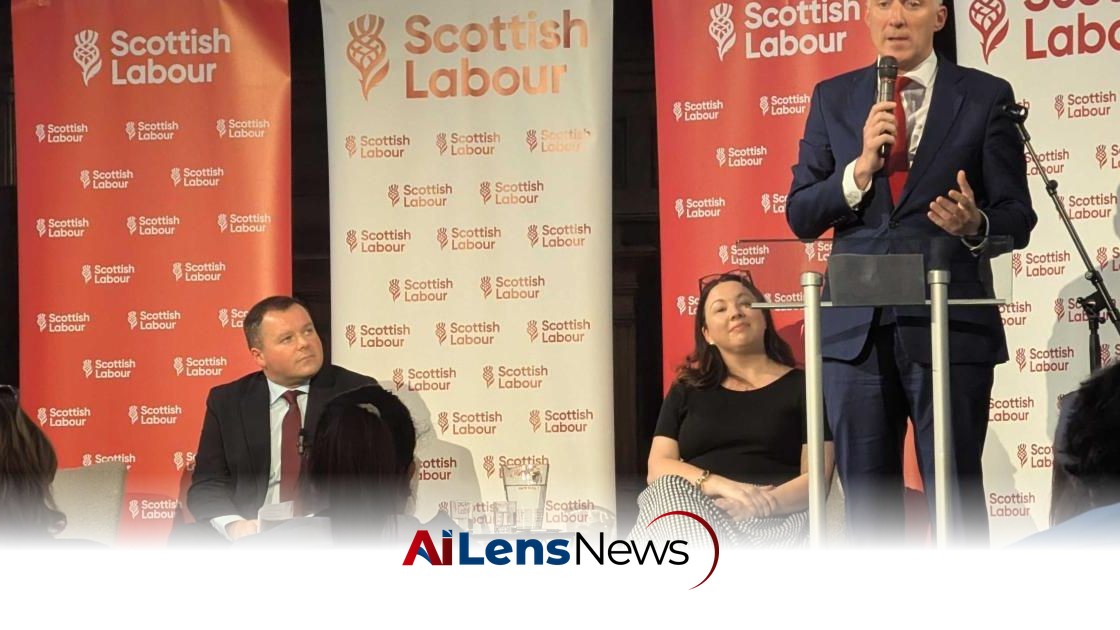


Scottish Labour's leadership hustings revealed a party grappling with its identity and future, as candidates addressed pressing issues and the need for revitalization.
London, United Kingdom Aug 13, 2026 ALN: IT started as you’d expect.
A spattering of Scottish Labour MSPs, MPs, activists and members milling about, chatting and waiting for the main event: a Glasgow hustings for the three who would be Anas Sarwar’s successor.
Leaflets were distributed for two of the leadership candidates throwing their hats into the ring – Joe Fagan and Monica Lennon.
Michael Marra – seen as the frontrunner by many – didn’t bother, from what I could see.
When all three eventually made their way to the stage, it was met by claps. But not the rapturous, excited kind.
Scottish Labour membership ‘collapsed by a third’ with Anas Sarwar as leader
After all, Scottish Labour have just had their worst-ever Holyrood results in May – turning just 17 MSPs. This result has been described as a reflection of the party's broader struggles in Scotland, where it has seen a steady decline in both membership and electoral success since the rise of the Scottish National Party (SNP) in the early 2010s. The loss of a third of its membership during Sarwar's tenure has raised alarms about the party's future and its ability to effectively challenge the SNP, which has dominated Scottish politics in recent years.
First, the three candidates made their opening speeches.
Michael Marra, up first, was polished if not entirely inspiring. He asked those in attendance: “How many times are we going to do this? How many times are we going to meet after losing another election to the SNP?” This rhetorical question underscored the frustration felt by many within the party regarding its inability to regain ground lost to the SNP, which has established itself as the primary political force in Scotland.
Meanwhile, just outside, pro-Palestine protesters were shouting at the top of their lungs and waving flags visible from inside the venue. This backdrop of activism highlights the complex landscape of political engagement in Scotland, where issues of international significance often intersect with local political discourse.
Marra also hit out at the “cowardly briefing” that rocked his campaign last weekend, referring to a report in The Herald, who spoke with a source accusing him of proposing to sack Labour staff at Holyrood. Such internal conflicts and public disputes can further complicate the party's image and distract from the substantive issues at hand.
Lennon, who is struggling to make the ballot, repeated her claim that Scottish Labour are facing their “worst-ever crisis.” Her stark assessment reflects a growing sentiment among party members that without significant changes in leadership and strategy, the party risks becoming increasingly irrelevant in Scottish politics. She went further, adding that the party is in a “coma” and must “stop sleepwalking into electoral oblivion.” This dramatic metaphor encapsulates the urgency of the situation as perceived by some in the party, emphasizing the need for immediate and effective action.
From left: Michael Marra, Monica Lennon, and Joe Fagan are all Scottish Labour MSPs aiming to lead their party (Image: Archive/PA)
Fagan, who was elected as an MSP for the first time just 3 months ago, was less damning of the place Scottish Labour find themselves in. He instead spoke of the “change” the party needs and flagged his experience as the former leader of South Lanarkshire Council. His relative newness to the political scene may allow him to present a fresh perspective, but it also raises questions about his ability to navigate the complexities of party leadership amid such turmoil.
Then came questions from members, which took the candidates onto topics ranging from North Sea oil and gas, austerity, local government and devolution, building more council homes and – albeit very briefly and with answers that totally dodged the question – Scottish independence. The question of independence remains a deeply divisive issue within Scottish politics, with Labour historically opposing independence while the SNP champions it. This divergence complicates Labour's positioning as it seeks to appeal to a broader electorate.
There were some points of difference policy-wise between the candidates. For example, Marra and Fagan backed more drilling for oil and gas in the North Sea and metro mayors in Scotland, while Lennon talked about Scotland’s “climate obligations” and brought up concerns that more politicians might not be the answer. This divergence in policy reflects the broader ideological divides within the party, as members grapple with how to address pressing issues like climate change while also focusing on economic recovery and growth.
But not many.
When the NHS was eventually brought up, Marra rehashed some of the party’s Holyrood manifesto – which he wrote. Fagan then praised the document, indicating a level of agreement on the importance of the NHS as a central issue for voters. “We had good ideas, we had good ideas to put forward for that election,” he said to nods from both. This acknowledgment of past efforts suggests a desire to build on existing platforms, but it also raises questions about why those ideas did not resonate with voters during the last election.
Lennon brought up her recent experience in hospital, using much of the rest of her answer to the importance of reforming Scotland’s care sector – praising the new Prime Minister Andy Burnham’s recent pledge to build a unified National Care Service in England. Her focus on care reform highlights a critical area of public concern, especially in light of the ongoing challenges faced by the NHS and social care systems across the UK. She hit out at the SNP, who made a similar pledge in 2021, but are yet to deliver it. This criticism of the SNP underscores the competitive nature of Scottish politics, where parties must continually hold each other accountable to maintain credibility with the electorate.
They all then made their impassioned final pitches to claps from around the room. However, the enthusiasm felt somewhat muted, reflecting the broader challenges facing the party. The sense of urgency for change was palpable, but the lack of a clear, unified vision among the candidates may hinder their ability to mobilize support effectively.
But for all the chat of the need for “change” and the dire situation the party finds itself in, you’d be hard-pressed to find much evidence of it in the room. There was little sense of a party actually wrestling with what went wrong in May, or that it has lost more than half its members in eight years. This lack of introspection raises concerns about the party's ability to learn from past mistakes and evolve in response to a changing political landscape.
Or, quite simply, of a leadership contest willing to test new ideas on how to turn things around. The absence of bold proposals or innovative strategies during the hustings may reflect a reluctance to break from traditional party lines, which could ultimately limit Labour's potential to regain its footing in Scottish politics. As the party prepares to choose its next leader, the stakes are higher than ever, and the path forward remains fraught with challenges and uncertainties.
To learn more about the latest developments in Elections, stay updated with our exclusive reports and analyses on AiLensNews.

