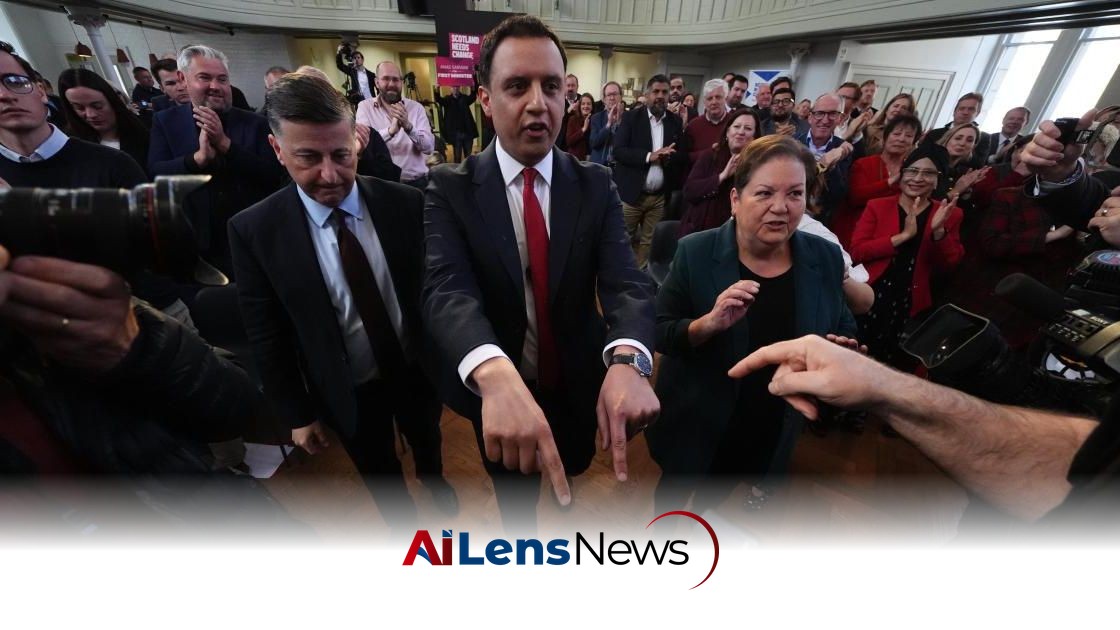


Anas Sarwar's unexpected departure leaves Scottish Labour grappling with leadership challenges and a bleak electoral future following a disastrous election.
London, United Kingdom Jul 26, 2026 ALN: By any yardstick, Labour's performance at May's Holyrood election was "disastrous", polling expert Mark Diffley tells The Herald on Sunday.
While voters in Scotland had been angry with the UK Government and Sir Keir Starmer, the result was not just the fault of the unpopular former prime minister.
"If you look at Anas Sarwar's ratings during the campaign or even before, they weren't much better than Starmer's," Mr Diffley said. "For all Starmer's unpopularity, Sarwar was almost equally as unpopular."
I am ready to lead Scottish Labour, says left wing trailblazer
Anger as PM downgrades key foreign office role as Scottish Labour MP appointed
Scotland betrayed once more by Scottish Labour and their supine 'leader' Sarwar
Polling on trust in the parties on devolved issues during the campaign also pointed to a deeper problem, he said.
"If you look at all the polling about who to trust on the key devolved issues — justice, education, the NHS — Labour was nowhere and the SNP were miles in front on all those," he said.
"That says to me that even during the campaign, the offer that they had, the manifesto, was not cutting through with voters whatsoever."
(Image: Andrew Milligan)
Mr Diffley pointed to Mr Sarwar's decision in February to call for Sir Keir to resign as further evidence that the party's problems ran deeper than its Westminster leader.
"He tried to lance that boil," he said. "That had absolutely zero impact. Even distancing himself and the party from the mess that was going on down south did not help him at all."
Earlier this week, a leading trade unionist described Mr Sarwar as a "generational talent".
But after two Holyrood defeats and his decision to head off to London, it is fair to say that it is not a universally held opinion among the Labour movement.
A chance to serve in government, rather than another four years of opposition, another four years of sitting through two sessions of FMQs a week — one of which he only gets to watch — obviously has its appeal.
But his exit leaves his colleagues north of the border with a sense of trepidation.
They were expecting a comprehensive review into May's shocker of a result, but now they are preparing for a leadership contest, one that has the potential to be brutal and messy.
When Wes Streeting abandoned his leadership ambitions following Andy Burnham's win in the Makerfield by-election, paving the way for a coronation after a bloodless coup, he said it was in part so that the party did not "spend the summer exaggerating small differences".
"There's every chance because of the timing of Anas's resignation that we're going to spend the summer and the autumn kicking the shit out of each other over some fairly big differences," one gloomy Scottish Labour insider said.
(Image: Colin Mearns)
So far, the names being touted for the contest are Monica Lennon, Paul Sweeney and Michael Marra.
Mr Diffley said the new leader would inherit "some absolutely huge challenges", starting with the party's relationship with the UK Government under Mr Burnham — the Branch Office question.
While there have been ever louder calls for a split from the UK party, it is still something of a niche concern among the membership.
One Scottish Labour MSP said the debate was more about the new leader setting clear terms for the relationship rather than redrawing it entirely.
"The question we're all asking is, who will Andy listen to when it comes to Scotland?" the MSP said. "Is it Douglas Alexander? Anas? The Westminster group?
"Whoever takes over from Anas needs to be the loudest voice in Burnham's ear on Scotland. Douglas and Anas can't end up with more sway over what Number 10 does than the person leading the party there."
"But also whoever takes over from Anas can't just be friends with the PM, they need to embody the PM, they need to speak about what Andy's project means in Scotland and why we need it."
This Burnhamaxxing might come easier to some candidates than others.
And then there is the wider constitutional question, which has long presented a particular difficulty for Labour given the party's voter base being primarily but not entirely unionist.
Back in 2021, when she was challenging Mr Sarwar for the leadership, Ms Lennon told The Herald she did not believe in independence but it was not her place to tell Scots "that they can't have a referendum".
More recently she suggested it could be looked at as part of the review into the party's defeat that was due to be carried out over the summer.
Meanwhile, Paul Sweeney recently told BBC Radio Scotland he was "open-minded" to a cross-party convention that would agree conditions for triggering a future referendum, modelled on the mechanism used in the Good Friday Agreement.
Mr Marra is likely to represent the more sceptical wing of the contest on this question. He has long argued that the route to a second independence referendum should follow the same path as the 1997 devolution vote — that the vote confirms the settled will.
Douglas Beattie, author of How Labour Wins (And Why It Loses) from 1900 to 2024, said the issue was likely to remain a persistent problem for the party regardless of who takes over.
"This has the potential to continue to be a thorn in Labour's side because it's not sustainable in the long run for Andy Burnham to simply deny requests from the Scottish Government for a second referendum," he said.
"The problem with doing so is it looks undemocratic no matter how anyone may feel about independence itself. No doubt the strategy in London will be to implement significant improvements to people's lives and in doing so demonstrate that independence is a path which does not need to be taken.
"Still, some deep thinking will need to be done about how Labour in Scotland, and at Westminster, answers this question. The approach to it may well differ depending on who now leads Scottish Labour."
It was Johann Lamont who accused UK Labour, then led by Ed Miliband, of treating Scottish Labour like a "branch office" when she resigned as Scottish leader in October 2014.
Speaking to the Times over the weekend, she cautioned comrades against trying to "outbid the SNP on the constitution".
"It's perfectly credible to argue for more powers and autonomy, but we are part of a UK-wide Labour movement that has done so many good things," she said. "Why should we shy away from that history or collude with this nationalist premise that the rest of the UK, and especially the , want to steal the eyes out of our heads?"
(Image: Scottish Parliament)
One of the frustrations of Labour MSPs is the sense that the SNP has a core independence-supporting vote who will turn out and vote for them, regardless of the government's achievements or failures.
But Mr Diffley said the SNP's continued dominance owed less to its own popularity than to the state of the opposition.
"It is not a popular government by any stretch of the imagination," he said. "If you look at the data during the election, most voters do not approve of the current Scottish Government, do not think it's doing a good job, and do not have a great deal of trust in it.
"And yet here we are with their fifth term, and still almost a majority in Holyrood.
"It is incumbent on Labour to come up with new ideas to challenge the SNP and to make our elections a bit more competitive again."
To learn more about the latest developments in Elections, stay updated with our exclusive reports and analyses on AiLensNews.

