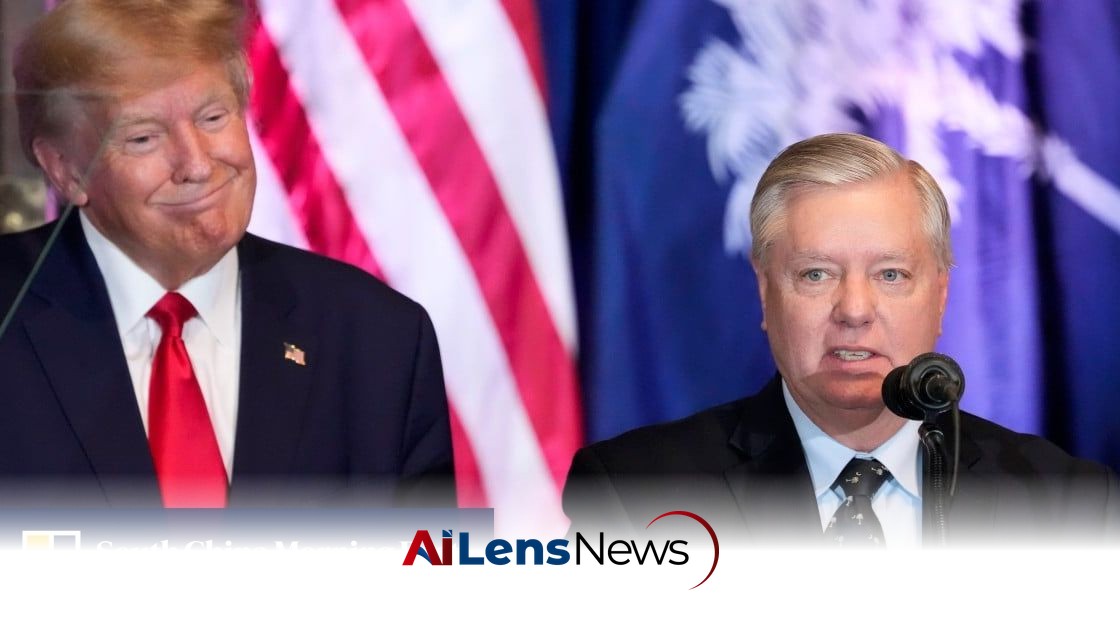


The death of Senator Lindsey Graham has significant implications for US-China relations, as his sister steps into his Senate seat amid ongoing debates on confronting Beijing.
London, United Kingdom Jul 14, 2026 ALN: The death of US Senator Lindsey Graham has removed one of Washington’s most influential advocates of a hardline approach towards China at a moment when Republicans are debating how aggressively the United States should confront Beijing and project military power overseas. Graham's passing not only leaves a significant gap in the Senate but also raises questions about the future direction of US-China relations and the broader implications for American foreign policy.
On Monday, South Carolina Governor Henry McMaster appointed Graham’s sister, Darline Graham Nordone, to fill the vacant Senate seat. This appointment is significant as it reflects a desire to maintain continuity in representation and policy direction for South Carolina. McMaster said he spoke with Nordone by phone on Sunday and she agreed to serve. Her appointment could influence the ongoing discussions within the Republican Party regarding China and other foreign policy issues, as she may carry forward her brother's legacy or chart a new course.
Attention is now turning to whether Nordone, or anyone else, will inherit the late lawmaker’s unusually prominent role as both a congressional China hawk and a close foreign policy adviser to US President Donald Trump. Graham was known for his robust stance against China, advocating for increased military spending and stronger alliances with countries in the Indo-Pacific region to counter Chinese influence. The question remains whether Nordone will continue this hardline approach or adopt a different strategy that could reflect a broader consensus within the party or the Senate.
“I promise to work hard over the next several months, to support the president, and carry forward the efforts of my brother,” Nordone said. “I know Lindsey thought the world of his staff and colleagues, and with their support, I feel confident.” Her commitment to uphold Graham's legacy suggests she may align with his views on China, but the political landscape is dynamic, and her actions will be closely scrutinized by both supporters and critics.
Graham, who served in Congress for more than three decades, first in the House and later in the Senate, died on Saturday night from an aortic dissection – a tear in the body’s main artery – according to a preliminary report from the Washington medical examiner’s office. His lengthy tenure in Congress allowed him to build extensive relationships and influence policy on various fronts, including national security, immigration, and foreign affairs. His death marks the end of an era for many who viewed him as a key player in shaping the United States' approach to global challenges.
While Graham was best known internationally for his outspoken support for Ukraine and Israel, China had increasingly become one of his defining foreign policy concerns in recent years. He repeatedly argued that Beijing posed one of the greatest long-term strategic challenges facing the United States and called for Washington to adopt a more confrontational posture. This perspective is particularly relevant as tensions between the US and China have escalated in recent years, encompassing trade disputes, military confrontations in the South China Sea, and human rights issues in Xinjiang and Hong Kong.
Graham's advocacy for a hardline stance against China was rooted in his belief that a strong response was necessary to deter aggressive actions by Beijing. He often emphasized the importance of strengthening alliances with other democracies in the Asia-Pacific region, such as Japan, South Korea, and Australia, to present a united front against Chinese expansionism. This approach has gained traction among many lawmakers who view China's rise as a direct challenge to the rules-based international order established after World War II.
The implications of Graham's death extend beyond the Senate chamber, as his absence will be felt in various discussions regarding US foreign policy strategy. The Republican Party is currently grappling with differing views on how to approach China, with some members advocating for engagement and dialogue, while others support a more aggressive stance. Graham's passing could tip the balance in favor of those who favor a tougher approach, especially as the Biden administration continues to navigate its own policies regarding China.
The timing of Graham's death also coincides with critical moments in US-China relations, including ongoing trade negotiations, military exercises, and diplomatic engagements. As the US seeks to reassert its influence in the Indo-Pacific region, Graham's absence could leave a void in leadership that may impact the effectiveness of US strategies aimed at countering China's assertiveness.
Furthermore, Graham's role in the Senate Armed Services Committee and his advocacy for increased defense spending were pivotal in shaping military readiness and capabilities in the face of perceived threats from China. His death raises questions about the future of defense policy and whether his successors will prioritize similar initiatives or pivot towards alternative strategies that may reflect a shift in the party's ideology.
As the political landscape evolves, the question of who will fill the void left by Graham in the context of US-China policy will be of paramount importance. Lawmakers and analysts will be closely monitoring the actions of Darline Graham Nordone and other potential candidates who may emerge to take up the mantle of leadership in this critical area. The direction they choose to take could have lasting implications for US foreign policy and the balance of power in the Asia-Pacific region.
In conclusion, Lindsey Graham's passing represents a significant loss for the Republican Party and the broader discourse on US-China relations. His hardline approach and commitment to a robust foreign policy will be remembered, but the future direction of US-China policy now hinges on the actions of those who follow in his footsteps. As the Senate begins to navigate this transition, the stakes are high, and the decisions made in the coming months will shape the United States' stance towards China for years to come.
To learn more about the latest developments in Political Controversies, stay updated with our exclusive reports and analyses on AiLensNews.

