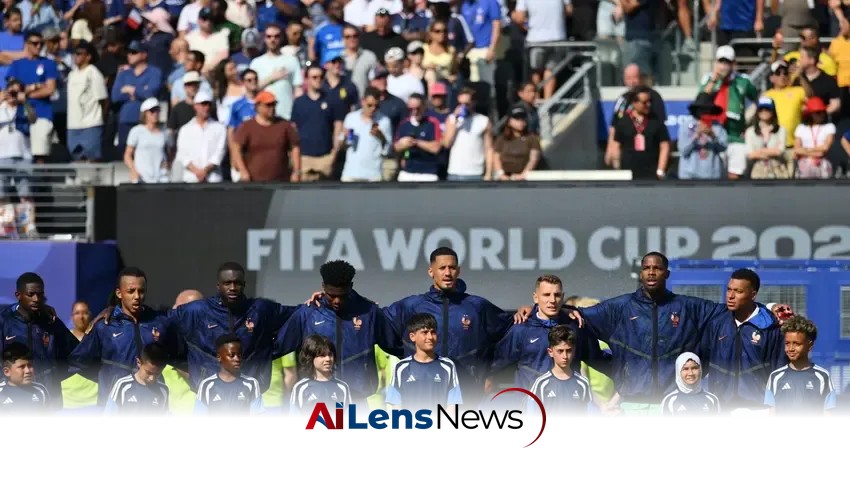


Recent comments questioning the nationality of France's footballers have sparked controversy. This article explores the origins and validity of these claims.
London, United Kingdom Jul 13, 2026 ALN: Recent remarks by Spain's former Prime Minister Mariano Rajoy have reignited discussions about the national identity of France's football team. In an opinion piece for a Spanish news outlet, Rajoy controversially stated that the French national team had 'no French players.' This assertion has drawn sharp criticism, including from Spain's current Prime Minister, Pedro Sánchez, who labeled it as 'xenophobic.' Such comments have not only sparked outrage within France but have also reignited debates about race, nationality, and identity in football, a sport that has long been intertwined with national pride and cultural representation.
Rajoy's comments are reminiscent of statements made by Paraguayan Senator Celeste Amarilla, who, after Paraguay's defeat to France, referred to star player Kylian Mbappé as a 'colonised Cameroonian pretending to be French.' Such remarks have been echoed by various far-right figures, leading to a broader discourse questioning the Frenchness of the team. This narrative is not new; it reflects ongoing tensions in society regarding immigration, integration, and what it means to be French in a multicultural context.
According to FIFA regulations, players must be citizens of the country they represent, which means all members of the French team hold French passports. There are no restrictions on players with dual nationality. Out of the 26-man squad, only three players were not born in France. This fact highlights the complexity of national identity in a globalized world, where individuals often have ties to multiple countries. The players' backgrounds serve as a microcosm of contemporary France, a nation that has been shaped by waves of immigration and cultural exchange.
The majority of the team members were born and raised in France, speaking French as their first language. Many are children of immigrants, and some hold dual nationality. For instance, Kylian Mbappé was born in Bondy, a suburb of Paris, to a French-Algerian mother and a father from Cameroon. His background exemplifies the multicultural identity that characterizes modern France, yet it also places him at the center of scrutiny and debate regarding national belonging.
Despite his achievements, Mbappé has faced derogatory remarks questioning his identity. Senator Amarilla's comments about him being a 'product of colonialism' reflect a troubling narrative that associates Frenchness with race. This perspective not only undermines the individual accomplishments of players like Mbappé but also perpetuates a harmful stereotype that seeks to delegitimize their place within the national team.
The questioning of the French team's nationality appears to be rooted in racial bias. While white second-generation immigrants in France, like far-right politician Jordan Bardella, are seldom scrutinised in the same way, players of diverse backgrounds face constant challenges to their identity. This disparity in treatment highlights a broader societal issue where racial and ethnic minorities are often subjected to different standards of belonging and acceptance.
Naima Moutchou, France's minister for overseas territories, condemned these remarks as evidence of 'systematic and widespread hatred of France and what the nation is.' She noted that such racist obsessions resurface every time the French team wins. This observation points to a cyclical pattern where the successes of a diverse team trigger xenophobic reactions, suggesting that the achievements of these players are not celebrated universally due to their backgrounds.
The implications of these discussions extend beyond the realm of sports. They reflect a larger societal struggle within France regarding national identity, integration, and the legacy of colonialism. The narrative questioning the Frenchness of France's footballers is not only unfounded but also deeply rooted in racial prejudice. The team's diversity is a reflection of modern France, and their achievements should be celebrated rather than undermined by xenophobic rhetoric. In a time when global events increasingly highlight issues of race and identity, the reactions to the French national team serve as a litmus test for how far society has come in embracing its multicultural reality.
Moreover, the ongoing dialogue surrounding the identity of the French football team can be seen as a microcosm of broader European tensions regarding immigration and integration. As countries grapple with the realities of a globalized world, the intersection of sport and national identity will likely continue to provoke debate and controversy. The French football team, with its diverse composition, stands as a testament to the complexities of modern national identity, challenging traditional notions of what it means to be French.
In conclusion, the French national football team embodies the rich tapestry of contemporary France, reflecting its history, culture, and the ongoing evolution of its identity. As discussions about nationality and belonging continue to unfold, it is crucial to recognize the contributions of all players, irrespective of their backgrounds, and to foster a sense of unity that transcends racial and ethnic divides. Only through such understanding can society move towards a more inclusive future, where the achievements of individuals are celebrated as part of a collective national identity.
To learn more about the latest developments in Political Controversies, stay updated with our exclusive reports and analyses on AiLensNews.

