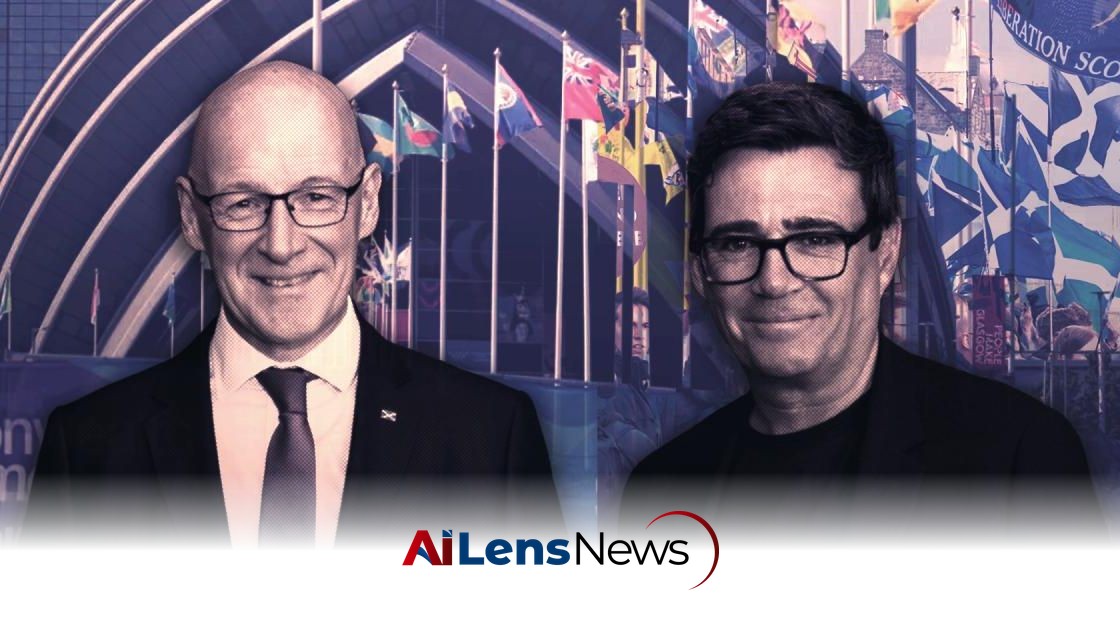


In his inaugural meeting with Scottish leader John Swinney, Prime Minister Andy Burnham's refusal to engage with the media raises questions about his commitment to accountability and collaboration.
London, United Kingdom Jul 24, 2026 ALN: This article appears as part of the Unspun: Scottish Politics newsletter.
He has only been Prime Minister for a matter of days, but Andy Burnham has already handed an own goal to John Swinney.
The UK and Scottish leaders met for the first time in Glasgow to mark the opening of the Commonwealth Games, a significant event that brings together nations from across the globe to celebrate sports and culture. The Commonwealth Games, which have a rich history dating back to 1930, serve not only as a platform for athletic prowess but also as an opportunity for political leaders to engage with one another and showcase their commitment to unity and collaboration.
Burnham's first visit to Scotland should have been an opportunity to set the tone, a chance to reset relations with Holyrood and show that Westminster was now listening. The relationship between the UK government and the Scottish Parliament has been fraught with tension in recent years, particularly in light of the ongoing discussions surrounding Scottish independence and the varying approaches to issues like health care, education, and economic policy. This meeting was anticipated as a turning point, a moment for Burnham to demonstrate his willingness to engage with Scottish leaders and address the concerns of the Scottish populace.
Journalists got wind of the visit earlier this week, but No 10 remained tight-lipped before confirming late on Wednesday night that the Prime Minister would not be speaking to the media during his first visit north of the border. This decision to avoid media interaction raised eyebrows among political analysts and commentators, who noted that it contradicted Burnham's previous assertions about the need for transparency and accountability in government.
His time as Prime Minister has been short so far, but this is already becoming something of a pattern. On Monday, after officially entering Downing Street, Burnham declined to take questions from journalists. This reluctance to engage with the press has sparked discussions about the implications for his leadership style moving forward. In a political landscape where public perception can be shaped significantly by media interactions, Burnham's approach may hinder his ability to connect with constituents and build the trust he has emphasized as a cornerstone of his political philosophy.
You might think that refusing to speak with the press isn’t a big deal. But Burnham has spent years arguing that the Westminster system had to change. Much of Burnham’s political appeal has been built on accountability and getting close to the people. He has often positioned himself as a champion of the public, advocating for policies that prioritize the needs of ordinary citizens over the interests of the political elite. By avoiding media scrutiny, Burnham risks alienating those who have supported him based on his previous commitments to openness.
Before he travelled to Scotland, the BBC captured Andy Burnham drinking a pint in the pub alongside Chancellor John Healey in Essex as he announced business rates would be cut. This casual setting was meant to convey a sense of approachability and relatability, yet it also highlighted the contrast between his willingness to engage in informal discussions in England while shunning formal interactions in Scotland. If there was time for a carefully choreographed pub visit in Essex, there was time to answer a handful of questions in Glasgow.
His first trip north offered the ideal opportunity to answer the obvious questions. Does he intend to strengthen Holyrood? What does "partnership" look like when Edinburgh and London disagree? Beyond warm words, how will his approach differ from the governments that came before him? These questions are not merely academic; they reflect the concerns of many Scots who feel marginalized by decisions made at Westminster that directly impact their lives. The lack of direct engagement from Burnham only serves to deepen the skepticism that exists around the UK government's intentions regarding Scotland.
Relations between the UK and Scottish Government have been strained over the last year or so, particularly in the wake of Brexit, which has had profound implications for Scotland's political landscape. The Scottish National Party (SNP) has been vocal in its criticisms of Westminster's handling of devolved matters, and there is a growing sentiment among some Scots that their voices are not being adequately represented. While Burnham promises to improve that, exactly how will he do it? Burnham says he wants a reset. Scotland deserves to know how.
Those questions were never asked because the Prime Minister never gave anyone the chance. Instead, his decision to remain silent left a vacuum that was quickly filled by John Swinney, the Scottish Deputy First Minister. Swinney, on the other hand, seized the opportunity from Burnham. While the Prime Minister won’t speak to the press, John Swinney has set aside an hour for broadcast and print media to brief us after the meeting. This proactive approach by Swinney not only allowed him to articulate the Scottish Government's position but also positioned him as a leader who is willing to engage with the media and the public.
Unspun:
It feels out of character for Burnham as a politician who has spent the majority of his career arguing that Westminster must be less about photo ops and more about engagement. His past rhetoric has emphasized the need for leaders to be accessible and accountable, yet his actions during this crucial meeting suggest a departure from those principles. If he wants to send a message of openness and collaboration, this approach misses the mark. What it does do, though, is ensure we will find out Burnham’s plans only when he wants to tell us, rather than through an open dialogue with the public and the press.
It matters because Burnham’s pitch is built on trust. He cannot ask people to believe Westminster has changed while behaving as though Westminster still decides when, where and whether it can be scrutinised. Trust is a fragile commodity in politics, and the initial steps a leader takes can significantly impact their ability to cultivate that trust over time.
First impressions count in politics. On his first visit as Prime Minister, Burnham had the chance to tell us how he will do politics differently. Instead, the story became the questions he chose not to answer. This missed opportunity may haunt him as he seeks to establish his legacy as a leader who prioritizes engagement and accountability.
Thanks to Downing Street, John Swinney could not have asked for a better start. The contrast between the two leaders' approaches may have lasting implications for their respective political futures and for the broader relationship between Scotland and Westminster. As the political landscape continues to evolve, the actions and decisions made by leaders like Burnham and Swinney will undoubtedly shape the narrative of Scottish politics for years to come.
To learn more about the latest developments in Political Controversies, stay updated with our exclusive reports and analyses on AiLensNews.

