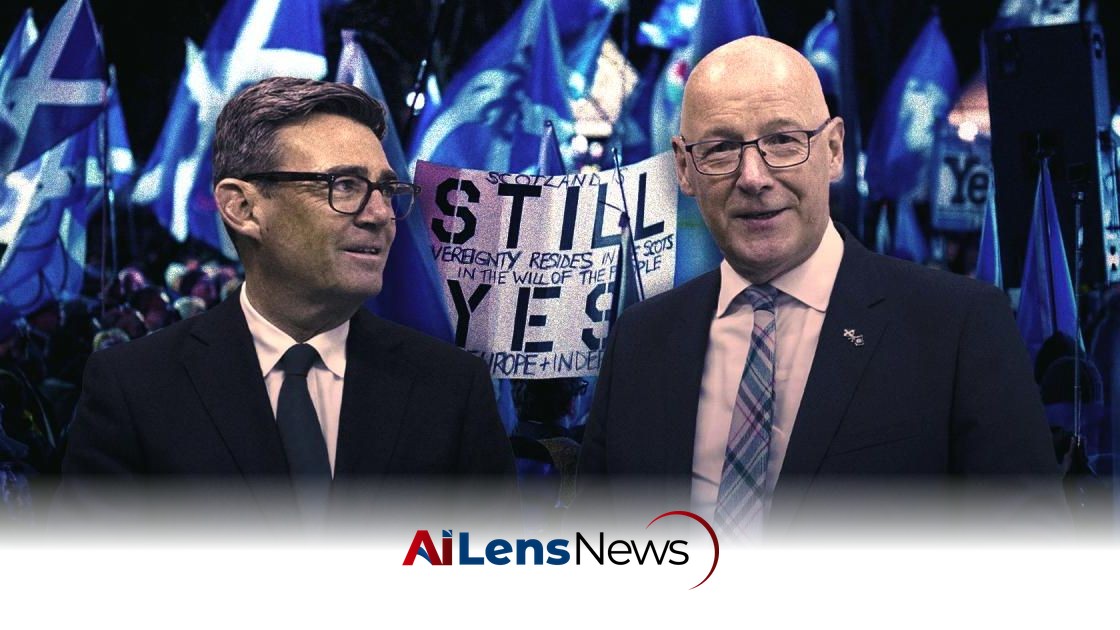


Andy Burnham's recent meeting with John Swinney could have reshaped the independence debate, but his refusal to engage has left Scotland in limbo.
London, United Kingdom Jul 25, 2026 ALN: This article appears as part of the Unspun: Scottish Politics newsletter.
We were so close, yet so far. So close you could almost taste it - like poor old Tantalus cursed to spend eternity with his mouth just beyond reach of the most delicious food imaginable.
It’s Scotland’s historic plight, it seems, to come always within inches of what it deserves - whether in battle, sport or politics.
On Thursday, when Andy Burnham met John Swinney, the Prime Minister could have taken the issue of another independence referendum off the table with some smart political manoeuvring.
Instead, he has doomed Scotland. We’ll now have to endure the SNP wanging on about the achingly dull issue of the process of getting another referendum for five more long and excruciating years.
Downing Street made clear Burnham isn’t interested in “constitutional changes like further referendums”.
Nobody expected him to grant another referendum. But he could have punctured the SNP’s ball by saying he was going to set up a constitutional convention which would include looking into the issue of how another referendum will be held.
If he’d done that, the SNP would have lost its two best weapons: distraction and victimhood. When the heat is on, the SNP pushes the question of another referendum centre stage.
To be fair, they have right on their side. It is undemocratic for one part of the UK - Northern Ireland - to have a route towards a referendum when another - Scotland - doesn’t.
So by continuing with the ‘just say no’ approach, Burnham has gifted the SNP free use of its favoured tactics until the next election.
His position clashes with his ideology. Burnham’s policy of extending devolution effectively demands that a constitutional convention be established.
He supports replacing the House of Lords with a Senate of the Nations and Regions, which would create a quasi federalised UK, with England represented by regions roughly the size of Scotland.
The question of another referendum could easily have been folded into the work of a pan-UK constitutional convention.
It would take a long time to set up, and when it was up and running it would likely find that Scotland should follow some sort of Northern Ireland route.
The Good Friday Agreement states that the Secretary of State for Northern Ireland is legally obliged to hold a border poll if it appears a majority backs Irish reunification.
It’s unclear what the precise criteria would be which would be taken as proof that a majority backed reunification, but most believe it would be a sustained run of opinion polls - say for six months - showing support of at least 55%, if not 60%.
The 55% mark seems fair given Brexit was achieved on 52%. Some might argue for 60%. Fine. Debate it, and decide.
Given Northern Ireland’s unique circumstances, it’s understandable that the secretary of state retains power over calling a border poll. It eliminates the risk of one or other community claiming they’re being exploited, thereby reducing any threat of violence.
Scotland is different, however. So it would be right and proper for any constitutional convention to discuss whether Westminster hands the power to call another referendum to Holyrood.
A real sense of fairness might be achieved if the power over the trigger mechanism lay in Westminster’s hands, but the power to pull the trigger lay with Holyrood.
Westminster could oversee the criteria for holding a referendum - say, 55% in multiple opinion polls. In the event of such polling, Holyrood would be empowered to legislate for a referendum.
All this would take years to sort out via a constitutional convention. And the SNP couldn’t complain about the wait, because to do so would be to undermine the process it has so long demanded.
There are a number of rather major pluses for Scotland when it comes to setting up a constitutional convention.
First, sheer boredom. I don’t know about you, but I’m sick to death of talking about process.
We must discuss it, because it’s one of the central issues in Scottish political life. But we all know the discussion as it stands is going nowhere. It’s like being trapped in a time-loop designed by the Marquis de Sade.
Second - and far more importantly - the creation of a constitutional convention would mean the SNP had to govern without permanent recourse to its habitual smokescreen.
Whenever it can - and especially when in trouble - the SNP diverts attention with talk of process, and complaints (which are justified) about the anti-democratic nature of Westminster’s refusal to fashion a way forward on the constitutional question.
This has been a terrible first full week for Burnham in Scotland. The promotion of Anas Sarwar to the House of Lords shames them both. It’s the very definition of feather-bedded privilege, entitlement and falling upwards.
Burnham also made a total ass of himself by dodging the Scottish press, and then later posing for a cheesy, meaningless photo-op drinking a pint.
Dodging Scottish press and posing for a pint - has the new Prime Minister already made an ass of himself to Scotland? (Image: PA)
Many of the SNP’s opponents in Holyrood and the media see Burnham’s refusal to engage on the question of a referendum as a win for unionism. It’s not.
It’s a fail for unionism because it perpetuates the very circumstances which benefit the SNP. As long as the SNP can gripe and moan about a referendum and wicked Westminster, it’s winning.
By setting up a constitutional convention, Burnham would have ripped the shield away and forced the SNP to govern unadorned - something it isn’t very good at.
Now that would have been a win for unionism.
Neil Mackay is the Herald’s Writer-at-Large. He’s a multi-award winning investigative journalist, author of both fiction and non-fiction, and a filmmaker and broadcaster.
To learn more about the latest developments in Elections, stay updated with our exclusive reports and analyses on AiLensNews.

