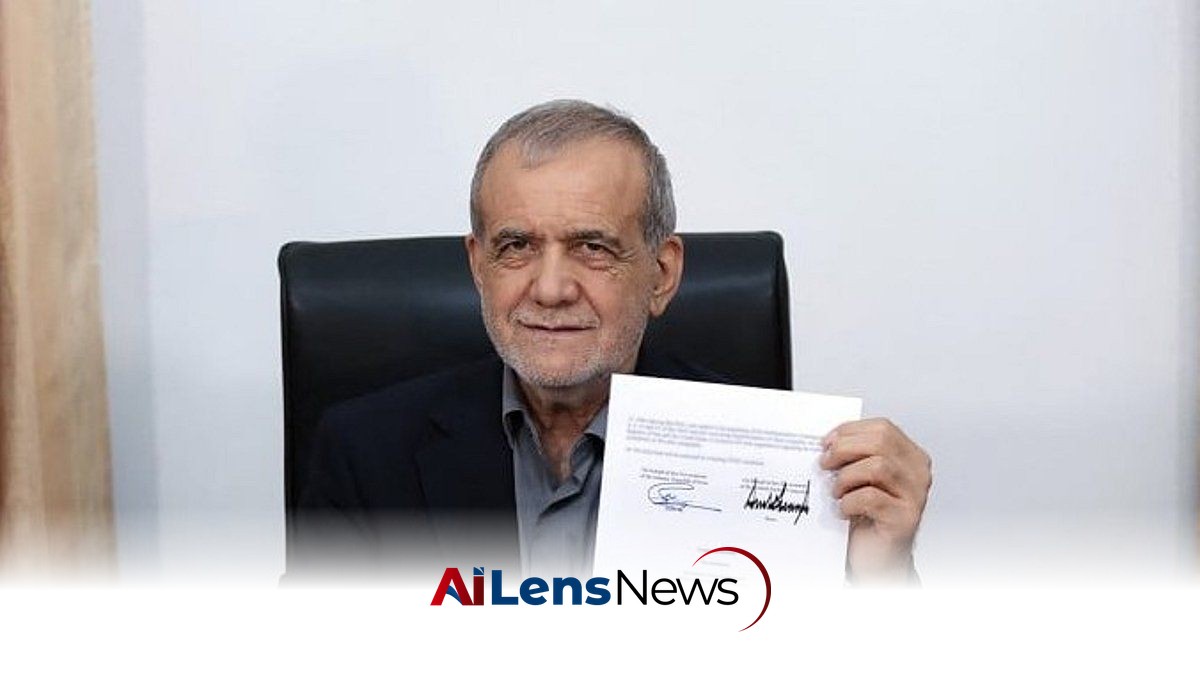


Iranian President Masoud Pezeshkian asserts that the US-Iran peace memorandum is crucial for future foreign relations and calls for its enforcement.
Abu Dhabi, United Arab Emirates Aug 3, 2026 ALN: The memorandum of understanding (MoU) signed by the US and Iran in June was the product of collective decision-making by Iran’s Supreme National Security Council and will serve as the foundation of the country’s future foreign relations, the Iranian President said early on Monday.
Iranian President Masoud Pezeshkian stated that all members of the council, known by its Persian acronym (SNSC), are aligned with the agreement. The SNSC plays a crucial role in shaping Iran's national security and foreign policy, comprising key figures from the military, political, and intelligence sectors. This collective endorsement indicates a significant level of consensus among Iran's leadership regarding the terms of the MoU.
“I believe that this memorandum of understanding will be the center of gravity of our foreign relations in the future,” he wrote in a post on X, a platform used for public communication and announcements. This statement underscores the Iranian government's intention to anchor its diplomatic engagements around this agreement, which they view as a pivotal moment in their foreign policy trajectory.
“We must strive to force the enemy to remain committed to what it has signed. The security of the country, the region and our allies will be enhanced with this memorandum of understanding.” These remarks reflect a dual focus: not only on the internal alignment within Iran regarding the MoU but also on the expectation that the United States will adhere to its commitments, which is a critical aspect of any international agreement.
The US-Iran Memorandum of Understanding (MOU) was signed on June 17-18, 2026, by US President Donald Trump and Iranian President Masoud Pezeshkian. The interim 14-point agreement was structured to formalise a ceasefire, address the reopening of the Strait of Hormuz, and initiate a 60-day window for permanent peace terms.
The remarks come about six weeks after Pezeshkian and US President Donald Trump digitally signed the memorandum between on June 17/18, 2026. The signing took place under unique circumstances, with both leaders participating remotely—Trump in France during the G7 summit and Pezeshkian in Tehran. This remote signing was indicative of the ongoing complexities in US-Iran relations, characterized by a mix of diplomatic engagement and underlying tensions.
The document, also referred to as the Islamabad Memorandum after mediation efforts involving Pakistan, was intended to end active hostilities between the two countries and lay the groundwork for a permanent peace deal. Pakistan's role as a mediator highlights its strategic position in the region and its interest in fostering stability between its neighbors, Iran and the US.
The memorandum included provisions for a temporary extension of a ceasefire, steps related to regional conflicts including Lebanon, and the reopening of the Strait of Hormuz, among other points. The Strait of Hormuz is a critical maritime chokepoint through which a significant portion of the world's oil supply is transported, making its security vital not just for Iran but for global energy markets.
Iranian officials have repeatedly emphasized that the deal received backing from the SNSC, with Pezeshkian previously stating that the vast majority of members—including senior military and political figures—supported it after discussions coordinated with Supreme Leader Mojtaba Khamenei. This backing from Iran's highest authority adds a layer of legitimacy to the agreement, suggesting that it is not merely a political maneuver but a strategic decision aimed at enhancing national security and diplomatic relations.
Pezeshkian has described the memorandum as a “historic document” that preserves Iran’s dignity and independence while offering potential benefits for the region. The use of the term "historic document" indicates a belief that this agreement could reshape Iran's international standing and relations, particularly after years of isolation and sanctions.
However, implementation has faced challenges. Iranian authorities earlier accused the United States of violations and reported suspending some commitments under the agreement. Such accusations highlight the fragility of the MoU and the ongoing mistrust that characterizes US-Iran relations. The enforcement of international agreements often hinges on the mutual trust and willingness of parties to adhere to the terms, a situation currently undermined by historical grievances and geopolitical rivalries.
Public debate inside Iran has included criticism from hard-line voices questioning the deal’s durability and enforcement mechanisms. This internal dissent reflects a broader concern among some factions within Iran about the potential for the US to revert to a confrontational stance, particularly given the volatile history of US-Iran relations. The hard-liners argue that any agreement must come with guarantees that the US will not backtrack on its commitments, a demand that complicates the diplomatic landscape.
Pezeshkian’s latest comments appear aimed at reinforcing domestic consensus around the accord while shifting focus to holding the other side accountable. By framing the MoU as a central pillar of Iran's foreign policy, he seeks to unify various political factions within Iran, particularly in light of the criticism from hard-liners.
The memorandum was signed remotely: Trump during events surrounding the G7 summit in France, and Pezeshkian in Tehran. It has been presented by both sides as a step toward de-escalation after a period of intensified conflict involving US, Iranian and regional actors. The context of the signing, amid international summits and negotiations, suggests that both leaders recognized the need to find common ground despite their differences.
Further negotiations on a comprehensive settlement were envisioned under the terms of the understanding. This indicates that the MoU is not merely a cessation of hostilities but a framework for ongoing dialogue aimed at resolving deeper issues between the two nations.
Pezeshkian’s post underscores Tehran’s public stance that the agreement, reached through institutional consensus rather than unilateral decision, remains central to its diplomatic outlook even amid questions over compliance. This emphasis on institutional consensus is significant in the context of Iran's political structure, where decisions are often contentious and subject to various influences from different power centers.
To learn more about the latest developments in Elections, stay updated with our exclusive reports and analyses on AiLensNews.

