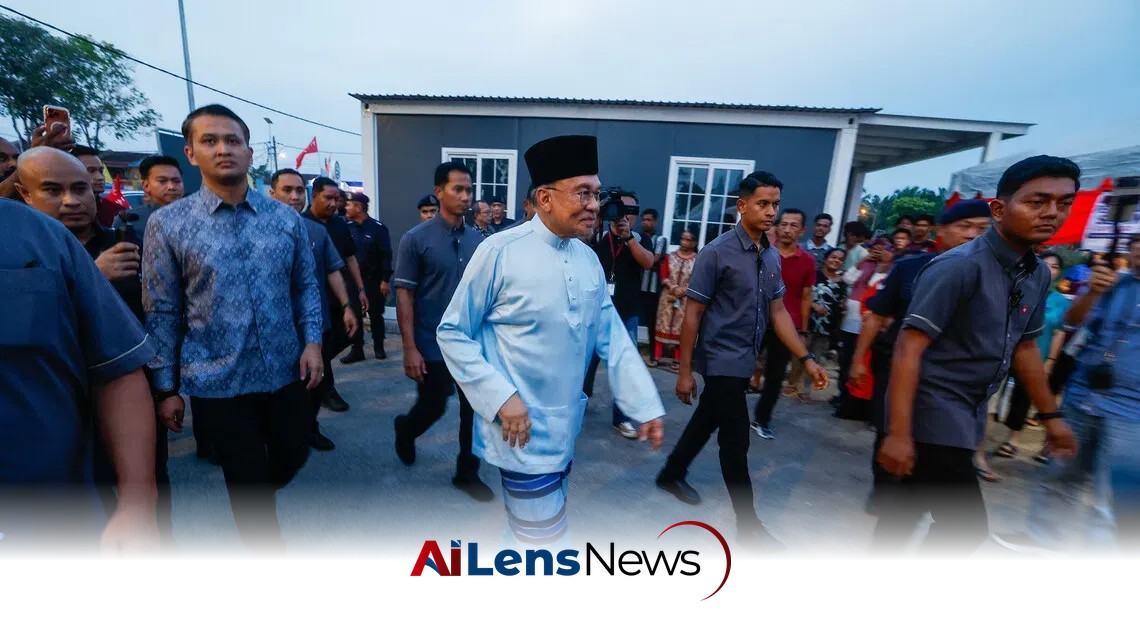


Polling has opened in Negeri Sembilan, where Prime Minister Anwar Ibrahim faces a critical test for re-election amid rising racial tensions and a royal succession dispute.
Singapore, Singapore Aug 1, 2026 ALN: SEREMBAN - The Negeri Sembilan state election, which commenced on August 1, marks a pivotal moment for Prime Minister Anwar Ibrahim as he navigates the complex landscape of Malaysian politics. This election serves as a barometer for Anwar’s prospects in the upcoming general election, which is scheduled for February 2028. With almost 900,000 eligible voters participating, the outcome will not only influence state governance but also shape national political dynamics.
Polling centers across Negeri Sembilan opened at 8 AM, with voters set to elect assembly members across 36 constituencies. The election is characterized by a significant face-off between the ruling coalition, Pakatan Harapan (PH), and the combined forces of Barisan Nasional (BN) and the opposition alliance Perikatan Nasional (PN). The latter coalition has gained momentum following a successful showing in Johor on July 11, where they won 48 out of 56 seats, signaling a resurgence of Malay political unity.
In a strategic move, Parti Islam SeMalaysia (PAS), the largest party within the PN coalition, instructed its members to support BN candidates in seats contested by BN. This collaboration illustrates a deepening of the Malay unity pact, with BN contesting 25 seats and PN vying for the remaining 11. This alliance, while politically advantageous for the parties involved, complicates the narrative at the federal level, where PH and BN continue to partner in a unity government established after the 2022 general election.
During a rally on the eve of polling day, BN chairman Zahid Hamidi emphasized that the competition in Negeri Sembilan would not jeopardize the unity government at the federal level. He reaffirmed BN's commitment to supporting Anwar Ibrahim's administration, stating, “In safeguarding the national interest, we must continue working together to strengthen the unity government.” This statement reflects the delicate balance that must be maintained between intra-coalition rivalry and the overarching need for political stability at the federal level.
The lead-up to the election was marked by a contentious atmosphere, heavily influenced by racial politics and a royal crisis concerning the state’s traditional leadership. On July 31, the state ruler, Muhriz Munawir, convened a meeting of the highest customary authority to discuss the potential removal of the Undang of Jelebu, Maarof Mat Rashad. This move was perceived as a strategy to bolster his authority in appointing the next menteri besar, following the installation of two chieftains aligned with him.
However, tensions escalated when customary leaders challenged the legality of the meeting. Maarof Mat Rashad did not attend, subsequently filing a letter with the Seremban High Court to contest the meeting’s validity, citing a court injunction that barred him from participating in discussions with the customary authority. This legal entanglement underscores the intricate relationship between traditional leadership and contemporary political maneuvering in Malaysia.
BN has leveraged this royal succession dispute to criticize the PH-led state government, accusing it of failing to effectively manage the situation. They argue that the ongoing crisis over Adat Perpatih, the state’s traditional customary law, has been weaponized politically in the context of this election. Such criticisms highlight the intersection of cultural identity and political power in Negeri Sembilan, where traditional norms play a significant role in governance and public sentiment.
As the campaign unfolded, identity politics took center stage. On July 30, the caretaker menteri besar, Aminuddin Harun, released a video on social media asserting his identity as “a Malay Muslim.” This move exemplified how identity has become a focal point in the electoral discourse, with PH candidates emphasizing their Malay heritage and connections within the community. The video also outlined various investment initiatives and reaffirmed PH’s commitment to upholding Adat Perpatih, attempting to resonate with the electorate's cultural values.
In an effort to broaden their appeal, Zahid Hamidi made a final push for Indian votes during a rally in Bahau, approximately 70 kilometers from Seremban. His appeal to Indian voters came shortly after Anwar’s own efforts to mend relations with this demographic, which constitutes a significant portion of the electorate in 11 of the state’s wards. Anwar publicly apologized for previously labeling certain temples built on disputed land as “kuil haram,” or illegal temples, a statement that had drawn criticism and could have alienated Indian voters. This attempt to reconcile past missteps highlights the importance of coalition-building and voter outreach in a racially diverse electorate.
The intensifying alliance between BN and PN has also led to an escalation in racial rhetoric. Notably, PAS election director Sanusi Md Nor’s comments emphasizing that “Malays only have Tanah Melayu (Malaya), Chinese have China, Indians have India” became a focal point in the campaign, reflecting a growing polarization in political discourse. Additionally, UMNO secretary-general Asyraf Dusuki’s warnings regarding the potential takeover of Negeri Sembilan by the Chinese-dominated Democratic Action Party (DAP) if PH retains power have been criticized as racially charged scaremongering. Such statements illustrate the delicate and often contentious nature of race relations in Malaysian politics, where identity can be both a unifying and divisive force.
In response to the rising tensions and criticism, Anwar’s Cabinet released a long-delayed report from a Royal Commission of Inquiry into the mismanagement of the Muslim pilgrimage fund, Tabung Haji, which had been a contentious issue during UMNO’s long-standing rule prior to their defeat in the 2018 general election. This move can be seen as an attempt to address past grievances and reaffirm the government’s commitment to accountability and transparency, potentially swaying public opinion in favor of PH.
As polling closed at 6 PM, early counts began to provide insights into voter preferences. Think-tank Ilham Centre projected that the BN-PN alliance would likely secure 22 of the 36 seats in the state assembly, achieving the simple majority necessary to form the state government. This forecast indicates a potential shift in power dynamics within Negeri Sembilan, which has significant implications for the broader political landscape in Malaysia.
The predictions suggest that PH may win approximately nine seats, which would represent a notable reduction compared to previous elections. If BN-PN manages to claim 19 or more seats collectively, this would signify UMNO’s reclamation of the state, a significant political development considering they lost control in 2018. Such a victory could pave the way for the two coalitions to solidify their partnership ahead of the upcoming general elections.
Some forecasts even suggest that BN could achieve a simple majority on its own, with the potential for PN to help them secure a two-thirds supermajority by winning 24 or more seats in the 36-strong legislature. This outcome would not only reaffirm BN’s political resurgence but also bolster their bargaining power in negotiations for the upcoming general election.
Political analysts, such as Taylor’s University adjunct professor Ong Kian Ming, have weighed in on the election dynamics, projecting that while PH might secure nine seats, BN-PN could potentially win 17. He noted that six of the remaining ten seats are Malay-majority areas, which could significantly aid the BN-PN alliance in approaching the two-thirds majority mark. This analysis underscores the importance of demographic factors in shaping electoral outcomes, particularly in a multi-ethnic society like Malaysia.
In conclusion, the Negeri Sembilan state election serves as a critical juncture for Anwar Ibrahim and the broader political landscape in Malaysia. The interplay of racial politics, identity, and traditional authority underscores the complexities of governance in a diverse society. As the results unfold, the implications for both state and national politics will become clearer, shaping the trajectory of Malaysian governance in the years to come.
To learn more about the latest developments in Elections, stay updated with our exclusive reports and analyses on AiLensNews.

