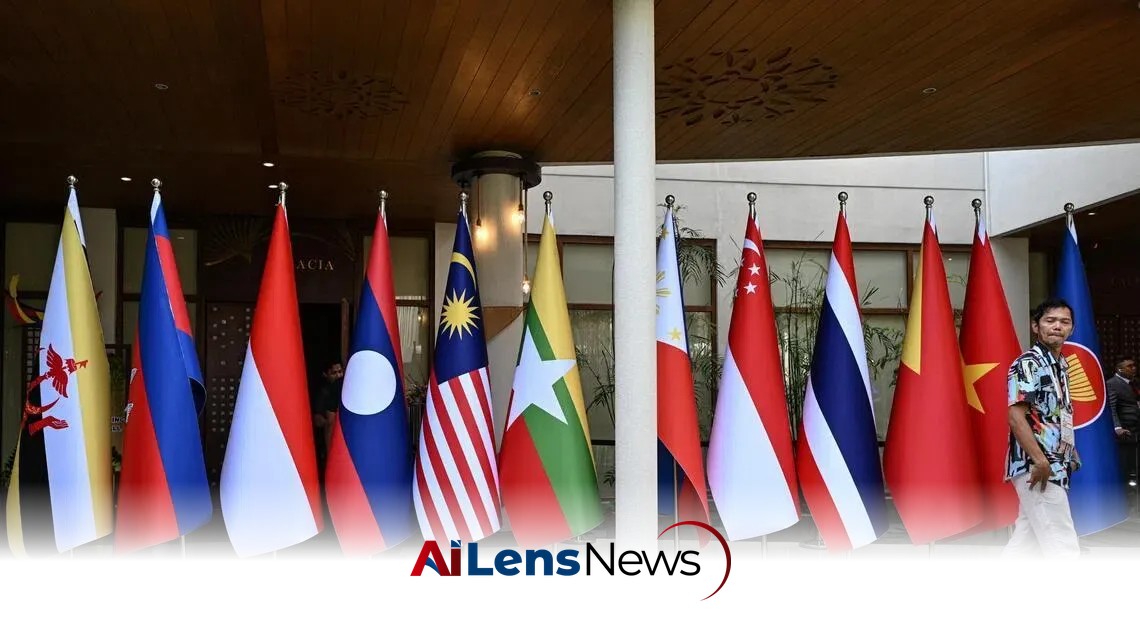


ASEAN foreign ministers are working on benchmarks and a permanent envoy to enhance the stalled Five-Point Consensus peace plan for Myanmar.
Singapore, Singapore Jul 21, 2026 ALN: ASEAN foreign ministers agreed on July 21 to develop benchmarks for measuring progress in Myanmar and began discussing appointing a longer-term special envoy, as the regional grouping sought to strengthen implementation of its long-stalled Five-Point Consensus peace plan.
The proposals, discussed during an extended informal consultation on Myanmar on the sidelines of the 59th ASEAN Foreign Ministers’ Meeting in Manila, will now be refined by senior officials before going to ASEAN leaders at their November summit, said Philippine Foreign Secretary Ma. Theresa Lazaro.
The discussions followed an informal meeting in Bangkok on July 12 that brought together nearly all ASEAN foreign ministers and Myanmar’s foreign minister for the first time since the military seized power in 2021.
In Manila, ministers revisited proposals from the Bangkok meeting, including creating an ASEAN framework to assess progress in Myanmar and exploring a longer-term special envoy instead of rotating the role annually.
“We have tasked the senior officials to really give meat and discuss this carefully because this is an input to the leaders’ meeting in November,” Lazaro, who also serves as the ASEAN chair’s special envoy to Myanmar, told reporters.
She said that Brunei had proposed establishing a unit within the ASEAN Secretariat to support the envoy’s work, although issues such as funding and operational arrangements still needed to be resolved.
The discussions took place as ASEAN foreign ministers gathered in Manila ahead of meetings this week with major dialogue partners including the United States, China and Russia, against a backdrop of intensifying geopolitical rivalry, South China Sea tensions and conflicts stretching from Myanmar to the Middle East.
The Bangkok meeting had prompted speculation that ASEAN might be softening its approach towards Myanmar’s military rulers after years of diplomatic stalemate.
Lazaro, however, reiterated in a July 19 statement that the discussions should not be interpreted as a departure from the Five-Point Consensus, adopted by ASEAN leaders in 2021 following the Myanmar military coup.
Asked whether ASEAN still believed the Five-Point Consensus remained viable after Myanmar’s Parliament had rejected it, Lazaro said Myanmar Foreign Minister Than Swe had disputed that characterization during the Bangkok meeting.
“He defended that the Five-Point Consensus still exists, so whatever resolution was passed in Parliament then is practically negated, because he mentioned to us that it’s no longer there,” Lazaro said.
Instead, she said ASEAN is now working on a “non-paper” that would help define how ministers should assess “demonstrable progress” in Myanmar, with senior officials tasked to flesh out the proposal.
Singapore’s Foreign Minister Vivian Balakrishnan had a wide-ranging discussion with his ASEAN counterparts in Manila, the Ministry of Foreign Affairs said in a July 21 statement.
According to the statement, the ministers reaffirmed the Five-Point Consensus on Myanmar and called for concrete and measurable steps towards its implementation, including the permanent cessation of violence, release of all political prisoners, as well as safe and unimpeded delivery of humanitarian aid across Myanmar.
The ministers also stressed the importance of constructive dialogue among all of Myanmar’s key stakeholders to achieve a peaceful and durable resolution of the crisis.
In addition, the ministers discussed the implications of the unfolding situation in the Middle East and reaffirmed the importance of upholding international law, particularly the 1982 United Nations Convention on the Law of the Sea.
This included safeguarding freedom of navigation and overflight and ensuring the safe, unimpeded, and continuous transit passage of vessels in straits used for international navigation, such as the Straits of Malacca and Singapore, the statement noted.
The Five-Point Consensus calls for an immediate cessation of violence, dialogue among all parties, the appointment of a special envoy to facilitate mediation, the provision of humanitarian assistance, and the envoy’s access to all parties concerned.
But more than five years on, implementation has remained elusive. Fighting continues across Myanmar, while the military has continued air strikes despite repeated ASEAN calls for an end to violence. Myanmar has also remained excluded from high-level ASEAN political meetings because of the lack of progress.
Analysts say the latest discussions reflected an attempt to improve ASEAN’s existing approach rather than replace it.
“It is more a recalibration than a fundamental change,” said Sharon Seah, principal fellow at the ISEAS – Yusof Ishak Institute in Singapore, told The Straits Times.
She said ASEAN remained anchored on the Five-Point Consensus while accommodating members that favour maintaining channels to Myanmar’s current authorities.
Seah said that absent a policy shift, ASEAN would likely continue insisting on an immediate cessation of violence, broader humanitarian access and access for its special envoy to all parties in the conflict.
Joanne Lin Weiling, coordinator of the ASEAN Studies Centre at ISEAS, said the challenge was ensuring that engagement remained coordinated.
She noted that ASEAN member states were already maintaining bilateral contacts with Naypyitaw, warning that this could weaken ASEAN’s collective leverage if Myanmar secured greater acceptance from individual members without responding to the regional grouping’s demands.
“A genuine shift would go beyond meetings to a more consolidated ASEAN approach that links engagement to clear expectations and also includes the other parties to the conflict,” she said.
The challenge for ASEAN is ensuring that greater engagement with Naypyitaw does not come at the expense of the regional grouping’s credibility.
“If ASEAN is to continue to evolve beyond being seen as ‘all talk, no action’, the institution must constructively and creatively address the region’s most critical issues, ranging from conflict in the South China Sea to what is going on in Myanmar,” she added.
To learn more about the latest developments in Elections, stay updated with our exclusive reports and analyses on AiLensNews.

