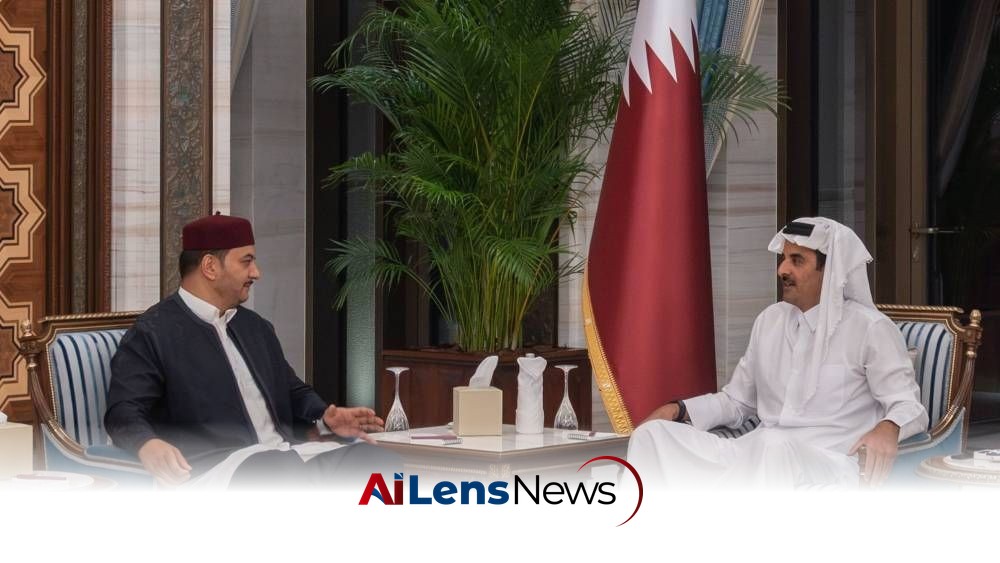


Sheikh Tamim bin Hamad Al Thani met with Lieutenant General Saddam Haftar, who expressed condolences for the passing of the Father Amir Sheikh Hamad bin Khalifa Al Thani.
Doha, Qatar Jul 16, 2026 ALN: His Highness the Amir of the State of Qatar, Sheikh Tamim bin Hamad Al Thani, received Lieutenant General Saddam Khalifa Haftar, who offered his condolences on the death of His Highness the Father Amir Sheikh Hamad bin Khalifa Al Thani, at His Highness’s office in Lusail Palace this evening.
The meeting was attended by Prime Minister and Minister of Foreign Affairs HE Sheikh Mohammed bin Abdulrahman bin Jassim Al Thani.
The passing of Sheikh Hamad bin Khalifa Al Thani marks a significant moment in Qatari history, as he was instrumental in shaping the modern state of Qatar. Sheikh Hamad ruled from 1995 until his abdication in 2013, during which time he transformed Qatar into a prominent player on the global stage, enhancing its political influence and economic power, particularly through the development of its vast natural gas reserves.
Sheikh Hamad's leadership was characterized by a focus on modernization, education, and the promotion of Qatar as a center for diplomacy and international dialogue. His tenure saw the establishment of Al Jazeera, the influential media network that has played a crucial role in shaping public discourse in the Arab world and beyond. Sheikh Hamad's foreign policy was marked by a willingness to engage with various regional and international actors, often positioning Qatar as a mediator in conflicts.
Lieutenant General Saddam Khalifa Haftar, who is a key figure in Libyan politics and military affairs, is known for his role in the ongoing conflict in Libya. As the leader of the Libyan National Army (LNA), Haftar has been a controversial figure, with his forces engaged in a struggle for control over the country against the internationally recognized Government of National Accord (GNA). His visit to Qatar to express condolences indicates the complex web of relationships and alliances that exist in the region, particularly in the context of the Libyan civil war.
The meeting between Sheikh Tamim and Haftar can be seen as a continuation of Qatar's diplomatic efforts in the region. Despite the challenges posed by the Libyan conflict, Qatar has maintained a policy of engagement with various factions within Libya, seeking to promote stability and dialogue. This approach aligns with Qatar's broader foreign policy objectives, which emphasize the importance of mediation and conflict resolution.
Qatar's relationship with Libya has evolved over the years, particularly since the fall of Muammar Gaddafi in 2011. Initially, Qatar supported the uprising against Gaddafi, providing military assistance and support to various rebel groups. In the aftermath of the revolution, Qatar continued to play a role in Libyan affairs, advocating for democratic governance and stability. However, as Libya descended into chaos and factional fighting, Qatar's involvement has been met with both support and criticism, as different factions vie for power.
The implications of Haftar's visit to Qatar extend beyond mere condolences. It highlights the ongoing complexities of Middle Eastern politics, where alliances can shift rapidly, and nations navigate a landscape marked by competing interests and historical grievances. The meeting also underscores Qatar's role as a diplomatic hub in the region, willing to engage with leaders across the spectrum, regardless of their political affiliations.
Furthermore, the meeting could signal potential future cooperation between Qatar and Haftar's forces, as both parties may seek to explore avenues for collaboration in areas such as security, counterterrorism, and economic development. Given Qatar's significant investment capabilities and Haftar's control over key territories in Libya, there may be opportunities for mutual benefit, especially in the context of rebuilding efforts in post-conflict Libya.
In the broader context, this meeting occurs against a backdrop of heightened tensions in the Middle East, with various nations grappling with the implications of the ongoing conflicts in Syria, Yemen, and Libya. Qatar's ability to engage with diverse actors in this environment is a testament to its diplomatic strategy, which seeks to balance relationships while promoting its national interests.
The geopolitical landscape of the Middle East is characterized by a series of complex interdependencies, where the actions of one nation can have far-reaching consequences for others. The ongoing Libyan civil war is a prime example, as it involves a multitude of local and international actors, each with their own agendas and interests. Qatar's historical support for various factions in Libya, including its backing of the GNA, has at times put it at odds with Haftar's forces, who have received support from other regional powers.
As Qatar continues to navigate this complex geopolitical landscape, the legacy of Sheikh Hamad bin Khalifa Al Thani will undoubtedly influence its future direction. His vision for a prosperous and influential Qatar remains a guiding principle for Sheikh Tamim and the Qatari leadership as they confront new challenges and opportunities. Sheikh Hamad's focus on education, economic diversification, and international engagement has established a foundation that continues to shape Qatar's policies today.
Moreover, the significance of the meeting between Sheikh Tamim and Haftar cannot be understated in the context of Qatar's broader foreign policy objectives. Qatar has positioned itself as a mediator in various regional conflicts, leveraging its unique relationships and diplomatic channels to facilitate dialogue. This approach is particularly important in the context of the Libyan civil war, where a negotiated settlement remains elusive amid ongoing violence and instability.
As Qatar mourns the loss of its Father Amir, it also looks to the future, seeking to uphold his legacy while navigating the complexities of an ever-changing geopolitical landscape. The meeting with Haftar may serve as a platform for Qatar to reaffirm its commitment to stability and peace in Libya while exploring new opportunities for collaboration that could benefit both nations.
In conclusion, the meeting between Sheikh Tamim and Lieutenant General Saddam Khalifa Haftar serves as a poignant reminder of the intricate ties that bind nations in the Middle East. It reflects the ongoing evolution of Qatar's foreign policy and its commitment to engaging with key regional players, even in the face of significant challenges. As Qatar continues to adapt to the shifting political dynamics in the region, it remains focused on fostering dialogue and cooperation, ensuring that the legacy of Sheikh Hamad bin Khalifa Al Thani continues to guide its path forward.
To learn more about the latest developments in Leaders & Politicians, stay updated with our exclusive reports and analyses on AiLensNews.

