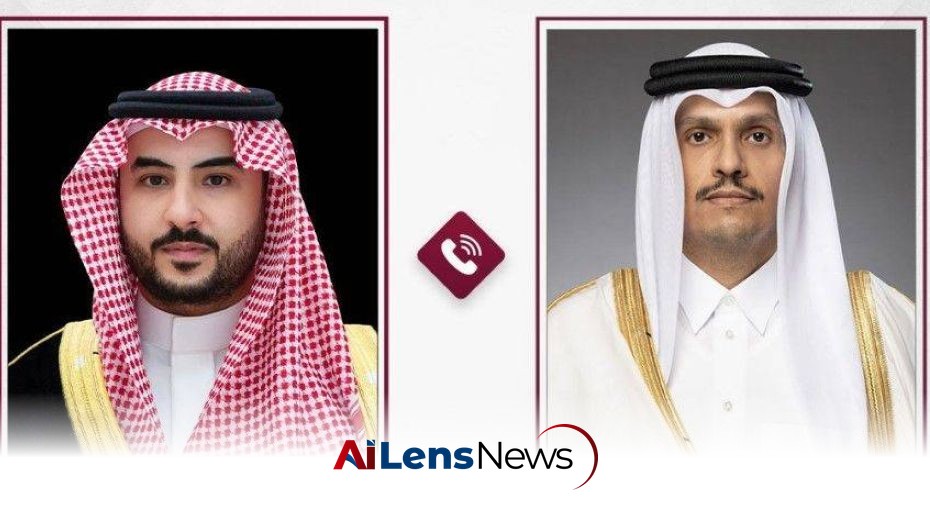


In a recent phone call, Saudi Arabia's Defense Minister expressed condolences to Qatar's Prime Minister over the passing of a prominent leader.
Doha, Qatar Jul 15, 2026 ALN: Prime Minister and Minister of Foreign Affairs HE Sheikh Mohammed bin Abdulrahman bin Jassim Al Thani received on Tuesday a telephone call from Minister of Defense of the Kingdom of Saudi Arabia HRH Prince Khalid bin Salman bin Abdulaziz Al Saud.
During the call, Prince Khalid offered his condolences on the passing of HH the Father Amir Sheikh Hamad bin Khalifa Al Thani. This gesture underscores the ongoing diplomatic relations between Qatar and Saudi Arabia, particularly during times of national mourning.
The passing of Sheikh Hamad bin Khalifa Al Thani has been a significant event in Qatar, marking the loss of a leader who played a pivotal role in the country's development. Sheikh Hamad, who ruled Qatar from 1995 until 2013, was instrumental in transforming the nation into a modern state with a robust economy, advanced infrastructure, and a significant presence on the global stage.
His reign was characterized by a shift towards a more open and liberal society, as well as an emphasis on education, healthcare, and economic diversification. Sheikh Hamad's vision for Qatar included the development of its natural gas resources, which propelled the country to become one of the richest per capita nations in the world. His leadership style was marked by a commitment to modernization while retaining the cultural heritage of the Qatari people.
Sheikh Hamad's contributions to Qatar's development are manifold. Under his leadership, Qatar witnessed a remarkable transformation in its economic landscape, moving from a primarily oil-dependent economy to one that heavily invested in natural gas, which has become a cornerstone of its wealth. The establishment of the Qatar Investment Authority and the diversification of its portfolio into international markets have positioned Qatar as a key player in global finance. Furthermore, his administration prioritized education, leading to the establishment of educational institutions such as Qatar University and the Qatar Foundation, which have attracted international partnerships and fostered a new generation of Qatari professionals.
The international response to Sheikh Hamad's passing reflects the respect and admiration he garnered during his tenure. Leaders from various countries have reached out to express their sympathies, highlighting the importance of solidarity in the region. This is particularly significant given the complex geopolitical landscape of the Middle East, where relationships between nations can be both cooperative and contentious. Sheikh Hamad's foreign policy initiatives, such as the establishment of Al Jazeera, have also played a crucial role in shaping regional narratives and promoting dialogue across borders.
The call from Prince Khalid signifies not only a personal expression of grief but also a reaffirmation of the ties that bind the two nations, especially in the context of shared history and mutual interests. Historically, Qatar and Saudi Arabia have had a close relationship, rooted in shared cultural and religious ties, as both nations are part of the Gulf Cooperation Council (GCC). However, their relationship has also faced challenges, particularly in recent years due to differing foreign policy approaches and regional alliances.
In recent years, tensions between Qatar and Saudi Arabia escalated significantly, culminating in a diplomatic rift that began in 2017. Saudi Arabia, along with several other Arab nations, imposed a blockade on Qatar, citing concerns over its support for groups they deemed extremist and its independent foreign policy. This blockade led to strained relations and significant economic impacts on Qatar, which had to adapt quickly to the new circumstances by finding alternative trade routes and partners. Despite these challenges, Qatar's resilience and ability to navigate the crisis have been notable, and the recent telephone call can be viewed as a positive step towards reconciliation and a testament to the importance of dialogue in addressing grievances and fostering cooperation.
The diplomatic communications between Qatar and Saudi Arabia are vital for maintaining stability in the region. The recent call from Prince Khalid may indicate a willingness on the part of Saudi Arabia to engage in constructive dialogue with Qatar moving forward. This could lead to enhanced cooperation on various fronts, including security, trade, and cultural exchange, all of which are essential for the stability and prosperity of the Gulf region.
In conclusion, such communications between leaders are vital for maintaining diplomatic channels and fostering cooperation, particularly in challenging times. The passing of a prominent leader like Sheikh Hamad bin Khalifa Al Thani serves as a poignant reminder of the need for unity and collaboration among Gulf nations. As Qatar reflects on his legacy, it is also an opportunity for neighboring countries to reaffirm their commitment to regional stability and solidarity.
As the nation mourns, discussions about Sheikh Hamad’s legacy will likely continue to shape Qatar's future policies and its role within the GCC and the broader international community. His contributions to the development of Qatar's foreign relations, including the establishment of Al Jazeera and Qatar's active participation in international diplomacy, will be remembered as critical components of his legacy.
The implications of Sheikh Hamad's passing extend beyond national borders, as it invites reflection on the future of leadership in Qatar and the ongoing dynamics within the Gulf region. The new leadership will be tasked with navigating the complexities of regional politics, economic diversification, and the pursuit of a cohesive foreign policy that aligns with the aspirations of the Qatari people while also addressing the concerns of its neighbors.
Overall, the passing of Sheikh Hamad bin Khalifa Al Thani marks a significant moment in Qatar's history, and the regional response reflects the interconnectedness of the Gulf nations. As Qatar navigates this period of mourning and reflection, the hope remains that it will also pave the way for renewed efforts towards unity and collaboration among the nations of the region. The legacy of Sheikh Hamad will undoubtedly influence the future trajectory of Qatar's domestic and foreign policy, and the regional dynamics will continue to evolve as nations seek to balance their interests and foster a stable and prosperous Gulf region.
To learn more about the latest developments in Political History & Legacy, stay updated with our exclusive reports and analyses on AiLensNews.

