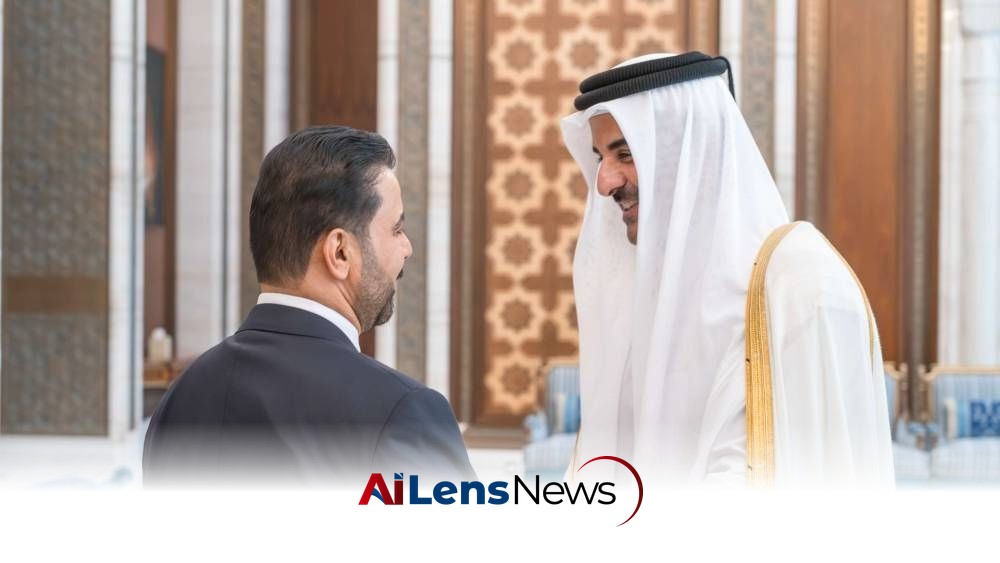


Sheikh Tamim bin Hamad Al Thani and Iraqi PM Ali Faleh Al Zaidi meet to enhance cooperation and address regional issues.
Doha, Qatar Jul 19, 2026 ALN: His Highness the Amir of the State of Qatar Sheikh Tamim bin Hamad Al Thani and Prime Minister of the Republic of Iraq HE Ali Faleh Al Zaidi held an official meeting at Lusail Palace this morning. This meeting marks a significant step in the ongoing dialogue between Qatar and Iraq, two nations that have a complex history but share a commitment to fostering stronger bilateral relations.
At the beginning of the session, His Highness the Amir welcomed the prime minister and the accompanying delegation, wishing the brotherly relations between the two countries further development and growth in various fields. The cordial reception is indicative of Qatar's diplomatic strategy to strengthen ties with its neighboring countries, especially those in the Gulf region and the broader Middle East. Qatar has historically sought to position itself as a mediator and facilitator of dialogue in the region, often stepping in to address conflicts and promote stability.
For his part, the Iraqi prime minister expressed his condolences and sympathy to His Highness the Amir on the death of the late His Highness the Father Amir Sheikh Hamad bin Khalifa Al Thani, asking God Almighty to have mercy on him and grant him paradise. This gesture underscores the deep historical ties between the two nations, as Sheikh Hamad bin Khalifa Al Thani played a crucial role in shaping modern Qatar and its foreign relations, including with Iraq. His leadership was marked by a focus on international diplomacy and the establishment of Qatar as a key player on the world stage.
The prime minister also expressed his thanks to His Highness the Amir for the warm welcome. He looked forward to the visit contributing to strengthening cooperation between the two countries to broader horizons. This optimism reflects a mutual desire for collaboration, particularly in areas such as trade, security, and cultural exchange, which are essential for both nations' development. The potential for collaboration is further enhanced by the complementary nature of both economies, with Qatar's wealth in energy resources and Iraq's need for investment and infrastructure development.
During the session, bilateral relations and ways to strengthen and develop them in various fields were discussed. These discussions are critical as both nations navigate the complexities of regional politics and economic challenges. Qatar has positioned itself as a mediator in various conflicts in the region, and Iraq is looking to stabilize and rebuild after years of conflict and turmoil. The alignment of interests presents an opportunity for both countries to collaborate in areas such as energy, infrastructure, and investment. Qatar's investments in Iraq, particularly in the energy sector, could significantly contribute to Iraq's recovery and growth.
In addition to discussing bilateral relations, the meeting also addressed the most prominent regional and international issues and developments. Both sides stressed the need for all parties to commit to dialogue and diplomacy. This emphasis on diplomatic engagement is particularly relevant given the current geopolitical climate, where tensions in the Middle East remain high. The discussions included the importance of implementing what was agreed upon within the framework of the memorandum of understanding between the United States of America and the Islamic Republic of Iran, which aims to ensure freedom of navigation in the Strait of Hormuz, a vital waterway for global oil shipments.
The Strait of Hormuz is a critical chokepoint for oil transportation, and ensuring its security is paramount for both Qatar and Iraq, as well as for the global economy. The commitment to maintaining open lines of communication and fostering a cooperative regional environment is essential for stability and peace in the area. The meeting reflects a shared understanding of the need for collaborative efforts to address these challenges. Both nations are aware that any disruption in this vital waterway could have far-reaching implications for global energy markets and, consequently, their own economies.
The session was attended by Prime Minister and Minister of Foreign Affairs HE Sheikh Mohammed bin Abdulrahman bin Jassim Al Thani, Head of the Amiri Diwan HE Abdullah bin Mohammed Al Khulaifi, and Minister of State at the Ministry of Foreign Affairs HE Dr. Mohammed bin Abdulaziz Al Khulaifi. Their presence highlights the importance that Qatar places on this meeting and the topics discussed, showcasing a united front in pursuing greater cooperation with Iraq. The involvement of high-level officials from various ministries indicates a comprehensive approach towards strengthening bilateral relations.
On the Iraqi side, the session was attended by Minister of Foreign Affairs HE Fuad Hussein, along with several senior officials. This delegation underscores Iraq's commitment to engaging with Qatar and exploring avenues for enhanced cooperation. The involvement of high-level officials from both sides signifies the seriousness with which both nations approach their bilateral relationship. Iraq's government is keen to leverage its relationships with its neighbors to foster economic growth and stability, particularly in the wake of its recent challenges.
The implications of this meeting extend beyond just diplomatic niceties. As both countries face unique challenges—Qatar with its regional isolation in the past and Iraq with its ongoing efforts for stability—there is a clear recognition that collaboration can yield mutual benefits. Economic cooperation, particularly in energy, could provide both nations with greater leverage and security in a volatile region. Qatar's investments in Iraq can help in the reconstruction efforts while ensuring energy security for both countries.
Moreover, the strengthening of ties between Qatar and Iraq could serve as a model for other nations in the region. In an era where geopolitical alliances are shifting, the ability to foster strong bilateral relationships based on mutual respect and shared interests may prove to be a valuable asset for both countries. The partnership could inspire other Middle Eastern nations to pursue similar paths of cooperation, leading to a more stable and prosperous region.
In conclusion, the meeting between His Highness the Amir of Qatar and the Iraqi Prime Minister represents a significant step forward in the relationship between the two nations. As they navigate the complexities of regional dynamics, their commitment to dialogue and cooperation will be essential in addressing the challenges that lie ahead. The discussions held at Lusail Palace may pave the way for a future marked by enhanced collaboration and stability in the region. As both nations continue to engage in constructive dialogue, the potential for a robust partnership that benefits not only Qatar and Iraq but also the broader Middle East becomes increasingly viable.
To learn more about the latest developments in Political History & Legacy, stay updated with our exclusive reports and analyses on AiLensNews.

