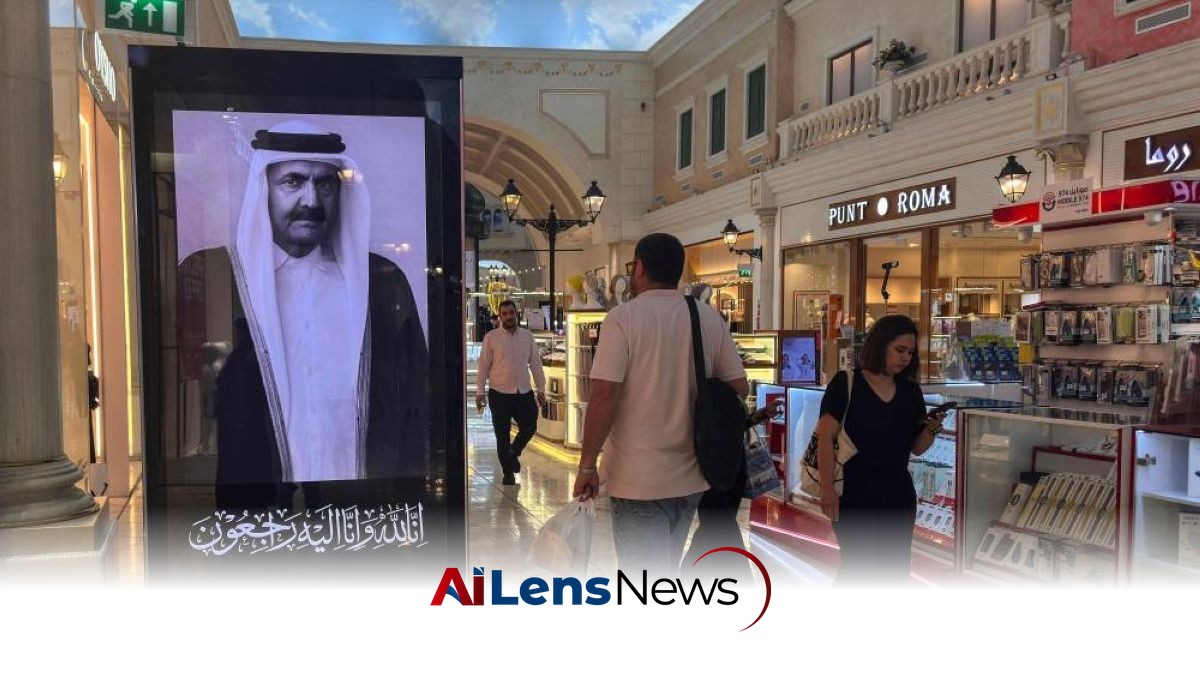


Sheikh Hamad bin Khalifa al-Thani's reign transformed Qatar into a leading regional power, marked by significant economic, social, and cultural advancements.
Doha, Qatar Jul 14, 2026 ALN: His Highness the late Father Amir Sheikh Hamad bin Khalifa al-Thani leaves behind a legacy of remarkable achievements during which Qatar emerged as a leading regional model for development and progress across all sectors.
During his reign from 1995 to 2013, Qatar attained a prominent position both regionally and internationally, witnessing sweeping economic, social, and cultural transformation.
His Highness Sheikh Hamad was born in Doha in January 1952, where he was raised and educated.
He then joined the British Royal Military Academy at Sandhurst. After his graduation in 1971, he joined the Qatar Armed Forces where he reached the rank of major-general.
He played a central role in developing and modernising the Qatari Armed Forces.
On May 31, 1977, he was appointed Heir Apparent and minister of defence.
On May 10, 1989, he became chairman of the Supreme Council for Planning, the body responsible for formulating the country’s social and economic policies.
He assumed power on June 27, 1995, and immediately embarked on an ambitious programme of development and reform.
During his reign, Qatar witnessed broad economic, cultural, and civilisational openness.
The country became a leading venue for political, economic, cultural, and scientific conferences and attained a distinguished regional and international standing.
Qatari diplomacy also assumed a pioneering role in resolving disputes and containing conflicts in various parts of the world.
On June 25, 2013, His Highness the late Father Amir handed over the reins of leadership to his Heir Apparent Sheikh Tamim bin Hamad al-Thani.
Permanent Constitution of the State of Qatar
One of the most notable achievements during the reign of His Highness the late Father Amir was the adoption of the country’s Permanent Constitution.
On July 13, 1999, His Highness Sheikh Hamad issued Amiri Decree No. (11) of 1999 on the formation of a committee for the drafting of the permanent constitution that would reflect the country’s progress and development.
His Highness the late Father Amir received the draft of the new constitution on July 2, 2002.
A public referendum on the Draft Permanent Constitution was held on April 29, 2003.
The large turnout at the ballot boxes clearly reflected the response of the Qatari people to the appeal of His Highness the late Father Amir, with 96.6% voting in favour of the draft.
On June 8, 2004, the Permanent Constitution of the State of Qatar was promulgated, which stipulates that the people are the source of authority, provides for the separation of powers, and vests legislative authority in the Shura Council.
Foreign Policy Based on Peace and Security
His Highness the late Father Amir also laid the foundations of Qatar’s foreign policy based on the principle of consolidating international peace and security, promoting peaceful settlement of international disputes, mutual respect and common interests, peaceful coexistence and international cooperation, adherence to the values of justice and openness, and respect for human rights.
The foreign policy of Qatar during the era of His Highness the late Father Amir accomplished many feats, including establishing the Qatari Committee for the Rescue of Jerusalem in April 1996 to support the Palestinian cause and defend Islamic holy sites in Palestine, sponsoring talks between the Taliban in Afghanistan and the US in order to find a solution to the conflict in Afghanistan, and mediating the Lebanese reconciliation in 2008 with the Doha Agreement.
Additionally, Qatar received the non-permanent membership of the United Nations Security Council (UNSC) for two years in October 2005 and chaired the UNSC in October 2006, as well as held the presidency over the 66th session of the United Nations General Assembly in 2011-12.
The country also sponsored several international and regional conferences and established international forums to promote the principle of dialogue and understanding between nations and peoples, such as the US-Islamic World Forum, the Doha Forum on Democracy, Development and Free Trade, and the Doha Interfaith Conference which led to the establishment of the Doha International Centre for Interfaith Dialogue by Amiri Decree on June 1, 2010 with the aim of promoting peaceful coexistence among adherents of religions and activating religious values to address problems and issues of concern to humanity.
In March 2013, His Highness the late Father Amir chaired the 24th ordinary session of the Arab League Council at the Summit Level hosted by Qatar, where the National Coalition for Revolutionary Forces and the Syrian Opposition held Syria’s seat in the League of Arab States.
At the summit, His Highness Sheikh Hamad launched an initiative to establish a fund for the support of Jerusalem with a capital of $1bn to fund projects and programmes that preserve the Arab and Islamic identity of Al-Quds Al-Sharif and to strengthen the steadfastness of its people and to enable the Palestinian economy to develop its own capacity, to disassociate itself from the Israeli economy, and to counter the policy of isolation and siege.
Qatar contributed $250mn to the fund.
Qatar National Vision 2030
Another prominent achievement during the reign of His Highness the late Father Amir was the Qatar National Vision 2030, prepared under his guidance in 2007 and approved in 2008.
The National Vision prompted a more modernised way of thinking, opened new horizons, and defined the features of the society that the government and people of Qatar aspire to establish.
The success achieved by Qatar in developing its energy sector was the result of extensive national efforts, ambitious aspirations and bold decisions led with wisdom and determination by His Highness Sheikh Hamad.
These efforts required overcoming numerous challenges.
The 1980s witnessed a sharp decline in oil production due to the ageing of oil fields, with output falling from 500,000 barrels per day (bpd) in the 1970s to 300,000bpd in 1987.
However, the intensive efforts undertaken by the state since His Highness the late Father Amir assumed power raised production to 680,000bpd in 2000 and 760,000bpd in 2005.
The first shipment of LNG was exported in late 1996, ushering in a major economic breakthrough, which became evident in 2006 when Qatar became the world’s largest LNG exporter and in 2010, when its production capacity reached 77mn tonnes annually.
At a ceremony held in Ras Laffan Industrial City, His Highness Sheikh Hamad said: “Qatar is celebrating the achievement of one of its historic goals with a feat that will be forever etched in the history of the international gas industry as the day when Qatar officially became the world’s leading producer of liquefied natural gas.”
Currently, Qatar exports gas to markets in Asia, Europe, the Americas and Africa.
In 1989, His Highness the late Father Amir decided to establish the Ras Laffan Industrial City as a centre for the gas industry in Qatar to export LNG.
At the time, he was faced with two choices: either establishing an industrial city in Mesaieed or in Ras Laffan.
He chose the latter for its proximity to gas fields, which allows it to be in line with Qatar’s goals of gas production.
Ras Laffan Port is now the largest facility of its kind in the world.
Mesaieed meanwhile became the second largest industrial city in Qatar, housing many industrial facilities.
The state has converted gas to liquids (GTL) for the sake of having an integrated system for gas production and exportation to benefit from the opportunities in the world markets; and to that end has set up the Oryx and Pearl projects.
Launched in 2006, the Pearl began its export activities in 2011 and boasts the world’s largest GTL plant.
The development of the energy sector included projects in oil and petrochemicals based on partnerships with international oil companies through oil production sharing agreements and through joint venture agreements with companies that specialise in petrochemicals.
The development of the northern fields gave additional impetus to the expansion of the petrochemical industry.
Additional quantities of methane increased the production capacity of ammonia and urea and enabled the state to move to downstream industries.
Additional quantities of ethane also contributed to the addition of new ethylene plants and the emergence of new industries such as the production of low- and high-density polyethylene, and many other products.
Among the most notable achievements during the tenure of His Highness the late Father Amir, was Qatar’s transformation in the field of communications and media, which had a profound impact locally, regionally and internationally.
Censorship of the local press was lifted in October 1995 and Law No. (25) of 1995 was issued on the establishment of the Qatar News Agency, which marked a significant milestone in the media landscape of the country.
To learn more about the latest developments in Political History & Legacy, stay updated with our exclusive reports and analyses on AiLensNews.

