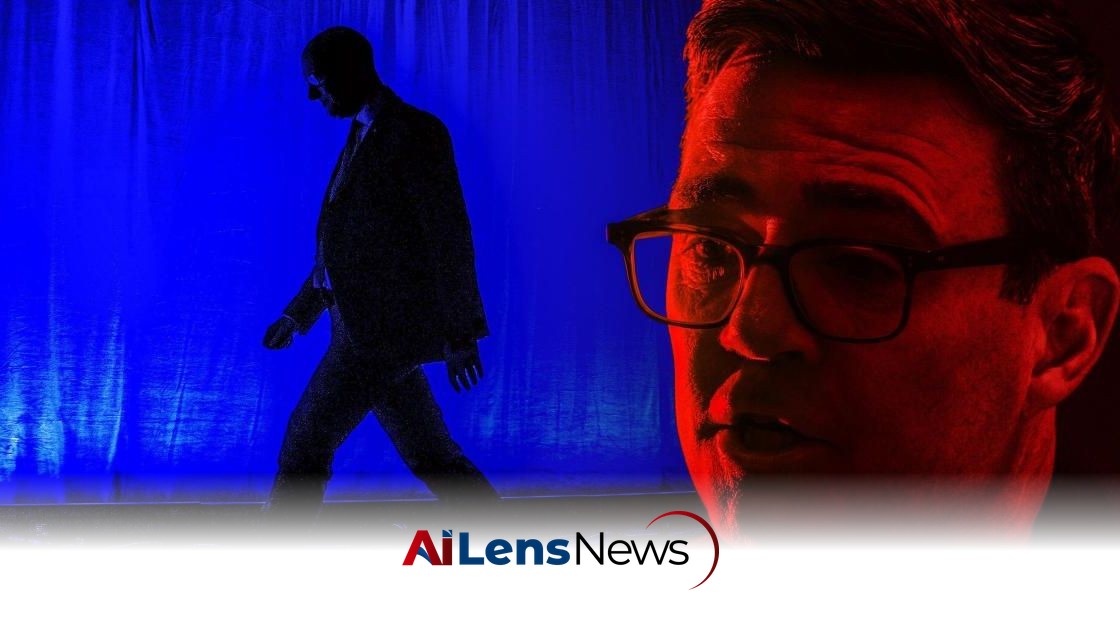


The implications of Andy Burnham's leadership for Scotland's political landscape and the independence debate are profound and multifaceted.
London, United Kingdom Jul 12, 2026 ALN: JUST as Keir Starmer’s leadership of the Labour government at Westminster had profound implications for politics in Scotland, so too will that of Andy Burnham.
The big difference will be that whereas Starmer was an albatross around the neck of Scottish Labour, as the recent Scottish Parliament elections showed, Burnham will be a disrupter of a different kind, potentially creating problems for the SNP, SNP leader and First Minister, John Swinney, and the case for independence on three fronts.
These three fronts revolve around the phenomena of political competition for left-wing credentials, the return of Devo-Max, and the London “blame game”. Here, the whole combined effect is greater than the sum of their parts as each one feeds into and out of the others.
Let’s take a step or two back first though. So, no matter that Scottish Labour leader, Anas Sarwar, called for Starmer to go in February this year, Scottish Labour could not turn the 2026 Scottish Parliament elections into a referendum on Swinney, the SNP and resisting independence. Instead, those elections were a referendum on Starmer as was also the case with the elections on the same day in England and Wales.
Starmer led Labour at Westminster to a loveless landslide on 4 July 2024 after a decade and more of Tory governments. In order to win the Labour leadership in 2020, he promised to uphold the policies of Jeremy Corbyn but he did the reverse, dropping every one of them.
And since becoming Labour leader, he promised change from the Tories without turning on the taps of public expenditure for public services. Thus, it was austerity rebooted in version 4.0. What little progressive hopes that were placed upon Starmer were steadily smashed to smithereens as Labour’s general election slogan of “Change begins” patently did not take place, especially if people were looking for positive changes in their lives.
This is the critical context for understanding the groundswell of support for Burnham and the desire to dump Starmer. To many, Burnham looks so good standing next to Starmer precisely because Starmer has become so detested and so quickly so. This also explains why somebody that was not an even MP on June 18, 2026 will be PM on July 17.
: Bus firm of billionaire Labour donors takes legal action against Scottish Government
Burnham’s had an easy ride since 2017 because he has been inoculated against and not infected by Westminster politics. As Mayor of Greater Manchester, he has been able to style himself as a departure from the Westminster way of the safe and the supine that protects the interests of the rich and powerful.
Starmer was quintessentially cautious, managerialist and incrementalist, without an ability to sum up what was his big vision for Britain. Burnham seems to promise a more combative approach to provide radical and sweeping changes even if he rode back on some of them in the final days of his successful bid to become the MP for Makerfield.
In order to get a good handle on the extent to which Swinney, the SNP and the case for independence face considerable challenges with Labour led by Burnham and, thus, Labour experiencing a bit of a bounce in the polls, we need to start by understanding the kind of political animal that Burnham is. This requires a deep dive into Burnham’s past.
Though Burnham has sometimes associated himself with socialism, he is only of the soft-left stable of the Labour Party. He is not of the hard left of the likes of the Socialist Campaign Group within Labour, and he is not “old Labour” either because he is not a left-wing or radical social democratic.
It would be better to characterise him as a left Brownite following from Gordon Brown. Out of office (before 1983 and after 2015), Brown has been more left-wing in words than he ever was in deeds when in parliament or government. How Burnham will stand up to the pressures of high office remains to be seen but there is a track record of tacking to the right from previously rebellious figures. Neil Kinnock is another good example of this.
Burnham’s veneer of radicalism comes from three sources. The first is his upbringing. He has described himself as ‘Catholic … [but] not particularly religious’, where ‘Catholic social teaching underpins my politics’. The second is the influence of the cooperative movement which began in Manchester as a form of working-class community self-help. Indeed, Burnham was before and is again a Labour and Co-operative Party MP. The third is his time as Mayor of Greater Manchester.
But before looking at these more recent years, it’s worth recalling Burnham’s earlier parliamentary career. He was MP for Leigh in the north-west England from 2001 until 2017. Under Prime Ministers, Tony Blair and Gordon Brown, he held several senior government roles including Parliamentary Under-Secretary of State for the Home Department, Minister of State for Health, Chief Secretary to the Treasury, and Secretary of State for Culture, Media and Sport. From 2010 to 2017, he served variously as Shadow Secretaries for education, health and the Home Office.
Former Manchester mayor Andy Burnham speaks as he celebrates his victory (Image: PA)
In all this, he voted for the Iraq war in 2003 along with resisting inquiries into it, and was a loyal backbencher, minister and shadow minister. As health secretary, he proposed the creation of a National Care Service, which would introduce a publicly funded system of social care, being free at the point of use along the same lines of the National Health Service (NHS).
At the same time, and even if he later expressed regrets over the value for money, he continued with Labour’s PFI (Private Finance Initiative) projects in the NHS. He also supported Starmer in his 2020 Labour leadership bid. Before that he warned he would resign from the Shadow Cabinet if Labour supported leaving NATO.
Burnham has previously harboured leadership ambitions, standing in 2010 and 2015. He came fourth in 2010 when Ed Miliband won, and second in 2015 when Jeremy Corbyn won. In the former, he stood on a platform of his philosophy of ‘aspirational socialism’ which he described as redistributive, collectivist and internationalist. One of his policies was replacing inheritance tax with a land value tax.
In the latter, he stood on a centrist pitch that sought to emphasise his business-friendly credentials, suggesting an entrepreneurs should be treated “as much our heroes as nurses” as part of the way to, in his words, “rediscover the beating heart of Labour”.
But disaffected with Labour’s move to the left under Corbyn and the continuing Westminster bubble effect on national politics, he chose to leave the House of Commons by fighting for – and winning with 63% of the votes – the Greater Manchester Mayoralty on 5 May 2017. He was re-elected in the 2021 and 2024 elections the Mayoralty with similar vote shares.
: Anger as Harry Kane shares 'surreal experience' of playing golf with Donald Trump
In his 2017 Mayoral victory speech, he stated: “This is the dawn of a new era, not just for this city region but for politics in our country. It has been too London-centric for too long. the old political and party structures haven’t delivered for all people and for all places ... Greater Manchester is going to take control. We are going to change politics and make it work better for people.”
Burnham has used the term “Manchesterism” to encapsulate the political philosophy underpinning his policy agenda as Mayor. He has variously characterised it as “the end of neo-liberalism”, “business-friendly socialism” and “a modern and functional response to the high-inequality, low-growth trap that came from the 1980s drive to privatise economic power and overcentralise political power in the Treasury”.
In other words, “Manchesterism” is about seeking to combine economic development with social benefits, where the proceeds of growth are consciously channelled towards local communities in a rejection of unregulated trickle-down economics.
So, let’s look at what he did do as Mayor. He implemented reforms to public transport, taking buses and trams into a locally controlled (but not owned) integrated transport system called the Bee Network. Prior to this, capped fares of £2 for adult single fares were introduced in September 2022.
In 2025, he established the Good Growth Fund, which provides funding for regeneration projects in the boroughs of Greater Manchester. For his role campaigning to secure more furlough funding for Northern communities during the COVID-19 pandemic, he was dubbed “King of the North” by both the media and Northerners even though he settled for less than he had initially asked for.
Manchester, like many other big cities, has the problems of homelessness and rough sleeping. Burnham pledged to end rough sleeping by 2020 but did not. He did, however, donate 15% of his mayoral salary to charities tackling homelessness and established a “homelessness fund” to provide further funding to those charities.
Yet the other side of the coin is that there has been a building boom in the centre of Manchester. There were only four skyscrapers before 2017 but now there are over thirty with many more planned.
Not only do these not provide affordable or social housing but the boom was heavily supported by the Greater Manchester Housing Investment Fund (GMHIF), a taxpayer-backed loan fund overseen by Burnham to reduce the risks associated with private building projects.
What does all this mean for having the keys to 10 Downing Street? Burnham has vowed to put energy, housing, water and transport under ‘stronger public control’. Whether this means further regulation without public ownership or public ownership is not clear at this point in time.
That said, we should note that he has rowed back on his statement of 2025 that the government should not be “in hock” to the bond markets and has undertaken to keep to the fiscal rules set out by the current Chancellor, Rachel Reeves. Tax and spend is not high on his list of priorities, and he has indicated he would cut welfare spending to boost defence spending.
Not only does this not leave much room for turning on the taps for public services (such as creating a new National Care Service) but this would rule out renationalising the utilities and the like in order take control of the prices of those commodities so as to reduce the effects of the current cost-of-living crisis.
(Image: PA)
Now let’s turn back to the first front. To summarise, Burnham sounds left-wing compared to Starmer and there is some substance to this. That is not a difficult task.
However, he has not yet been tested in the pressure cooker of the highest office in these isles. And there are good grounds for thinking that when he is, he will compromise and concede when met by the forces of the rich and powerful, whether at home or abroad or even in his own party as the Starmerites regroup.
The upshot of this is that the Swinney and the SNP will not sound quite so left-wing as they used to in comparison to the Labour Westminster government. It was pretty easy in the age of Starmer to appear progressive.
If this is the case, this might lead to three changes on the domestic front. One is that after Scottish Labour’s drubbing in the recent Scottish Parliament elections, Anas Sarwar’s position as Scottish Labour leader is ever more put on a shoogly peg as he declined to back Burnham for the Labour leadership and Burnham is to the left of Sarwar. A change of leadership in Scottish Labour may precipitate a more autonomous Scottish Labour party and a recalibrated stance on independence.
The other is that if the SNP wants to deliver on its claim to be social democratic, then it will have to do a lot more (even within the devolved settlement) in order to open up ‘clear red water’ between Holyrood and Westminster.
Another is that Swinney is not the combative operator that Burnham is so that this will open up a space for Stephen Flynn MSP to challenge for the leadership of the SNP by being this type of belligerent political operator. Swinney is somewhat like Starmer in being a grey-suited bank manager of old kind of figure, namely, dull, boring and overly cautious.
The bigger prize here is, of course, to show that left-wing policies when implemented will undercut the basis of the material grievances that give rise to the racist rise of Reform – with its 17 MSPs now – by bettering the living standards of those at the bottom of society.
On the second front, that of the future constitutional settlement, Burnham staunchly opposes Scottish independence, advocating for ‘solidarity, not separation’ as a firm unionist. However, he does favour further decentralisation and devolution in the nations and regions of the United Kingdom and has empathised with the anti-Westminster sentiment following his time as Manchester Mayor in dealing with a London-centric government.
Consequently, he believes he understands why so many in Scotland want independence. His conclusion here is that the current situation is unsustainable and suggests that a super-charged Devo-Max is what is needed for Scotland and the other nations and regions.
Part and parcel of this is replacing the House of Lords with an elected senate to guarantee better representation for Scotland, Wales and regions as well as using proportional representation to elect MPs in the House of Commons.
The key question that then arises here is this. After the Smith Commission of 2014 following “The Vow” that led to the Scotland Act 2016, will the return of an enhanced Devo-Max on the political agenda be a boon or barrier to the case for independence?
Flowing from this, there are other subsidiary questions. One is will an enhanced Devo-Max satisfy enough demands for control of affairs in Scotland by the populace in Scotland as to stymie the case for independence or will it help build the capacity for independence by showing that it is still inadequate?
Another is will an enhanced Devo-Max bring about the return of the “gradualist” versus “fundamentalist” divide in the SNP? A third is will those against independence make a bigger play of the argument that existing devolved powers have not been used so why is there a need for further devolution, thus, stymieing any sense that distinct stages are needed to get to independence as per the “gradualists”?
: Ann Widdecombe 'attacked day before body found' as police manhunt continues
And a fourth is will an enhanced Devo-Max create pressure on the SNP Scottish Government to decentralise the Scottish state within Scotland so that Edinburgh and Holyrood relinquish some powers?
Or, and negating the pertinence of all those issues, has Burnham shown his ignorance of Scottish matters by...
To learn more about the latest developments in Regional Politics, stay updated with our exclusive reports and analyses on AiLensNews.

