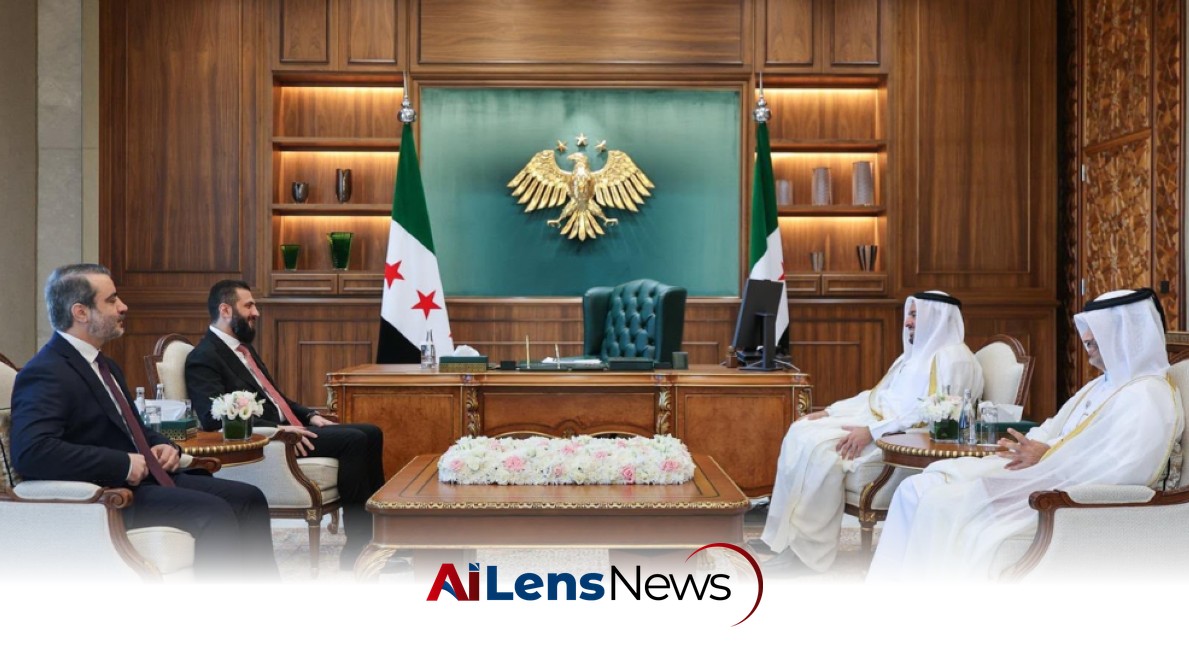


Syrian President Ahmed Al Sharaa held a meeting with Dr. Mohammed bin Abdulaziz Al Khulaifi, Minister of State at the Ministry of Foreign Affairs, discussing bilateral cooperation.
Doha, Qatar Jul 12, 2026 ALN: The meeting between President Ahmed Al Sharaa of the Syrian Arab Republic and Dr. Mohammed bin Abdulaziz bin Saleh Al Khulaifi, the Minister of State at the Ministry of Foreign Affairs of Qatar, represents a significant diplomatic engagement within the context of Middle Eastern politics. This encounter, which took place on a Saturday, highlights ongoing efforts to strengthen ties between Syria and Qatar, two nations that have experienced fluctuating relations over the years, particularly in light of the Syrian civil war and its aftermath.
Historically, Qatar has played a complex role in the Syrian conflict. Initially, it was one of the regional powers that supported opposition groups seeking to overthrow the government of President Bashar al-Assad. This support was part of a broader strategy by Qatar to assert its influence in the region and counterbalance the power of Iran and its allies. However, as the conflict evolved, Qatar's stance and its foreign policy objectives shifted, leading to a more nuanced approach. The recent meeting indicates a potential thaw in relations and a willingness to engage in dialogue and foster cooperation.
During the meeting, Dr. Al Khulaifi conveyed greetings from His Highness the Amir Sheikh Tamim bin Hamad Al-Thani to President Al Sharaa, which underscores the importance of diplomatic niceties in international relations. Such gestures are not merely ceremonial; they reflect a desire for mutual respect and recognition between the two states. The mention of health, happiness, progress, and prosperity in the greetings exchanged is indicative of the aspirations both leaders hold for their respective nations. This exchange of pleasantries serves as a foundation upon which further discussions can be built, particularly concerning cooperation in various fields.
The discussions that followed between the two leaders were centered on deepening and expanding bilateral cooperation. This is a crucial aspect of any diplomatic meeting, as it allows both parties to outline specific areas of mutual interest and potential collaboration. The fields of cooperation could range from economic partnerships, cultural exchanges, security cooperation, and humanitarian assistance, among others. Each of these areas holds significant implications for both nations.
Economically, Syria has been heavily impacted by the civil war, which has devastated its infrastructure and economy. The United Nations has estimated that the conflict has resulted in significant economic losses, with the Syrian economy shrinking dramatically over the years. Qatar, with its substantial financial resources, could play a pivotal role in Syria's reconstruction efforts. Engaging in economic cooperation may involve investments in rebuilding critical infrastructure, such as hospitals, schools, and transportation networks, which are essential for the revival of the Syrian economy. Moreover, Qatar's experience in post-conflict reconstruction in other regions may provide valuable lessons and strategies that could be applied to Syria.
Furthermore, cultural exchanges can foster greater understanding and solidarity between the two nations. This could involve initiatives such as educational programs, artistic collaborations, and tourism development, which can enhance people-to-people connections and promote a positive image of both countries in the region. Cultural diplomacy has been a tool used by various states to improve bilateral relations, and it could serve a similar purpose in this context, helping to bridge gaps that have formed due to past tensions.
Security cooperation is another vital area, especially considering the ongoing instability in the region. With various factions operating within Syria and the presence of external powers, a collaborative security framework could be beneficial. This might include intelligence sharing, joint training exercises, and coordinated efforts to combat terrorism, which remains a significant threat in the region. Both countries face challenges related to radicalization and extremism, and a cooperative approach could enhance their ability to address these issues effectively.
As the meeting concluded, it is essential to consider the broader implications of this engagement. The diplomatic overtures between Syria and Qatar may signal a shift in regional dynamics. As countries in the Middle East reassess their foreign policies in light of changing geopolitical realities, such meetings could pave the way for a more stable and cooperative regional environment. The normalization of relations between Syria and Qatar could also encourage other Arab states to reevaluate their positions regarding Damascus and potentially lead to a broader acceptance of the Syrian government within the Arab League.
Moreover, this meeting could also be viewed in the context of the broader Arab League dynamics, where Syria's readmission is a topic of discussion among member states. The potential for Syria to reintegrate into the Arab League could lead to increased diplomatic recognition and support from other Arab countries, further solidifying its position in the region. The Arab League has historically played a significant role in mediating conflicts and fostering cooperation among its members, and Syria's return could facilitate greater regional collaboration on various issues, including trade, security, and cultural initiatives.
In conclusion, the meeting between President Al Sharaa and Minister Al Khulaifi is a significant step in the ongoing efforts to rebuild and strengthen bilateral relations between Syria and Qatar. It reflects a mutual desire for cooperation and dialogue, which could have far-reaching implications for both nations and the broader Middle Eastern landscape. As the situation in Syria continues to evolve, such diplomatic engagements will be crucial in shaping the future of the region. The potential for improved relations between Syria and Qatar may not only benefit the two countries but could also contribute to a more stable and prosperous Middle East, where cooperation takes precedence over conflict, and dialogue replaces division.
To learn more about the latest developments in Leaders & Politicians, stay updated with our exclusive reports and analyses on AiLensNews.

