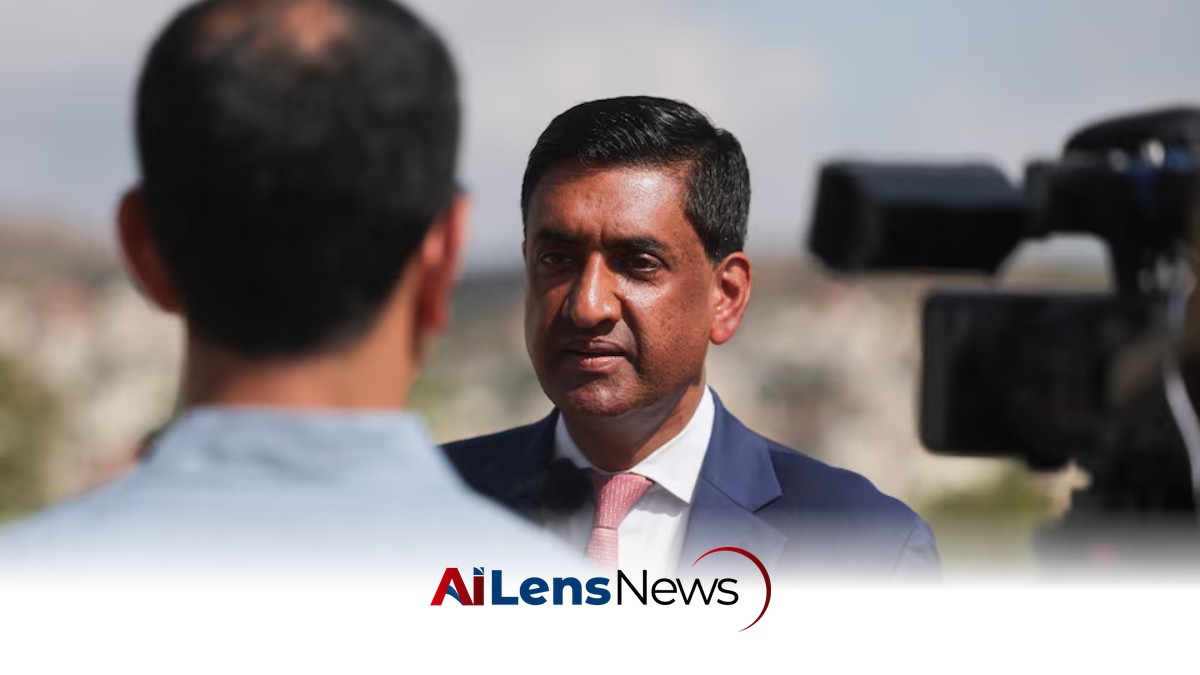


US Democratic lawmaker Ro Khanna was detained by Israeli settlers armed with rifles during a visit to the West Bank, highlighting tensions surrounding Israeli policies.
Islamabad, Pakistan Jul 12, 2026 ALN: TURMUS AYYA, West Bank: U.S. Democratic lawmaker Ro Khanna said he was detained by Israeli settlers armed with U.S.-made rifles during a West Bank visit this week that he cast as an unfiltered look at the human toll of Israeli occupation as he weighs a 2028 presidential run.
Speaking with Reuters on Thursday in a Palestinian village, Khanna said his group’s van was surrounded by settlers wielding M4 rifles a day earlier while touring a part of the southern West Bank where residents face frequent settler attacks. This incident highlights the ongoing tensions and violence in the region, particularly concerning the Israeli-Palestinian conflict, which has seen escalating hostilities and a complex web of historical grievances.
“We were at a village that Israeli settlers had destroyed, they had destroyed the school, they had destroyed that village, and we were just looking at it,” said Khanna, a progressive lawmaker from California in the U.S. House of Representatives. His comments reflect a growing concern among some U.S. lawmakers about the impact of Israeli settlement policies on Palestinian communities and the broader implications for peace in the region.
“And these hoodlums come in with machine guns – M4, an American-made machine gun – and they detain us. They block off the road. And then they call the IDF and the IDF is on their side, not on the side of the Americans,” Khanna said, referring to the Israeli military. His remarks underscore the contentious nature of U.S. military support for Israel, particularly in light of the weapons used by settlers during the incident.
An aide to Khanna who was in the group, Cameron Kasky, said they were held for more than an hour and made appeals to the U.S. Embassy in Jerusalem for help. A group of officers who appeared to be police eventually intervened, leading to their release, Kasky said. This incident raises questions about the safety of U.S. citizens in the West Bank and the role of the Israeli military and police in protecting or failing to protect individuals who may be caught in the crossfire of ongoing conflicts.
The Israeli military said troops and police officers intervened after receiving a report of settlers blocking vehicles near Khirbet Zanuta, a small Palestinian hamlet whose residents were forcibly displaced by violent settler raids following the 2023 Hamas attacks on Israel. The military's statement reflects the complexities of security in the region, where tensions often escalate into violence, and the role of the military in managing these situations.
“Upon their arrival, the troops dispersed the Israeli civilians and allowed the vehicles to continue on their way,” the military said. However, the effectiveness of such interventions is often called into question, particularly by those who argue that the military's actions tend to favor settlers over Palestinian residents, further complicating the situation.
Israel’s police did not immediately respond to a request for comment, nor did the U.S. Embassy in Jerusalem. The lack of immediate response from these entities raises concerns about accountability and the transparency of actions taken by both Israeli authorities and U.S. representatives in the region.
Khanna is the second Democrat considering a White House bid to visit the region this week. In Tel Aviv on Wednesday, Rahm Emanuel, who was chief of staff to former President Barack Obama, said Israeli policies toward Palestinians were eroding support for the U.S.-Israeli alliance. Emanuel's comments reflect a broader trend within the Democratic Party, where a growing faction is increasingly critical of Israeli policies, particularly in light of recent violence and human rights concerns.
Asked if he was running for president, Khanna said: “I’m strongly considering it and I’m more resolved to consider it after this trip.” His experience in the West Bank may influence his political stance and campaign platform, particularly as he navigates the complex landscape of U.S. politics regarding Israel and Palestine.
Israel’s conduct toward Palestinians has emerged as a flashpoint in Democratic politics ahead of November’s U.S. midterm elections, contributing to primary defeats for some incumbent lawmakers targeted by left-wing challengers who accused them of supporting Israel’s right-wing government. This internal division within the Democratic Party reflects a significant shift in the party's approach to foreign policy, particularly regarding human rights and international relations.
Israel’s favorability rating among Democrats fell from 59% in 2018 to 22% in May, according to Reuters/Ipsos polling. This decline indicates a growing discontent among Democratic voters regarding U.S. support for Israeli policies, particularly in light of humanitarian concerns in Palestine.
: Businessman who sold land for Kushner resort in Albania suspected of faking the deeds
While Israel has long enjoyed strong bipartisan U.S. support, an increasing number of Democrats in Congress are now pressing to cut off military aid, which amounts to $3.8 billion per year and includes funding for light weaponry like M4 rifles and missile interceptors that Israel used in the Iran war. This push to reconsider military aid reflects a broader reevaluation of U.S. foreign policy priorities and the implications of military support for human rights abuses.
Overlooking a valley dotted with settler outposts on the outskirts of Turmus Ayya, a village home to thousands of Palestinian American dual nationals, Khanna said he believed his party’s establishment was “clueless about how much of a moral test Palestine, Gaza and Israel have become.” His statement underscores the moral complexities surrounding U.S. foreign policy in the region and the challenges faced by lawmakers in balancing national interests with humanitarian concerns.
He said he chose to do a visit exclusively to the West Bank, with programming led by Palestinians, to give him an unfiltered view of territory Israel captured in the 1967 Middle East war. This choice reflects a conscious effort to engage with the Palestinian narrative and understand the realities of life under occupation, which contrasts with the often one-sided portrayals of the conflict in mainstream media.
“If you’re unwilling to speak up for Palestinian human rights, if you’re unwilling to speak up against the genocide in Gaza, the apartheid in the West Bank, then you are morally compromised,” Khanna said. His comments resonate with a growing movement within the U.S. that advocates for Palestinian rights and seeks to hold Israel accountable for its actions.
Israel rejects allegations it carried out a genocide in Gaza or that it institutes an apartheid regime in the West Bank, which has a population of about 3 million Palestinians and around 500,000 Jewish settlers. These denials reflect the contentious nature of the Israeli narrative, which often emphasizes security concerns and historical claims to the land.
Most countries and the United Nations regard Israeli settlements in the West Bank as illegal under international law, citing the Fourth Geneva Convention’s prohibition on transferring a civilian population into occupied territory. This international perspective complicates the situation further, as Israel continues to expand its settlements despite widespread condemnation.
Israel rejects that position, saying the West Bank is disputed territory where there has been a Jewish presence for thousands of years. Palestinians view the West Bank, together with Gaza and East Jerusalem, as part of a Palestinian state. The differing narratives highlight the deep-seated historical grievances that fuel the ongoing conflict.
Support remains strong among Republicans, though some elements of Trump’s coalition have also called for cutting off aid. This division within both major political parties reflects the evolving landscape of U.S. politics regarding Israel and Palestine, as more voices advocate for a reexamination of longstanding policies and alliances.
To learn more about the latest developments in Political Controversies, stay updated with our exclusive reports and analyses on AiLensNews.

