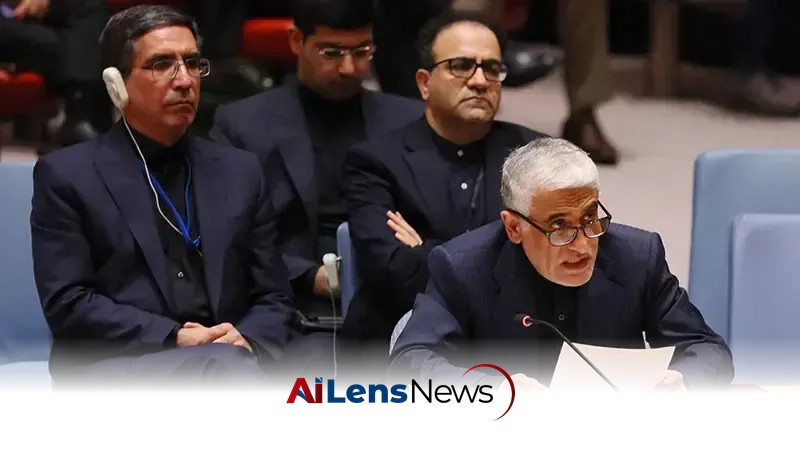


Iran expressed gratitude to Pakistan for its abstention during a UN Security Council vote regarding Tehran's nuclear program, asserting the meeting was 'legally unfounded'.
Islamabad, Pakistan Jul 12, 2026 ALN: Iran expressed its gratitude towards Pakistan on Friday for abstaining from a vote that permitted a UN Security Council meeting focused on Iran's nuclear program to proceed. This meeting was characterized by Tehran as “legally unfounded,” reflecting the ongoing tensions surrounding Iran's nuclear activities and international diplomatic relations.
Iran’s Ambassador and Permanent Representative to the United Nations, Amir Saeid Iravani, made a statement following the contentious meeting, which was convened at the request of Bahrain and five European members of the Security Council—Denmark, France, Greece, Latvia, and the United Kingdom. Iravani specifically acknowledged Pakistan and Somalia for their abstention, which he interpreted as a refusal to support what he deemed an unjustified convening of the meeting. He also praised Russia and China for their opposition to the session, indicating a divide among Security Council members regarding Iran's nuclear program and the broader geopolitical implications.
The Security Council meeting was primarily convened to discuss the implementation of Resolution 2231, which endorses the 2015 Iran nuclear agreement, known as the Joint Comprehensive Plan of Action (JCPOA). This agreement was designed to limit Iran's nuclear capabilities in exchange for the lifting of economic sanctions. However, the session occurred amidst a significant dispute over the status and relevance of Resolution 2231, with Western members asserting that it still provides a legal framework for addressing Iran’s nuclear commitments. Conversely, Tehran maintains that the resolution expired on October 18, 2022, thereby lacking any legal authority to justify discussions or reports regarding Iran’s nuclear activities.
In his remarks, Mr. Iravani underscored Iran's position by stating, "There is therefore no legal basis for the Secretary General to submit reports, for the secretariat to brief the Council, or for the Security Council to discuss this issue under the agenda item ‘Non-Proliferation’.” This assertion reflects Iran's broader strategy to challenge the legitimacy of international scrutiny over its nuclear program, which it insists is solely for peaceful purposes.
Furthermore, Iravani rejected the European powers' invocation of the “snapback” mechanism, which allows for the reimposition of sanctions on Iran if it is deemed to be in violation of the JCPOA. He argued that France, Germany, and the United Kingdom had failed to uphold their own commitments under the agreement, stating, “A party that has materially breached its obligations cannot invoke rights arising from the same legal instrument.” This statement highlights a key contention in the ongoing negotiations and diplomatic relations surrounding Iran's nuclear program, as both sides accuse each other of failing to adhere to the terms of the JCPOA.
In a broader context, Mr. Iravani also accused the United States and Israel of violating international law through military actions against Iran. He called for accountability for these actions, asserting, “The United States and the Israeli regime bear full responsibility for the consequences of their unlawful acts and must be held fully accountable.” This rhetoric underscores the heightened tensions between Iran and these nations, particularly in light of recent military confrontations and regional conflicts that have drawn international attention.
In addressing the allegations surrounding Tehran’s nuclear activities, Iravani emphasized that Iran’s nuclear program remains peaceful and is subject to international monitoring. He stated, “Its nuclear programme has never been diverted to military purposes and has remained exclusively peaceful under the most extensive IAEA verification regime.” This assertion is critical for Iran as it seeks to reassure both domestic and international audiences of its commitment to peaceful nuclear development, especially in the face of ongoing sanctions and pressures from Western powers.
Moreover, the Iranian envoy criticized Western countries for allegedly politicizing the Security Council, suggesting that their claims were an attempt to “distort Resolution 2231, misrepresent the facts, and misuse the Security Council.” This accusation reflects Iran's broader narrative of victimization and its portrayal of Western nations as aggressors in the international arena.
In a related discussion, Mr. Iravani touched upon the tensions in the Strait of Hormuz, a strategic waterway through which a significant portion of the world’s oil supply is transported. He asserted that the responsibility for maintaining maritime navigation and conducting demining operations in the area lies exclusively with Iran, referencing the Islamabad Memorandum of Understanding. “Responsibility for maritime navigation through the Strait of Hormuz, including its reopening and all necessary demining operations, rests exclusively with Iran,” he stated. This claim emphasizes Iran's strategic interests in the region and its assertion of sovereignty over critical maritime routes.
Iravani also issued a warning regarding potential outside interference in the Strait of Hormuz, suggesting that such actions could exacerbate tensions and undermine the implementation of existing agreements. This statement reflects Iran's sensitivity to foreign military presence in the region and its broader concerns about national security and territorial integrity.
The implications of these developments extend beyond the immediate context of the UN Security Council meeting. They reflect the ongoing geopolitical struggle surrounding Iran's nuclear program, the efficacy of international agreements like the JCPOA, and the broader dynamics of power in the Middle East. As tensions continue to rise, the potential for conflict remains a significant concern for regional and global actors alike.
In conclusion, the recent UN Security Council meeting and the subsequent statements from Iranian officials highlight the complex and often contentious nature of international diplomacy regarding Iran's nuclear ambitions. As Iran continues to assert its position on the global stage, the responses from other nations will likely shape the future of negotiations and the stability of the region.
Published in , July 12th, 2026
To learn more about the latest developments in Regional Politics, stay updated with our exclusive reports and analyses on AiLensNews.

