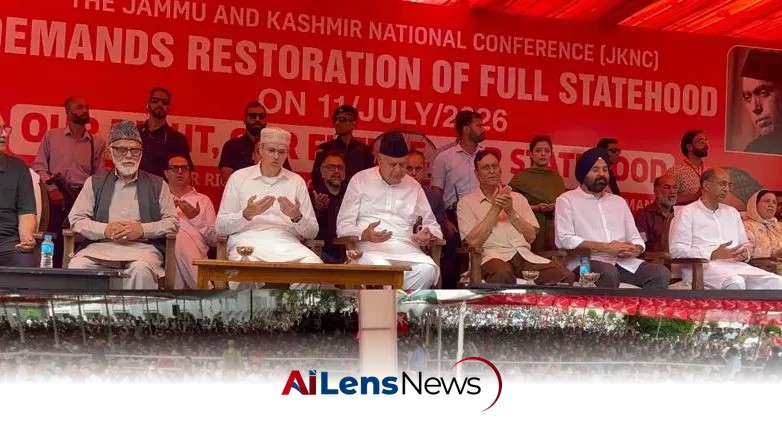


Omar Abdullah urges the Union Government to restore Jammu and Kashmir's statehood, asserting that patience should not be mistaken for weakness.
New Delhi, India Jul 12, 2026 ALN: Says Centre ‘must not mistake our patience for weakness’
Appeals to all political parties to join July 20 protest in New Delhi
Srinagar: Jammu and Kashmir National Conference Vice President and Chief Minister Omar Abdullah on Saturday called upon the Union Government to immediately restore Jammu and Kashmir’s statehood, asserting that the Centre must not mistake the people’s patience for weakness, while addressing a grand convention held on the death anniversary of Madar-e-Meherban Begum Akbar Jehan.
In recent years, the political landscape of Jammu and Kashmir has undergone significant changes, particularly following the abrogation of Article 370 in August 2019. This constitutional amendment effectively stripped Jammu and Kashmir of its special status, leading to heightened tensions and a complex political situation in the region. The subsequent bifurcation of the state into two Union Territories—Jammu & Kashmir and Ladakh—has further complicated matters, prompting calls for the restoration of statehood.
Omar Abdullah emphasized that for nearly two years, his government had exercised restraint and patience, but he cautioned that patience should never be interpreted as silence or surrender. “Patience does not mean that we will stop raising our voice for our constitutional and democratic rights. It does not mean that anyone can take undue advantage of our restraint or consider us weak. Our patience is our strength, our voice, and, God willing, it will ultimately lead us to victory,” he said. This statement reflects a broader sentiment among many in Jammu and Kashmir who feel disenfranchised and marginalized following the changes imposed by the central government.
During his address, Abdullah questioned why, despite nearly two years of his government being in office, they were now compelled to speak of protesting at Jantar Mantar, a prominent protest site in New Delhi. “There must be a reason that has forced us to take this course,” he remarked, suggesting that the political climate in the region had reached a point where peaceful protests were necessary to draw attention to their demands. He highlighted his commitment to pursuing dialogue with the Centre rather than confrontation, acknowledging the potential political costs of such an approach. This indicates a strategic choice to engage with the central government, hoping for a resolution through negotiation rather than conflict.
Abdullah reminded the gathering that the Union Government had assured the Supreme Court that the restoration of statehood would take place in three stages: delimitation, Assembly elections, and finally the restoration of full statehood. He expressed anguish over the continued delay, questioning the government's transparency regarding its commitments. “If that was always the intention, why was it not stated before the Supreme Court? The commitment made before the Court was that statehood would be restored after the elections,” he said. This assertion raises concerns about accountability and the need for the Union Government to adhere to its promises, particularly in a region where trust in the central authority has been eroded following the abrupt changes to its political status.
Drawing a comparison with Ladakh, Omar Abdullah asked why the Union Government was willing to engage in dialogue with Ladakh on constitutional safeguards under Article 371 and issues relating to administrative authority, while refusing similar engagement with Jammu and Kashmir. “We are only asking for the restoration of our constitutional status as a State,” he said. The contrast between the treatment of Ladakh and Jammu and Kashmir highlights perceptions of inequality in how the central government addresses the needs and aspirations of different regions within its jurisdiction. This discrepancy is likely to fuel further discontent among the people of Jammu and Kashmir, who may feel that their voices are being marginalized in favor of other regions.
Abdullah stated that he had raised the issue of statehood with the Prime Minister on every occasion, including meetings in Sonamarg and Kathua, but each time he was told that it would happen at the “appropriate time.” He questioned when that appropriate time would arrive, adding that if the Centre’s position was that statehood would only be restored after the BJP formed the government in Jammu and Kashmir, then it should state so openly instead of keeping the people under false expectations. This statement underscores the frustrations felt by many in Jammu and Kashmir regarding the lack of clarity and commitment from the central government regarding their political future.
In a further escalation of tensions, Omar Abdullah alleged that fresh attempts were being made to engineer defections within the National Conference, claiming that after financial inducements and offers of ministerial positions failed, some legislators were allegedly being offered ₹20–30 crore, ministerial berths, and even promises of statehood to switch sides. “They should understand that our faith and our conscience are not for sale,” he declared. This accusation points to a troubling trend in Indian politics where the integrity of elected representatives is challenged, and the political landscape is manipulated through financial means. Such tactics can undermine democratic processes and further alienate the electorate.
Referring to the proposed protest programme on July 20, Omar Abdullah stated that the movement was not the struggle of one family or one political party, but of the entire people of Jammu and Kashmir. He emphasized that invitations had been extended to all political parties currently represented in the Assembly, as well as those previously represented, to participate in the campaign. “Statehood does not belong to the National Conference alone; it belongs to every citizen of Jammu and Kashmir,” he said. This call for unity among various political factions reflects a growing recognition that the issue of statehood transcends individual party interests and is a matter of collective concern for the region's populace.
Concluding his address, Omar Abdullah announced that peaceful demonstrations would be held at all district headquarters on July 20, with the sole demand of restoring Jammu and Kashmir’s statehood, describing the protest as the beginning of a broader democratic movement. This planned demonstration is expected to mobilize significant public support, highlighting the ongoing struggle for political recognition and rights in Jammu and Kashmir. As the situation continues to evolve, the implications of Abdullah's statements and the planned protests could have far-reaching effects on the political dynamics in the region, potentially influencing the central government's approach to Jammu and Kashmir and its aspirations for statehood.
To learn more about the latest developments in Regional Politics, stay updated with our exclusive reports and analyses on AiLensNews.

