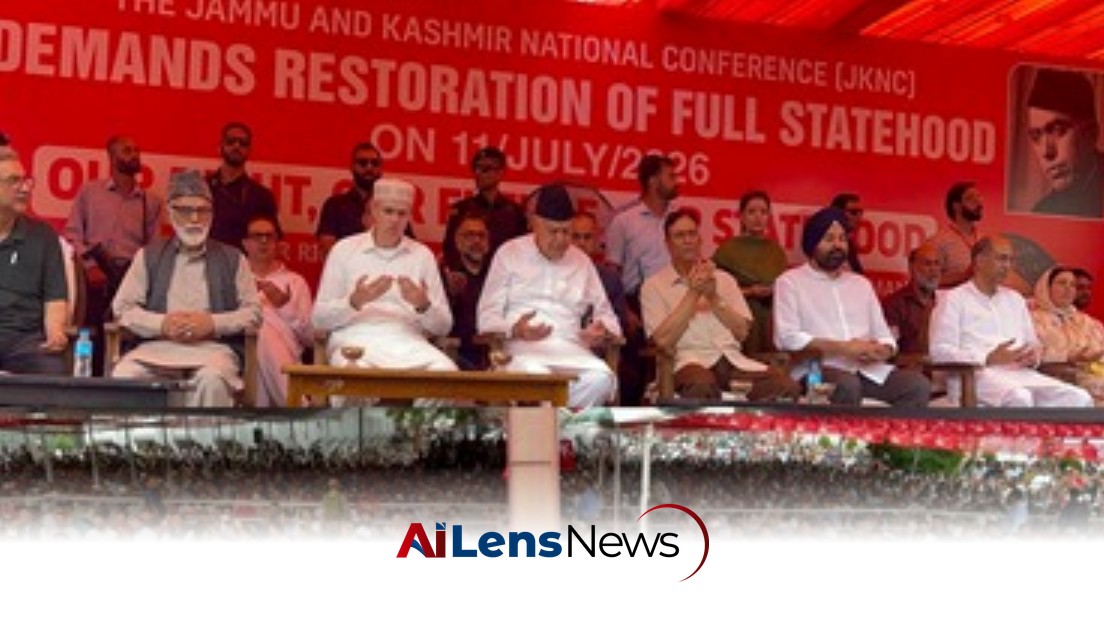


Omar Abdullah claims attempts to destabilize the National Conference government through monetary offers and promises of statehood. Protests planned for July 20.
New Delhi, India Jul 11, 2026 ALN: Chief Minister Omar Abdullah on Saturday alleged that attempts were being made to destabilise the National Conference-led government by luring its legislators with huge monetary offers, ministerial positions, and promises linked to the restoration of statehood. This claim comes at a time when the political landscape in Jammu and Kashmir is particularly sensitive, following significant changes in the region's governance structure in recent years.
The National Conference (NC), a major political party in Jammu and Kashmir, has a storied history dating back to its founding in 1932. The party has traditionally advocated for the rights and interests of the people of Jammu and Kashmir, and it has played a pivotal role in the region's politics, particularly during and after the tumultuous events of the late 20th century, including the insurgency that began in the late 1980s. The party's leadership has often emphasized the importance of maintaining a democratic framework in the region and has been vocal about the need for restoring statehood following its revocation in 2019.
Addressing party workers during the 26th death anniversary of Begum Akbar Jehan Abdullah, popularly known as Madar-e-Meharban, at Hazratbal, Omar claimed that one of the National Conference legislators from Jammu was offered between Rs 20 crore and Rs 30 crore, along with a ministerial berth and assurances regarding statehood, in return for quitting the party. This allegation reflects a broader concern within the National Conference about the integrity of its members and the pressures they face from rival political factions.
"They are once again trying to break the National Conference. I have been told that one of our MLAs from Jammu was offered Rs 20 to Rs 30 crore, a ministerial berth and a promise of statehood if he joined them. They think people's conscience can be bought so cheaply," Omar alleged. This statement underscores the ongoing political maneuvering in the region, where financial inducements are not uncommon in efforts to sway political allegiances.
Omar Abdullah's assertion that no amount of money could sway the loyalty of National Conference leaders is significant. "Even if they offer Rs 100 crore to our leaders, no one in the National Conference will sell his conscience or loyalty to the party," he said. This strong declaration serves to reinforce the party's commitment to its foundational principles and its resilience in the face of external pressures.
Furthermore, Omar accused political opponents, particularly the Bharatiya Janata Party (BJP), of attempting to engineer defections instead of respecting the mandate delivered by the people during the Assembly elections. The BJP's rise in Jammu and Kashmir has been marked by a series of strategic moves aimed at consolidating power, especially after the abrogation of Article 370, which granted special status to the region. This has led to a significant shift in the political dynamics, with the NC and other regional parties feeling increasingly marginalized.
The Chief Minister stated that the National Conference had exercised restraint despite repeated delays in restoring Jammu and Kashmir's statehood, but cautioned against interpreting the party's patience as weakness. "Our patience is not our weakness; it is our strength. But if anyone mistakes it for surrender, they are mistaken," he said. This statement reflects a determination to maintain a strong political stance while advocating for the rights of the people of Jammu and Kashmir.
Omar reiterated that the restoration of statehood remains the party's foremost political demand, a sentiment that resonates with many residents who feel disenfranchised following the central government's decision to reorganize the region. The National Conference has been vocal about the need for a return to a statehood status that would allow for greater local governance and autonomy, issues that have become central to the party's platform.
In an effort to mobilize public support for this cause, Omar announced that the National Conference would intensify its campaign through peaceful and democratic means. He called upon party workers and supporters to hold protests at all district headquarters across Jammu and Kashmir on July 20 to press for the restoration of statehood. This grassroots mobilization strategy aims to engage the local population and demonstrate the party's commitment to their demands.
Additionally, Omar mentioned that the party was also planning to stage a protest at Jantar Mantar in New Delhi on the same day, but added that permission from the authorities was still awaited. The choice of Jantar Mantar, a prominent site for political demonstrations in the Indian capital, indicates the party's intention to draw national attention to the issue of statehood and the broader concerns affecting Jammu and Kashmir.
In his address, Omar also took the time to recall the contribution of Begum Akbar Jehan Abdullah, highlighting her unwavering support for the National Conference during some of the most difficult periods in Jammu and Kashmir's political history. He emphasized the values of patience, resilience, and commitment to democratic principles that she embodied, which continue to inspire the party's current leadership.
"Our demand is simple — restore the statehood of Jammu and Kashmir. We will continue to raise our voice peacefully until justice is delivered," Omar concluded. This statement encapsulates the National Conference's ongoing struggle for recognition and autonomy within the Indian political framework. As the party prepares for upcoming protests and continues to advocate for its demands, the political climate in Jammu and Kashmir remains charged, with implications that extend beyond the region and into the national political discourse.
The future of Jammu and Kashmir's political landscape will largely depend on how these tensions unfold, particularly in light of the National Conference's efforts to maintain its relevance and the BJP's strategic positioning in the region. The dynamics of power, loyalty, and public sentiment will play critical roles in shaping the next chapter of Jammu and Kashmir's governance and political identity.
To learn more about the latest developments in Political Controversies, stay updated with our exclusive reports and analyses on AiLensNews.

