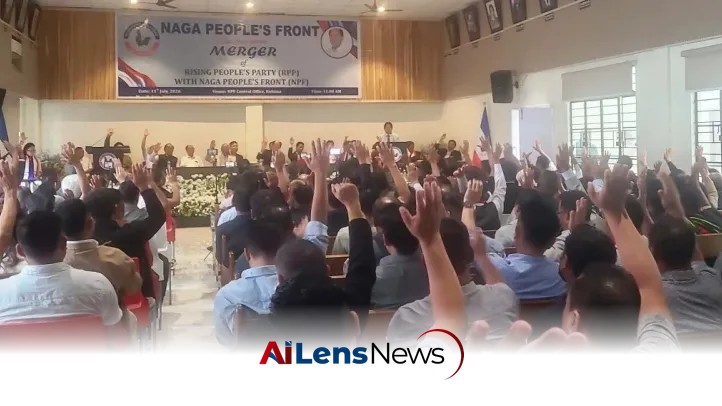


The Rising People's Party has officially merged with the Naga People's Front, marking a significant step towards Naga unity and political strength.
Kohima, India Jul 11, 2026 ALN: EC to be notified
Kohima | July 11
In a significant political development, the Rising People’s Party (RPP) has officially merged with the Naga People’s Front (NPF), a move that could reshape the political landscape in . The announcement was made in Kohima on July 11, marking a pivotal moment not only for the two parties involved but also for the broader Naga community. This merger comes at a time when regional political dynamics are increasingly critical to addressing the aspirations and challenges faced by the Naga people.
NPF Secretary General Achumbemo Kikon heralded the merger as a momentous occasion, stating, “Today marks another very important, significant occasion for the party in particular and for the Nagas in general.” His remarks underscored the broader intention behind the merger: to foster unity and reconciliation among the Naga populace. The historical context of Naga politics is marked by a desire for greater autonomy and recognition of their unique cultural identity, and Kikon's comments reflect an acknowledgment of these aspirations.
Kikon elaborated on the motivations behind the merger, explaining that the RPP responded positively to the NPF’s call for unity among like-minded regional political parties. He indicated that the decision to merge was driven by a shared commitment to strengthening regional identity and creating a more robust voice on critical issues, particularly concerning the ongoing Naga political situation. This is particularly pertinent as the Naga peace talks, which have been ongoing for several years, continue to seek a resolution that honors the aspirations of the Naga people.
“I now declare that the merger of the RPP to NPF is officially confirmed and it is legitimate,” Kikon stated, assuring that all constitutional requirements for the merger had been fulfilled. He confirmed that the merger would be communicated to the Election Commission of India, signaling the formalization of this political alliance.
The merger was accepted by the House through a show of hands, a demonstration of support that reflects the prevailing sentiment among party members. Following this, NPF Working President Pusazo Luruo administered oaths to five former RPP leaders, marking their official transition into their new roles within the NPF. The leaders included Joel Naga and Vitho Zao, who were appointed as Vice Presidents, Amai Chingkhu as General Secretary, Likhro Kreo as Secretary, and Zhokhoi Chuzho as Vice President of the Central Youth Wing. This reshuffling of leadership is indicative of the NPF’s strategy to incorporate fresh perspectives while maintaining continuity in its leadership structure.
Chief Minister and NPF President Dr. Neiphiu Rio welcomed the merger, describing it as a step towards “unity and oneness” among the Naga people. His assertion that every act of unity strengthens the collective Naga voice reflects a long-standing goal of the Naga community to present a united front in political negotiations and discussions. Dr. Rio emphasized the importance of collaboration among various factions within the Naga society, stating, “It is only through unity we can reach our destination.” This sentiment resonates deeply within the context of Naga politics, where fragmentation has often hampered collective efforts toward achieving political goals.
Dr. Rio's remarks also highlight the significance of merging two political organizations that have historically represented different facets of Naga interests. The NPF, which has been a prominent player in 's political arena since its establishment in 1963, has consistently championed the cause of Naga identity, tradition, and unity. This merger with the RPP, which has sought to address contemporary issues facing the Naga people, represents a strategic alignment that could potentially amplify their collective voice in regional and national discussions.
RPP President Joel Naga characterized joining the NPF as a privilege rather than a right, reinforcing the respect and recognition the RPP holds for the NPF's historical significance. He noted that the NPF has been a longstanding advocate for “Nagaism,” a term that encapsulates the cultural and political aspirations of the Naga people. This historical context is crucial for understanding the motivations behind the merger, as the RPP concluded that aligning with the NPF was a strategic move in light of the NPF's established presence and influence.
Following the merger of the Nationalist Democratic Progressive Party (NDPP) and NPF last October, the RPP recognized the potential for greater collaboration under the leadership of CM Neiphiu Rio. This decision reflects a broader trend in regional politics where smaller parties seek to consolidate power and influence by aligning with larger, more established entities. Joel Naga articulated this sentiment, stating, “NPF is not merely a political party but a Naga institution, the edifice upon which Naga unity will be built and Naga aspiration fulfilled.” This framing positions the NPF not just as a political actor, but as a custodian of Naga identity and aspirations.
NPF President Emeritus and Advisor to the Chief Minister, Chingwang Konyak, expressed optimism that the merger would further strengthen the NPF at all levels. His call for party members to maintain discipline and cohesion within the grassroots is particularly important in the context of a merger, where integrating diverse perspectives and maintaining a unified direction can be challenging. The emphasis on discipline suggests a recognition of the need for a clear organizational structure and shared goals as the NPF seeks to navigate the complexities of regional politics.
Apong Pongener, an Advisor to the NPF President and CM, highlighted the significance of unity in serving the Naga people. He noted the NPF's current strength, with 34 MLAs, which positions the party favorably in the political landscape of . His call for like-minded regional parties to join forces with the NPF underscores a strategic vision for consolidating regional power to protect the unique Naga identity amidst national political dynamics that often overlook regional concerns.
Pongener also announced that the NPF will celebrate its 64th Foundation Day on October 21, 2026. This milestone will mark its status as the oldest registered regional party in Northeast India and the second oldest in the country, following the Dravida Munnetra Kazhagam (DMK). Such celebrations not only commemorate the party's history but also serve as an opportunity to rally support and reinforce its commitment to the Naga cause.
The program was chaired by NPF Working President Ahovi Zhimomi, with a vote of thanks delivered by Charlie Sekhose, Senior Vice President of the NPF. The collaborative spirit evident in the proceedings reflects a concerted effort to build a unified front as the newly merged party moves forward. As the NPF and RPP embark on this new chapter together, the implications for Naga politics will be closely observed, particularly regarding how this merger influences the ongoing discourse around Naga identity and autonomy.
To learn more about the latest developments in Political Parties, stay updated with our exclusive reports and analyses on AiLensNews.

