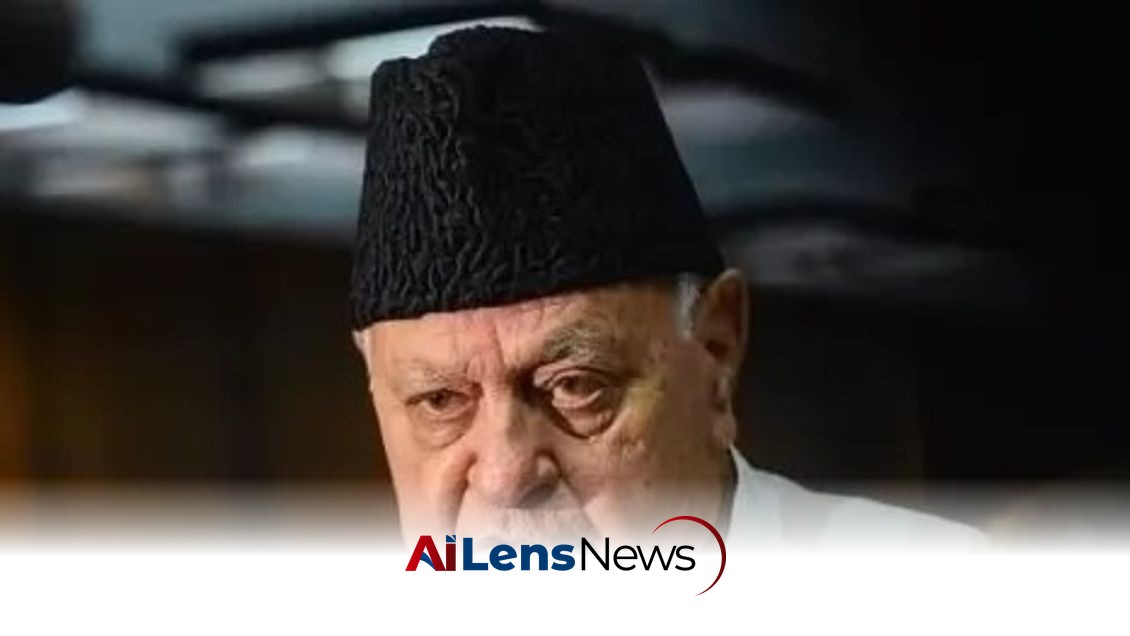


Dr. Farooq Abdullah criticizes New Delhi for failing to uphold promises made to Jammu and Kashmir, emphasizing the need for trust and dignity.
New Delhi, India Jul 11, 2026 ALN: National Conference President Dr. Farooq Abdullah on Saturday accused successive governments in New Delhi of repeatedly breaking promises made to Jammu and Kashmir. His remarks were made during a gathering commemorating the 26th death anniversary of Begum Akbar Jehan Abdullah, who is affectionately referred to as Madar-e-Meharban, at Hazratbal. This event not only pays homage to a significant figure in the region's political history but also serves as a platform for discussing ongoing political issues affecting Jammu and Kashmir.
Dr. Farooq Abdullah, a prominent political figure in Jammu and Kashmir, has a long history of engaging with the complexities of the region's political landscape. His comments reflect a broader sentiment among many residents of Jammu and Kashmir who feel disillusioned with the central government's approach to the region. Addressing National Conference workers, he recalled assurances made by former Prime Minister P.V. Narasimha Rao regarding Article 370, which grants special autonomy to Jammu and Kashmir. Dr. Farooq's interactions with various Prime Ministers over the years illustrate an ongoing dialogue about the status of the region and its relationship with the rest of India.
Article 370 has been a focal point of contention and debate since it was first enacted in 1949. It was intended to provide Jammu and Kashmir with a degree of autonomy, allowing it to maintain its own laws and governance structures. However, Dr. Farooq asserted that despite the promises made by successive governments, the trust deficit between Delhi and Kashmir has only widened. His statement underscores a critical issue: the perception that the central government has not only failed to uphold its commitments but has actively sought to undermine the special status that Jammu and Kashmir has traditionally enjoyed.
Dr. Farooq's assertion that every government in New Delhi since 1947 has promised justice to Jammu and Kashmir, yet has failed to deliver, resonates with many in the region who feel that their rights have been consistently overlooked. He alleged that whenever the Centre found an opportunity, it weakened Jammu and Kashmir’s constitutional position by eroding Article 370. This claim reflects a broader concern among the populace about the potential loss of their unique identity and rights within the Indian Union.
In his speech, Dr. Farooq recalled a significant moment during his meetings with former Prime Minister P.V. Narasimha Rao, who famously stated, "the sky is the limit" regarding the Centre's commitment to addressing the shortcomings related to Article 370. This historical context highlights the expectations that were set and the subsequent disappointment felt by many in Jammu and Kashmir when those expectations were not met. Dr. Farooq’s declaration that "We never asked for independence. We are a part of this country and we want to strengthen it, not weaken it" emphasizes a desire for integration within India while advocating for the preservation of rights and autonomy.
Dr. Farooq highlighted the significant challenge of rebuilding trust between New Delhi and the people of Jammu and Kashmir. He recounted a meeting convened by Prime Minister Narendra Modi after the constitutional changes, where he candidly expressed that both parties lacked trust in each other. His acknowledgment of this trust deficit illustrates a critical barrier to effective governance and dialogue in the region. Despite Modi’s assurances of reducing the distance between Delhi and Kashmir, Dr. Farooq expressed skepticism about any real progress, stating, "I do not see that distance reducing even today." This sentiment reflects a broader frustration felt by many in the region regarding the perceived lack of genuine engagement from the central government.
Dr. Farooq emphasized the need for the people of Jammu and Kashmir to receive the same dignity and respect as every other citizen of India. His statement, "We are also human beings. We are also the crown of India. We also have our dignity," is a powerful reminder of the human aspect of political discourse, highlighting how issues of identity, respect, and dignity are central to the ongoing struggle for rights in the region.
Supporting Chief Minister Omar Abdullah’s remarks regarding the restoration of statehood, Dr. Farooq noted that National Conference leaders have consistently raised Jammu and Kashmir's concerns with the Centre. However, he lamented that the promises made over the years have remained unfulfilled. This ongoing struggle reflects a deep-seated desire for autonomy and recognition within the framework of Indian democracy. Dr. Farooq expressed that the party had not lost hope and would continue its peaceful and democratic struggle for the restoration of the people’s rights, indicating a commitment to non-violent political engagement despite the challenges faced.
In a pointed critique of political rivals, Dr. Farooq accused certain leaders of speaking differently in Delhi compared to their rhetoric in Jammu and Kashmir. This observation highlights a perceived duplicity in political discourse, where leaders may align their messages based on their audience, potentially undermining the trust of their constituents. He urged these leaders to prioritize the interests of the people over personal gains, questioning their commitment to the dignity of Jammu and Kashmir.
Dr. Farooq rejected criticism of the Omar Abdullah-led government, asserting that no administration could have achieved more under the prevailing circumstances. His defense of the government’s efforts to improve public infrastructure, including schools, colleges, hospitals, and roads, underscores the ongoing challenges faced by the region in terms of development and governance.
Additionally, Dr. Farooq alleged that there have been repeated attempts to weaken the National Conference, recalling significant political developments from 1984 and after the 2014 elections. These historical references serve to contextualize the ongoing political struggles within Jammu and Kashmir, illustrating how past events continue to shape the current political landscape. He asserted that such efforts had failed in the past and would likely fail again, reinforcing a sense of resilience among his supporters.
Dr. Farooq concluded his remarks by emphasizing that the people of Jammu and Kashmir are not asking for charity but are demanding the restoration of their rightful entitlements. His statement, "We are not beggars. We are asking for our right. Give us back our rights," encapsulates a broader demand for justice and recognition within the Indian state. His emphasis on rights rather than charity reflects a desire for equality and dignity within the framework of Indian democracy.
Ultimately, Dr. Farooq Abdullah's remarks underscore the complexities of the political situation in Jammu and Kashmir, where issues of identity, autonomy, and trust remain deeply intertwined. He articulated a vision for lasting peace that hinges on justice, dignity, and the fulfillment of promises made to the people of the region. His confidence in the ongoing democratic struggle suggests that despite the challenges ahead, there is a belief among his supporters that their efforts will ultimately succeed in achieving the rights and recognition they seek within India.
To learn more about the latest developments in Political Controversies, stay updated with our exclusive reports and analyses on AiLensNews.

