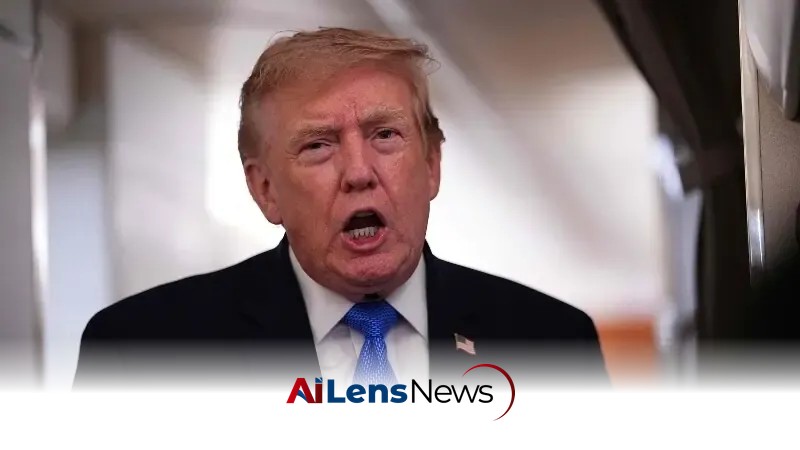



US President Donald Trump has announced the start of new negotiations with Iran, focusing on the Strait of Hormuz and the denuclearization of Iran, following a decision to halt military strikes.
Islamabad, Pakistan Aug 3, 2026 ALN: The ongoing conflict between the United States and Iran has reached a pivotal moment as US President Donald Trump announced that new negotiations with Iran would commence on Monday. This decision comes amidst a war that has persisted for almost six months, following a series of military strikes initiated by the US and Israel against Iranian targets. The announcement of negotiations represents a significant shift in strategy, as Trump had previously threatened to escalate military actions against Iran, particularly targeting its energy infrastructure.
During a press conference held aboard Air Force One, Trump communicated that the upcoming discussions would focus primarily on the Strait of Hormuz, a critical maritime corridor for global energy supplies. The strait is a vital passage for oil tankers, with approximately 20% of the world's oil trade transiting through this narrow waterway. The security of this route has become increasingly precarious due to military tensions, with recent reports of explosions near tankers further underscoring the volatility of the region.
In light of this instability, oil prices experienced a notable decline on Monday, with West Texas Intermediate dropping by 4.7 percent to $80.72 per barrel. This price fluctuation reflects the market's sensitivity to geopolitical developments, particularly those affecting oil supply routes. The decline in oil prices could have broader implications for the global economy, especially for countries heavily reliant on oil exports and imports.
The backdrop to the current negotiations is a history of fluctuating diplomatic relations between Washington and Tehran. The conflict escalated on February 28, when the US and Israel launched surprise strikes against Iranian military assets. This marked the beginning of a war that has seen intermittent periods of relative calm interspersed with renewed hostilities. The complexity of the situation is compounded by the fact that both nations have engaged in on-and-off diplomacy, attempting to reach agreements that could stabilize the region.
In recent weeks, fears of escalating violence have been palpable, particularly after a return to strikes against Iranian positions. Trump had previously warned of a significant military response, stating that he was contemplating a series of attacks that could be described as "the biggest attack since World War II." In light of these threats, US embassies across the Middle East were placed on high alert, reflecting concerns over potential retaliatory actions from Iran.
However, in a surprising turn of events, Trump announced his decision to pursue negotiations instead of immediate military action. He noted that the parameters for a potential deal were already established and that the US was prepared to engage in dialogue with Iranian representatives. The president did not disclose specific details regarding the venue or participants involved in the upcoming talks, leaving many questions unanswered about the structure and scope of the negotiations.
In response to Trump's announcement, Iranian officials have expressed skepticism regarding the claims that Tehran requested the US to hold off on military strikes. Iranian media outlets have denied that any such request was made, indicating a divergence in narratives between the two nations. This discrepancy highlights the challenges of communication and trust that persist in US-Iran relations.
Previously, a ceasefire agreement aimed at reopening the Strait of Hormuz fell through, leading to increased Iranian control over the waterway. The US has maintained a firm stance against Iran's attempts to exert control over this critical maritime route, insisting that free passage must be guaranteed for all vessels traversing the strait.
Iranian lawmaker Hassan Ghashghavi, who serves as a spokesperson for the parliament's national security commission, indicated that mediators are attempting to revive a memorandum of understanding that was initially agreed upon in June. This earlier agreement was not intended as a comprehensive peace deal but rather as a framework for future negotiations. Ghashghavi emphasized that the Strait of Hormuz remains a central issue in these discussions, underscoring its significance in the broader context of US-Iran relations.
In a related development, Iranian President Masoud Pezeshkian took to social media platform X to assert the importance of compelling the US to adhere to its commitments. His remarks reflect a broader sentiment within the Iranian leadership regarding the necessity of holding the US accountable for its actions and agreements.
As the negotiations unfold, there are indications that Iran is pursuing a separate agreement with Oman regarding a new maritime route through the Strait of Hormuz. Prior to the onset of the war, vessels enjoyed free passage through this critical waterway. However, the conflict has led Iran to impose restrictions on navigation, insisting on maintaining control and charging tolls for passage—conditions that the US vehemently opposes. This dispute over maritime rights has been a significant factor in the escalation of hostilities between the two nations.
Iranian foreign ministry spokesman Esmaeil Baqaei stated that discussions with Oman are progressing towards an understanding that respects the sovereign rights of both nations involved. However, he clarified that such an agreement would not signify the reopening of the Strait of Hormuz for unrestricted maritime traffic, indicating that tensions in the region may persist even as negotiations progress.
Trade tracking firm Kpler reported a marked decrease in maritime traffic through the Strait of Hormuz, reflecting the ongoing uncertainties faced by shipping companies operating in the region. The recent explosion reported near a tanker off the coast of Oman serves as a stark reminder of the dangers that vessels encounter in these contested waters. Fortunately, it was noted that both the vessel and its crew were unharmed, but such incidents contribute to an atmosphere of fear and caution among maritime operators.
In conclusion, the upcoming negotiations between the US and Iran represent a critical juncture in a protracted conflict that has significant implications for regional stability and global energy markets. As both sides prepare to engage in dialogue, the outcome of these discussions may shape the future of US-Iran relations and the security of one of the world's most vital maritime corridors. The international community will be closely monitoring these developments, hoping for a peaceful resolution that can avert further escalation and promote stability in the region.
To learn more about the latest developments in Elections, stay updated with our exclusive reports and analyses on AILensNews.

