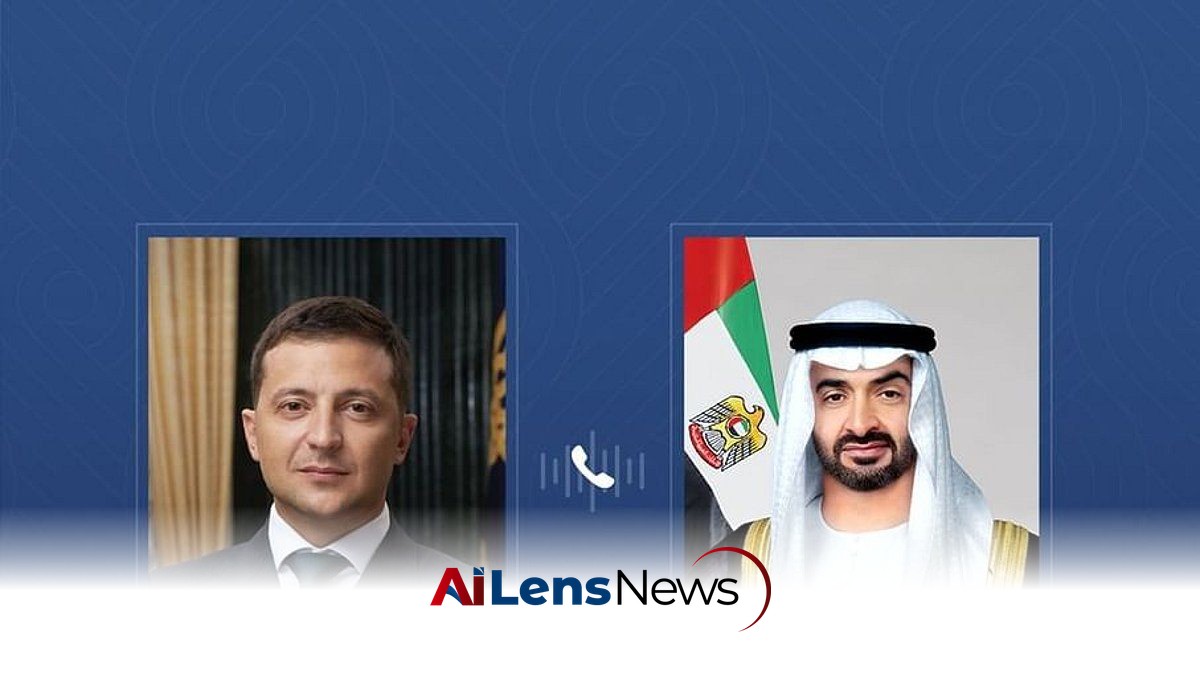



UAE President Sheikh Mohamed bin Zayed Al Nahyan and Ukrainian President Volodymyr Zelenskyy discuss cooperation and humanitarian efforts amid the ongoing Ukraine crisis.
Kuwait City, Kuwait Aug 2, 2026 ALN: Abu Dhabi: UAE President His Highness Sheikh Mohamed bin Zayed Al Nahyan received a phone call from President of Ukraine Volodymyr Zelenskyy, during which the two leaders discussed strengthening cooperation across various fields in support of mutual interests under the Comprehensive Economic Partnership Agreement between the two countries.
Sheikh Mohamed and Zelenskyy also reviewed the latest developments in the Ukraine crisis and its humanitarian implications. The ongoing conflict, which began in 2014 with Russia's annexation of Crimea and escalated dramatically in February 2022 with a full-scale invasion by Russia, has led to significant geopolitical shifts and humanitarian crises across Europe and beyond. The war has not only reshaped the political landscape in Eastern Europe but has also had far-reaching effects on global energy markets, food security, and international relations.
The conflict has resulted in thousands of casualties and displaced millions of Ukrainians, with the humanitarian situation deteriorating as winter approaches. The United Nations and various international organizations have reported on the dire conditions faced by civilians, including lack of access to basic necessities such as food, clean water, and medical care. As winter sets in, the challenges for displaced families become more acute, with many lacking adequate shelter and heating. In this context, the discussions between Sheikh Mohamed and Zelenskyy reflect the UAE's commitment to playing a constructive role in mitigating the humanitarian fallout of the conflict.
Zelenskyy thanked Sheikh Mohamed for the UAE's continued diplomatic efforts to facilitate prisoner exchanges between the Russian Federation and Ukraine, as well as its sustained focus on addressing the humanitarian aspects of the crisis.
The issue of prisoner exchanges has been a critical and sensitive aspect of the ongoing conflict. Both sides have held numerous rounds of negotiations to secure the release of captured soldiers and civilians. The UAE's involvement in these negotiations highlights its diplomatic clout and willingness to act as a mediator in complex international disputes. This role is significant, especially given the polarized nature of the conflict, where many nations have taken sides and diplomatic channels have become strained. The UAE's mediation efforts could potentially lead to a more stable situation and provide a framework for future negotiations aimed at achieving a lasting peace.
Furthermore, the Comprehensive Economic Partnership Agreement (CEPA) between the UAE and Ukraine, signed in early 2022, aims to enhance trade and investment ties between the two nations. This agreement is particularly important as both countries seek to diversify their economies and reduce reliance on traditional sectors. For Ukraine, which has been heavily affected by the war, strengthening economic ties with the UAE could provide vital support for its economy and recovery efforts. The UAE, on the other hand, is looking to expand its influence and economic partnerships in Eastern Europe, which is a region of growing strategic importance. The CEPA is expected to facilitate increased bilateral trade, investment in infrastructure, and collaboration in sectors such as technology and renewable energy.
The two leaders also exchanged views on a number of regional and international issues of joint interest, underscoring the importance of intensifying efforts to advance regional and global peace, security, and stability in support of the wellbeing and development of peoples around the world. This emphasis on collaboration reflects a broader trend in international relations where countries are increasingly seeking multilateral approaches to address global challenges, including security threats, economic instability, and climate change. The dialogue between Sheikh Mohamed and Zelenskyy serves as a reminder of the interconnectedness of global issues and the need for cooperative solutions.
The UAE's foreign policy has been characterized by a pragmatic approach that seeks to balance its relationships with major powers, including the United States, Russia, and China. This balancing act allows the UAE to position itself as a mediator in various conflicts, leveraging its diplomatic relationships to foster dialogue and negotiations. The conversation between Sheikh Mohamed and Zelenskyy is a testament to this approach, as the UAE continues to navigate the complexities of international diplomacy in a rapidly changing global landscape. By maintaining open lines of communication with both Ukraine and Russia, the UAE can play a crucial role in facilitating dialogue and reducing tensions.
In addition to its diplomatic efforts, the UAE has also provided humanitarian aid to Ukraine since the onset of the conflict. This aid has included medical supplies, food assistance, and support for displaced families. The UAE's humanitarian initiatives are aligned with its broader commitment to international development and humanitarian assistance, which has been a cornerstone of its foreign policy. The UAE's contributions to humanitarian efforts in Ukraine reflect its desire to be seen as a responsible global actor and to support those in need during times of crisis.
As the situation in Ukraine remains fluid, the role of international mediators like the UAE will be crucial in seeking a resolution to the conflict. The ongoing dialogue between Sheikh Mohamed and Zelenskyy may pave the way for further collaborative efforts, not only in addressing the immediate humanitarian needs but also in laying the groundwork for long-term peace and stability in the region. The UAE's continued engagement in this area demonstrates its commitment to fostering international cooperation and understanding.
Looking ahead, the implications of this dialogue extend beyond the immediate context of the Ukraine crisis. The UAE's active engagement in international diplomacy could enhance its reputation as a key player on the global stage, particularly in conflict resolution. By positioning itself as a neutral mediator, the UAE can strengthen its relationships with both Western nations and Russia, potentially opening doors for further economic and political partnerships. This could lead to increased investments in the UAE and bolster its status as a hub for international diplomacy and commerce.
In conclusion, the recent phone call between Sheikh Mohamed and Zelenskyy underscores the UAE's commitment to supporting Ukraine during a time of crisis. The discussions not only highlight the importance of humanitarian efforts and diplomatic mediation but also reflect the broader geopolitical dynamics at play. As the conflict continues, the UAE's role as a mediator could be pivotal in shaping the future of Ukraine and its relationships with other nations, reinforcing the significance of diplomacy in resolving complex international issues. The ongoing collaboration between the UAE and Ukraine may also serve as a model for other nations seeking to engage in constructive dialogue and support for conflict resolution initiatives worldwide.
To learn more about the latest developments in Elections, stay updated with our exclusive reports and analyses on AILensNews.

