

Javad Emam, spokesperson for the Reform Front, emphasizes the importance of national unity in enhancing Iran's global bargaining power amid complex geopolitical developments.
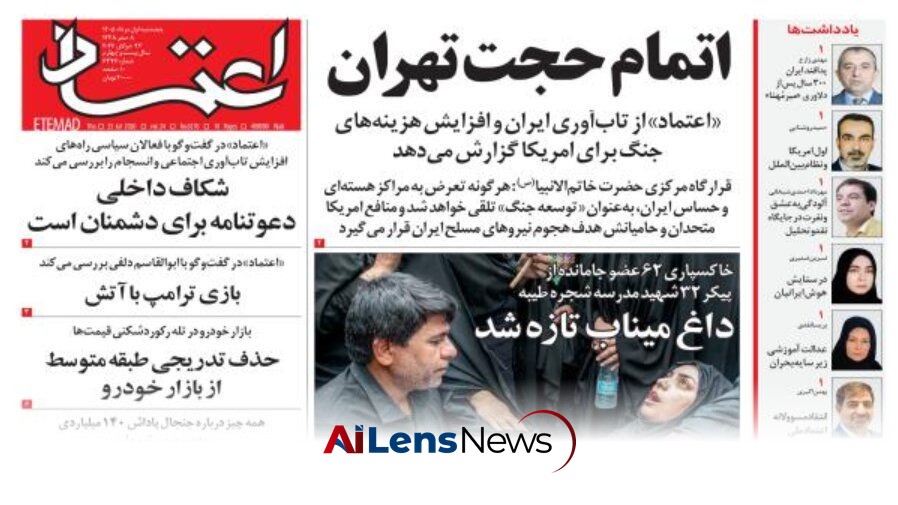
Tehran, Iran Jul 24, 2026 ALN: In a recent discussion with Etemad newspaper, Javad Emam, spokesperson for the Reform Front, emphasized the critical importance of national unity and social cohesion as a strategy to enhance Iran's bargaining power in the face of external pressures, particularly from the United States and Israel. Emam's remarks come at a time when the geopolitical landscape is rapidly shifting, and the region is experiencing complex developments that could have significant implications for security and stability.
The call for strengthening national unity is not merely a political slogan; it reflects a broader understanding of how internal dynamics can influence a country's position on the global stage. Emam articulated that the preservation of national unity is paramount, especially when faced with external threats. He posited that the foundation of national power is rooted in societal cohesion, suggesting that when a nation is united, it can respond more effectively to external pressures and maintain its sovereignty and security. This perspective aligns with historical precedents where internal discord has often led to vulnerability against external adversaries.
In the context of Iran's ongoing tensions with the United States and Israel, the notion of internal solidarity becomes even more critical. The adversarial relationship with the United States has been characterized by sanctions, diplomatic isolation, and military threats, which have compelled Iran to seek ways to bolster its defenses and assert its position in the region. Emam's assertion that national power originates from within society underscores the idea that a united populace can enhance a country's resilience against foreign adversaries and bolster its negotiating position in international forums.
Moreover, the article discusses the implications of a potential US-Saudi civilian nuclear agreement, which Shargh analyzed as a pivotal development in the geopolitical landscape. Such an agreement could serve to stabilize relations between Washington and Riyadh, especially as the ongoing conflict with Iran continues to create tensions in the region. The strategic bond between the United States and Saudi Arabia is essential not only for their bilateral relations but also for the broader dynamics of power in the Middle East.
Saudi Arabia's pursuit of a civilian nuclear program is also a response to perceived threats from Iran. The kingdom's reliance on US military support, particularly in terms of air defense capabilities, highlights the strategic calculations being made in light of Iran's military advancements. The concern among Saudi officials regarding US policies, particularly its partnership with Israel, reflects a growing unease about the shifting balance of power in the region. This unease has prompted Saudi Arabia to engage in diplomatic discussions with Iran, a move that indicates a desire to mitigate risks and navigate a complex security environment.
In the same vein, Farhikhtegan reported on the recent uptick in Iran's military operations, which have reportedly shown increased precision and effectiveness. The advancements in Iran's military capabilities, particularly in missile technology and intelligence gathering, are indicative of a broader strategy to enhance its deterrent posture. The ability to disrupt supply routes and target key infrastructure, such as the Strait of Hormuz and ports in the region, underscores Iran's commitment to safeguarding its national interests and projecting power in the face of external threats.
The closure of critical maritime routes, including the Fujairah route and the targeting of Oman’s Duqm port, exemplifies Iran's strategic approach to countering perceived aggressions. These actions not only disrupt logistical support for adversaries but also send a clear message about Iran's willingness to defend its interests aggressively. The implications of these military operations extend beyond immediate tactical gains; they signal Iran's determination to assert its influence in the region and challenge the status quo.
Furthermore, Javan's analysis of the IRGC's operations in Iraqi Kurdistan highlights the interconnectedness of regional threats and the complexities of Iran's security calculus. The presence of separatist groups and Israeli operatives in Iraqi Kurdistan presents a multifaceted challenge for Iran, as it seeks to secure its borders while countering external influences. The IRGC's military actions are part of a broader strategy to address these threats and ensure that Iran's security remains uncompromised. This approach reinforces the notion that Iran views its security as a red line that cannot be crossed, reflecting a commitment to maintaining territorial integrity and regional influence.
In this context, Arman-e-Melli's assessment of Iran's strategy against the US-Israeli adversary provides further insight into Tehran's military doctrine. The emphasis on a “step-by-step” strategy indicates a calculated approach to responding to provocations while managing the escalation of conflict. By calibrating its responses, Iran seeks to maintain the initiative in the confrontation, ensuring that it can dictate the terms of engagement and minimize the risks of excessive retaliation from its adversaries.
The escalation-ladder model referenced in the article encapsulates this strategic thinking. It suggests that Iran is adept at navigating the complexities of military engagement, allowing it to respond proportionately to threats while avoiding a full-scale conflict that could have devastating consequences. This model not only reflects Iran's military strategy but also highlights the importance of maintaining a cohesive national front in the face of external pressures.
In conclusion, the discourse surrounding national unity and social cohesion as a strategy for enhancing Iran's bargaining power in global affairs is multifaceted. As external pressures from the United States and Israel continue to mount, the emphasis on internal solidarity becomes increasingly relevant. The geopolitical landscape is evolving, with developments such as the US-Saudi nuclear agreement and Iran's military operations shaping the dynamics of power in the region. In this context, the interplay between internal cohesion and external diplomacy will play a critical role in determining Iran's future trajectory on the global stage.
To learn more about the latest developments in Elections, stay updated with our exclusive reports and analyses on AiLensNews.

