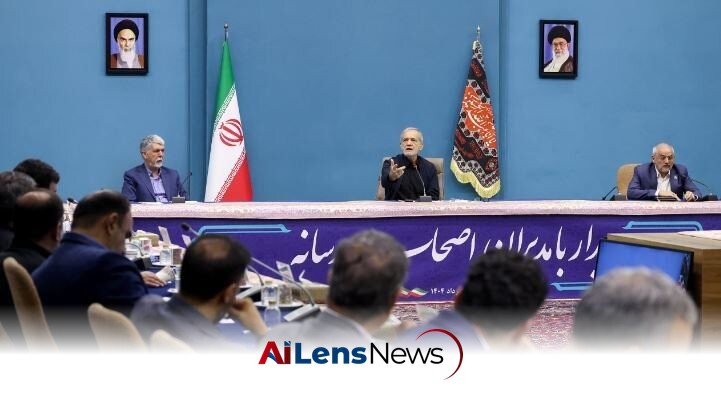


TEHRAN – President Masoud Pezeshkian has affirmed that his government will carry out all foreign policy decisions and negotiations in close coordination with the Leader of the Islamic Revolution, Ayatollah Seyyed Ali Khamenei.
Tehran, Iran Jul 21, 2026 ALN: President Masoud Pezeshkian has affirmed that his government will carry out all foreign policy decisions and negotiations in close coordination with the Leader of the Islamic Revolution, Ayatollah Seyyed Ali Khamenei. This declaration comes at a time when Iran is navigating complex international relations and facing various geopolitical challenges. The statement reflects a significant aspect of Iran's political structure, where the Supreme Leader plays a pivotal role in guiding the country's foreign policy and strategic decisions.
In his remarks during a meeting with media leaders in Tehran on Sunday, which coincided with Journalist's Day, Pezeshkian stated, "No policies concerning international relations or negotiations are pursued without the Leader’s approval." This assertion underscores the significant influence that the Supreme Leader holds over Iran’s foreign policy, a characteristic that has been a hallmark of the Islamic Republic since its establishment in 1979. The intertwining of state and religious authority in Iran means that political leaders often emphasize their alignment with the Supreme Leader to validate their decisions and maintain legitimacy.
The president emphasized that this alignment is "not just a slogan" but a core principle of his administration. "From both a scientific and ideological standpoint, I firmly believe that anything contradicting the Leader’s views must be avoided," he added, indicating a commitment to a unified approach in governance that prioritizes the Leader's directives. This reflects a broader trend in Iranian politics where the Supreme Leader's authority is seen as paramount, especially in matters of national security and foreign relations. The necessity for conformity to the Supreme Leader's views is not merely a political strategy but is also rooted in the ideological framework of the Islamic Republic.
Pezeshkian described Ayatollah Khamenei as "the pillar and foundation of the Islamic Republic," stressing that all matters should align with his guidance. This statement can be interpreted as a reaffirmation of the ideological underpinnings of the Iranian state, which is based on the principles of velayat-e faqih, or the guardianship of the Islamic jurist. This doctrine places significant power in the hands of the Supreme Leader, allowing for a centralized decision-making process that is intended to maintain the ideological purity and stability of the regime. The Supreme Leader's role is enshrined in the Iranian constitution, granting him extensive powers over military, foreign, and domestic policies, which has historically shaped the country's political landscape.
In the context of Iran's foreign policy, this alignment with the Leader’s guidance comes as the country faces a multitude of challenges on the international stage. The ongoing tensions with the United States, particularly in light of the 2015 nuclear deal, officially known as the Joint Comprehensive Plan of Action (JCPOA), have created a precarious situation for Iranian diplomacy. Following the U.S. withdrawal from the agreement in 2018 and the subsequent imposition of severe sanctions, Iran has had to navigate a landscape fraught with hostility and economic hardship. The sanctions have severely impacted Iran's economy, leading to inflation, currency devaluation, and widespread public discontent. In this context, the government's insistence on adhering to the Supreme Leader's policies may be an attempt to present a united front amid external pressures.
Moreover, the geopolitical dynamics in the Middle East, including Iran’s relationships with neighboring countries and regional powers, further complicate its foreign policy. The president's statement reflects an understanding that any deviation from the Leader's policies could exacerbate these tensions and lead to further isolation. By emphasizing the need for unity in foreign policy, Pezeshkian is likely signaling to both domestic and international audiences that the government remains steadfast in its approach despite external pressures. The complexities of Iran's relationships with countries like Saudi Arabia, Israel, and Iraq, as well as its involvement in regional conflicts, necessitate a cohesive foreign policy that aligns with the Supreme Leader's vision.
On the domestic front, the president highlighted the importance of national unity, a key focus of his government. He cautioned that weakening national cohesion would harm the country, indicating a recognition of the internal challenges that Iran faces, including economic difficulties and social unrest. "During the 12-day war, the enemy anticipated internal division and rebellion—and they continue to wait for it," Pezeshkian said. "The nation must overcome the enemy through unity and solidarity." This statement reflects a broader narrative within the Iranian leadership that emphasizes resilience and collective strength in the face of external threats. The reference to the "12-day war" likely pertains to a historical context that resonates with the Iranian populace, invoking memories of past conflicts and the importance of national solidarity during times of crisis. This narrative serves to rally support around the government and reinforce the idea that unity is essential for overcoming adversities.
Furthermore, Pezeshkian's remarks can be seen as an attempt to consolidate support within the political landscape of Iran, where factions often vie for influence. By aligning his administration closely with the Leader's guidance, he may be seeking to mitigate potential dissent and unify various political factions under a common cause. The Iranian political system is characterized by a complex interplay of various factions, including hardliners, moderates, and reformists, each with differing views on how to approach domestic and foreign issues. By emphasizing adherence to the Supreme Leader's directives, Pezeshkian may be attempting to navigate these internal divisions and present a unified front in the face of external challenges.
In conclusion, President Masoud Pezeshkian's affirmation of foreign policy alignment with Ayatollah Khamenei's guidance underscores the centrality of the Supreme Leader's authority in Iranian governance. As Iran continues to navigate a complex web of international relations and domestic challenges, the emphasis on unity and adherence to the Leader's directives may play a crucial role in shaping the trajectory of the nation’s policies. The implications of this alignment extend beyond mere rhetoric, reflecting the underlying ideological framework that governs the Islamic Republic and its approach to both foreign and domestic affairs. The commitment to a unified foreign policy approach, particularly in the face of ongoing geopolitical tensions, highlights the challenges that Iran faces as it seeks to assert its position on the global stage while maintaining internal cohesion.
To learn more about the latest developments in Elections, stay updated with our exclusive reports and analyses on AiLensNews.

