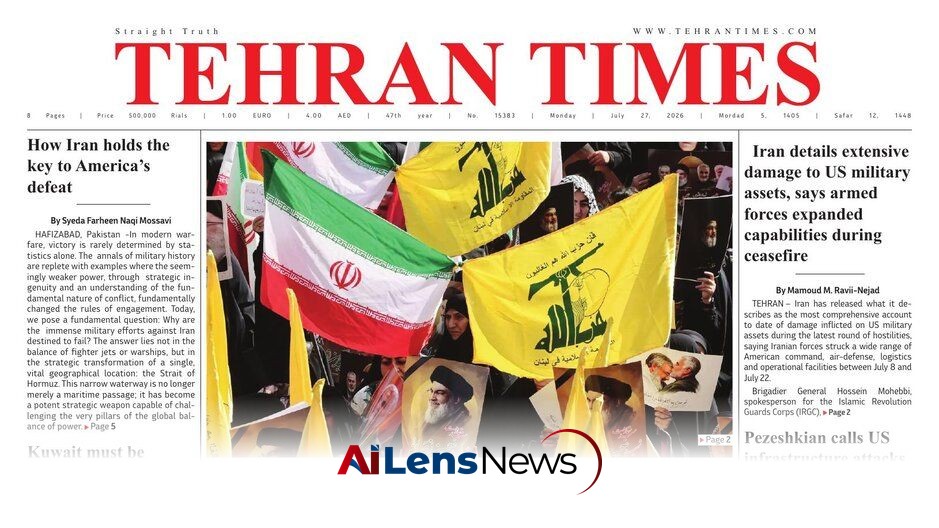


Iran emphasizes its commitment to supporting Hezbollah as a key element of its foreign policy, amidst rising tensions with the U.S. and regional adversaries.
Tehran, Iran Jul 27, 2026 ALN: In a recent statement, Iranian Supreme Leader Ayatollah Seyyed Ali Khamenei reaffirmed Iran's unwavering support for Hezbollah, framing it as a crucial aspect of the nation's strategic policy. This declaration comes at a time when Iran faces increasing pressure from the United States and its allies, who have accused Tehran of destabilizing the region through its support for militant groups. The geopolitical landscape in the Middle East is complex, with various actors pursuing their interests, often leading to heightened tensions and conflicts.
Khamenei's remarks highlight the ideological and political significance of Hezbollah in Iran's foreign policy framework. He described the group as a 'resistance force' against Western imperialism and a protector of the oppressed in the region. This narrative resonates deeply within Iran, where the government seeks to position itself as a champion of anti-imperialist movements. The support for Hezbollah is not simply a matter of military alliance; it is rooted in a broader ideological commitment to opposing foreign intervention and promoting what Iran considers legitimate resistance against perceived aggressors.
The backdrop of Khamenei's comments includes ongoing tensions between Iran and the U.S., particularly following the withdrawal of American troops from Afghanistan and the subsequent rise of the Taliban. Analysts suggest that this shift has emboldened Iran to assert its influence more aggressively in the region, particularly in Lebanon and Syria, where Hezbollah operates. The U.S. withdrawal has been interpreted by Iranian leaders as a sign of American weakness, potentially allowing Iran to expand its regional footprint.
Furthermore, the U.S. has ramped up its military presence in the Gulf, citing threats from Iran and its proxies. This has led to heightened fears of a potential conflict, with both sides engaging in a war of words and military posturing. The presence of U.S. naval forces in the Persian Gulf and the deployment of additional troops to nearby bases have been framed by Washington as necessary measures to counter Iranian aggression. In turn, Iran has responded by increasing its rhetoric against U.S. interests in the region, warning of dire consequences should its sovereignty be threatened.
Hezbollah, which has been a significant player in Lebanese politics and a formidable military force, serves as a critical ally for Iran in its efforts to project power in the Middle East. The group has been involved in various conflicts, including the Syrian Civil War, where it has fought alongside Iranian forces and the Assad regime. This involvement has allowed Iran to maintain a foothold in Syria, which is strategically important for its access to Lebanon and the Mediterranean Sea.
Iran's support for Hezbollah is not merely military; it also includes financial aid and training, which have allowed the group to enhance its capabilities significantly. This relationship is viewed by many in the West as a direct challenge to U.S. interests and those of its allies in the region. The U.S. has designated Hezbollah as a terrorist organization, citing its involvement in attacks against American and Israeli targets. This designation complicates the dynamics of U.S.-Iran relations, as any support for Hezbollah is interpreted as a direct affront to U.S. policy and objectives in the Middle East.
The international community has reacted with concern to Iran's steadfast support for Hezbollah. Critics argue that this support undermines efforts to stabilize the region and poses a threat to Israel, which views Hezbollah as one of its primary adversaries. The Israeli government has consistently expressed alarm over Hezbollah's military capabilities, particularly its missile arsenal, which poses a direct threat to Israeli cities.
In response, Israel has conducted numerous airstrikes in Syria targeting Iranian positions and Hezbollah assets, further escalating tensions. The situation remains precarious, with the potential for miscalculations leading to broader conflict. The risk of a direct confrontation between Israel and Iran, facilitated by Hezbollah's actions, raises alarms among regional and global powers. Such a conflict could draw in various actors, potentially leading to a wider war that could destabilize the entire region.
As Iran continues to assert its influence through groups like Hezbollah, the implications for regional stability are profound. Khamenei's recent statements serve as a reminder of Iran's commitment to its allies and its determination to counter U.S. policies in the Middle East. The ongoing geopolitical chess game in the region will likely see further developments as both sides navigate this complex landscape. The interplay of local grievances, international rivalries, and ideological commitments will continue to shape the future of Iran's relationships with Hezbollah and other regional actors.
In summary, Iran's support for Hezbollah is emblematic of its broader strategy to challenge U.S. influence in the Middle East while promoting its vision of resistance against Western powers. The implications of this strategy extend beyond the immediate conflict dynamics and into the realms of international diplomacy, regional alliances, and the future of Middle Eastern geopolitics. As the situation evolves, the international community will be closely monitoring the developments, seeking to mitigate the risks of escalation while addressing the underlying issues that fuel these tensions.
Moreover, Iran's backing of Hezbollah can be seen as part of a larger narrative in which Tehran positions itself as a leader of resistance movements across the region. This narrative not only strengthens its domestic political standing but also enhances its influence over various non-state actors who share a similar ideological framework. Such dynamics complicate the efforts of regional and global powers to address conflicts in Lebanon, Syria, and beyond, as they must navigate a landscape where Iran's strategic partnerships play a crucial role.
In the context of the broader Middle Eastern geopolitical landscape, the relationship between Iran and Hezbollah exemplifies the challenges faced by countries attempting to exert influence while managing complex alliances. The ongoing tensions between Iran and the U.S. and its allies, particularly Israel, highlight the precarious balance of power in the region. As military capabilities continue to evolve and the stakes increase, the potential for conflict remains a pressing concern for policymakers and analysts alike.
Ultimately, the situation requires careful diplomacy and engagement from all parties involved. While military posturing may dominate headlines, the underlying issues—such as economic disparities, governance challenges, and the quest for sovereignty—must be addressed to achieve lasting peace and stability in the region. The international community's ability to facilitate dialogue and foster understanding among these diverse actors will be critical in shaping the future trajectory of Middle Eastern geopolitics.
To learn more about the latest developments in Elections, stay updated with our exclusive reports and analyses on AiLensNews.

