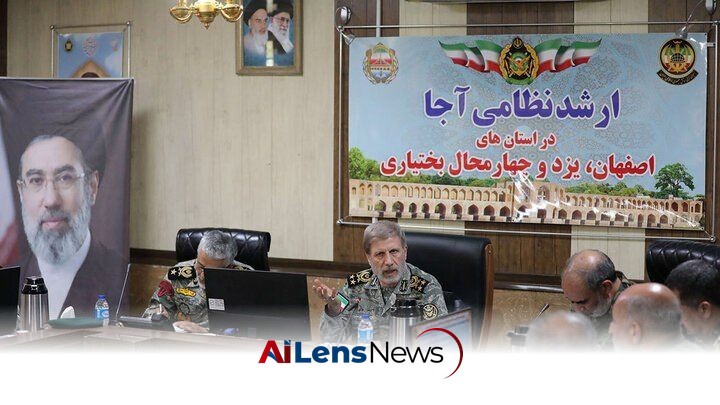


Iran's Army Commander Maj. Gen. Amir Hatami asserts that Tehran has 'not an iota of trust' in its adversaries, emphasizing military preparedness against ongoing threats.
Tehran, Iran Jul 23, 2026 ALN: Iran's Army Commander-in-Chief Maj. Gen. Amir Hatami stated that Tehran has "not even an iota of trust" in its adversaries, accusing them of conducting both military and psychological campaigns against Iran. He insisted that the country's armed forces remain fully prepared for future threats.
Hatami made these remarks during an inspection of Army grounds, air defense, and air force units in the central province of Isfahan, where he assessed operational readiness and addressed military commanders. This inspection comes at a time of heightened tensions in the region, particularly concerning Iran's relationships with the United States and its regional allies.
The backdrop of Hatami's statements is critical to understanding the current geopolitical climate. Iran has faced significant pressure from various nations, particularly following its controversial nuclear program and its involvement in regional conflicts such as those in Syria and Yemen. The Iranian leadership perceives these pressures as part of a broader strategy by adversaries to destabilize the country and undermine its sovereignty.
In discussing the ongoing conflict, Hatami asserted that Iran believes its adversaries seek more than temporary military gains. According to him, their ultimate objective is to weaken the Islamic Republic, undermine national unity, and ultimately bring about the country's disintegration. This perspective reflects a long-standing narrative within Iranian political discourse, which often characterizes foreign interventions as existential threats to the nation.
Hatami emphasized that the Iranian people have resisted these efforts, drawing a parallel to their stand against Iraq during the 1980–1988 Iran-Iraq War, adding that the alleged objectives of Iran's enemies have failed. This reference serves to evoke national pride and resilience, reminding citizens of their historical capacity to withstand external pressures. The Iran-Iraq War is a pivotal event in Iranian history, shaping the national identity and military doctrine of the country.
During his address, Hatami praised the performance of the Iranian armed forces, including both the Army and the Islamic Revolution Guard Corps (IRGC), stating they had executed successful operations during recent conflicts. The IRGC, in particular, has been a central figure in Iran's military strategy, often engaging in asymmetric warfare and supporting proxy groups across the region. This support has drawn criticism and concern from various nations, especially the United States and its allies, who view it as a destabilizing factor in the Middle East.
Hatami specifically noted that an Iranian Air Force F-5 fighter successfully struck a military base protected by Patriot air defense systems, which hosted F-15 and F-16 fighter jets, before returning safely to base. This incident highlights the ongoing technological arms race in the region, where both sides continually seek to enhance their military capabilities. During this incident, opposing forces mistakenly shot down three of their own F-15 aircraft, an event that may raise questions about operational security and the effectiveness of their defense systems.
The army chief also referred to comments made by the chairman of the US Joint Chiefs of Staff, who acknowledged that US helicopters flying over Iran were fired upon by civilians using available weapons. Hatami interpreted this as evidence that any attempt to deploy foreign ground forces in Iran would face widespread public resistance. This assertion underscores the complex relationship between the Iranian government and its populace, where nationalistic sentiments can be mobilized against perceived foreign aggressions.
Addressing the broader confrontation, Hatami argued that the conflict extends beyond the battlefield. He accused Iran's adversaries of conducting a coordinated campaign through military operations, media coverage, cyberspace, and psychological warfare aimed at weakening public morale and creating despair among the Iranian population. This claim reflects a significant concern within the Iranian leadership about the impact of external narratives and information warfare on domestic stability.
"We do not trust this enemy," Hatami declared. "We never expected it to honor its commitments, and for that reason we did not lose a single moment in strengthening our combat readiness." This statement reinforces the Iranian military's focus on self-sufficiency and preparedness, particularly in light of sanctions and international isolation that have restricted access to advanced military technology.
He stated that Iran's armed forces have continued to enhance their military capabilities throughout the crisis, expressing confidence that the country will overcome current challenges. This commitment to military enhancement is evident in Iran's ongoing development of missile technology and drone capabilities, which have been showcased in various military parades and exercises. These advancements have raised alarms among neighboring countries and the international community, as they suggest an increasingly capable Iranian military.
Hatami concluded that, in his view, Iran's adversaries will ultimately fail to achieve their objectives and regret their actions. This sentiment reflects a broader narrative within Iranian political rhetoric that emphasizes resilience and the inevitability of victory against foreign pressures. Such statements are crucial for maintaining domestic support and fostering a sense of unity among the Iranian populace in challenging times.
In summary, Maj. Gen. Amir Hatami's remarks underscore the Iranian military's stance of vigilance and preparedness in the face of perceived threats from adversaries. The historical context of Iran's conflicts, coupled with the current geopolitical dynamics, shapes the military's approach to national security. As tensions continue to simmer in the region, Iran's commitment to its military readiness and the narrative of resistance against foreign intervention remain central to its defense strategy.
To learn more about the latest developments in Political Controversies, stay updated with our exclusive reports and analyses on AiLensNews.

