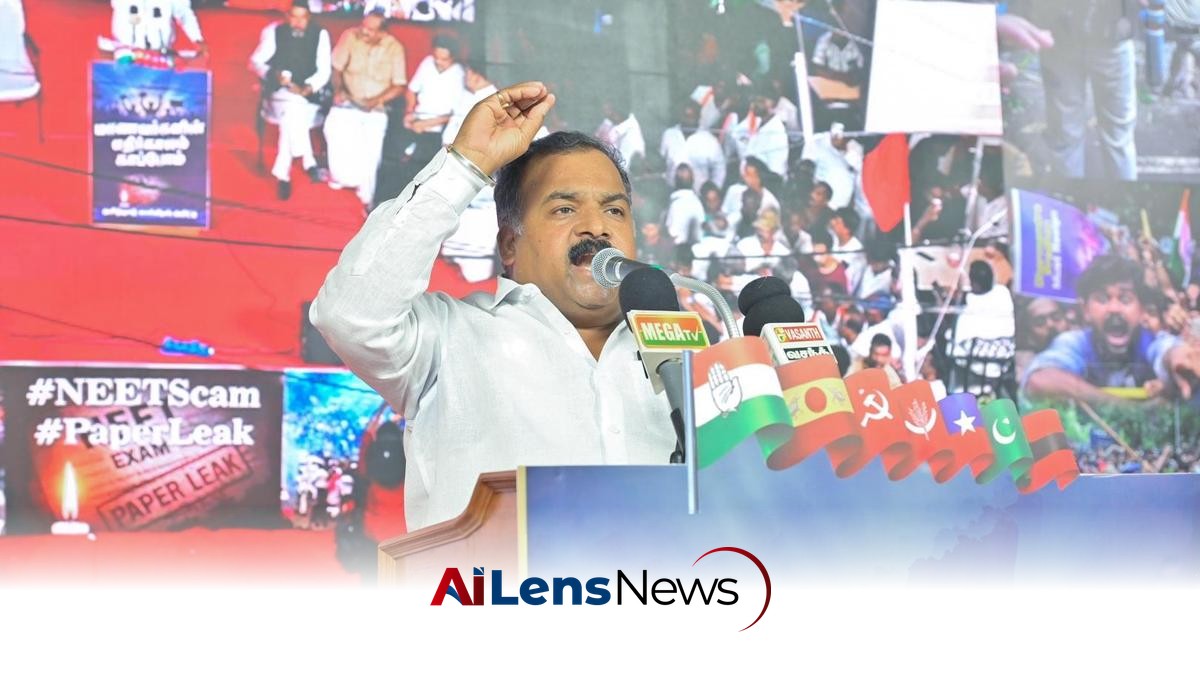


During a public meeting in Chennai, TNCC President Manickam Tagore criticized PM Modi and the DMK for their handling of student issues, particularly regarding NEET.
Chennai, India Jul 26, 2026 ALN: The Congress Committee held a significant public meeting in T. Nagar, Chennai, which served as a platform for expressing dissent against recent police actions directed at young students and protesters in New Delhi. This gathering was not only a protest but also a call to action, aiming to demand the resignation of Union Minister Dharmendra Pradhan, who has been under scrutiny for his role in the mismanagement of the National Eligibility cum Entrance Test (NEET). The event saw participation from various political allies, highlighting a unified front among opposition parties against the current government’s policies.
At the forefront of the meeting was TNCC President Manickam Tagore, who took the opportunity to deliver a scathing critique of the Dravida Munnetra Kazhagam (DMK) party. He particularly pointed out that the Communist Party of India (Marxist) or CPI(M) was the only political entity that proactively reached out to the families of students who tragically took their own lives amid the pressures associated with the NEET examination. This issue has garnered attention due to the alarming number of student suicides linked to the exam's high stakes and the emotional toll it takes on aspirants.
Tagore presented sobering statistics regarding the NEET examination, stating that approximately 174,000 aspirants register for this critical test, but only 74,000 manage to qualify. Of this pool, merely 13,000 students can secure admission into medical colleges, a situation that has led to immense pressure among students. He referenced a particularly distressing statistic: this year alone, 21 students reportedly took their own lives, with four confirmed cases of suicide directly attributed to the stress of the examination process. Tagore lamented the lack of timely intervention from the opposition, stating, "The only party that met the families before we did was the CPI (M). Where is the Opposition party leader now?" His comments underscore the emotional and psychological burden faced by students who often attempt the exam multiple times, leading to heightened anxiety about their futures.
In his address, Tagore called for Dharmendra Pradhan to resign, asserting that he should take moral responsibility for what he termed the NEET fiasco. His criticism extended beyond Pradhan to include the Rashtriya Swayamsevak Sangh (RSS) and the Bharatiya Janata Party (BJP), which he accused of lacking moral integrity and evading accountability for their actions. He remarked, "Whenever people protested against them, they retreated. They may appear fierce, but if you raise your voice, they fold," citing the government's retreat on contentious issues such as the Farm Laws and the Land Acquisition Bill as evidence of their inability to withstand public dissent.
Tagore also highlighted the ongoing concerns regarding the integrity of examination processes, mentioning that Lok Sabha Opposition leader Rahul Gandhi has consistently raised alarms about paper leaks. He expressed skepticism about Prime Minister Narendra Modi's ability to empathize with the plight of students, suggesting that Modi's own lack of formal education prevents him from understanding the struggles faced by young aspirants. Tagore pointed out that while opposition parties like CPI(M) and VCK have actively participated in protests, the DMK and AIADMK have remained conspicuously silent on these pressing issues.
Adding to the discourse, CPI(M) MP Su. Venkatesan emphasized the significance of the protests that have unfolded over the past 12 years, noting that students have managed to achieve victories in their struggles in a remarkably short span of time. He framed the demand for Pradhan's resignation as not merely a procedural request but as a symbolic blow to the ego of Prime Minister Modi. Venkatesan remarked, "They forced him to upload a selfie-video at midnight," indicating the pressure the government faces from public dissent.
Furthermore, MDMK chief Vaiko issued a stern warning regarding the future of Modi's administration, suggesting that if the BJP continues to impose its Hindutva agenda and deny rights to various states, its time in power will be limited. Vaiko praised the youth for their resilience and achievements, framing their activism as a critical component of the broader struggle for rights and representation.
The meeting was not solely a political assembly but also featured participation from various ministers, including School Education Minister Rajmohan, Social Justice Minister Vanni Arasu, and Tourism Minister S. Rajesh Kumar. Their presence underscored the coalition's commitment to addressing the grievances of students and the broader societal issues at play.
This public meeting in Chennai reflects a growing discontent among various segments of society regarding the current government's policies, particularly as they pertain to education and youth welfare. The tragic outcomes associated with the NEET exam have sparked a larger conversation about the pressures faced by students in India, a nation where educational success is often seen as a prerequisite for social mobility and economic stability.
The implications of these protests extend beyond immediate political ramifications; they highlight a critical juncture in India's educational landscape, where the mental health and well-being of students are increasingly coming under scrutiny. As opposition parties rally together to challenge the ruling government, the discourse around educational reform and accountability in governance is likely to gain momentum, potentially influencing future policies and the political climate leading up to upcoming elections.
In recent years, the NEET examination has become a focal point of contention, particularly due to its perceived role in exacerbating student stress and mental health issues. The pressure to succeed in NEET often leads to a hyper-competitive environment, where students feel compelled to invest enormous amounts of time and resources into preparation. This intense focus on a single examination raises questions about the overall health of the education system in India, where such high-stakes assessments can overshadow the holistic development of students.
Moreover, the rising incidence of student suicides has prompted calls for reforms in the educational system, with advocates urging for more supportive measures for students, including mental health resources, counseling, and alternative pathways to higher education. The tragic stories of students who have taken their own lives serve as a grim reminder of the urgent need for systemic change, not only in how exams are conducted but also in how society perceives success and failure in education.
As the opposition continues to leverage these issues to galvanize public support, the political implications could be significant. The forthcoming elections may see a shift in voter sentiment, particularly among the youth demographic, who are increasingly vocal about their needs and concerns. The ability of political parties to address these pressing issues could determine their electoral fortunes in a rapidly evolving political landscape.
In conclusion, the protest meeting in Chennai is emblematic of a broader struggle for educational reform and accountability in governance. The convergence of political parties around the issues related to NEET highlights a collective recognition of the urgent need for change. As the discourse evolves, it may pave the way for more comprehensive policies aimed at safeguarding the mental health and well-being of students, ultimately leading to a more equitable and effective educational system in India.
To learn more about the latest developments in Political Controversies, stay updated with our exclusive reports and analyses on AiLensNews.

