

More
Checking your session
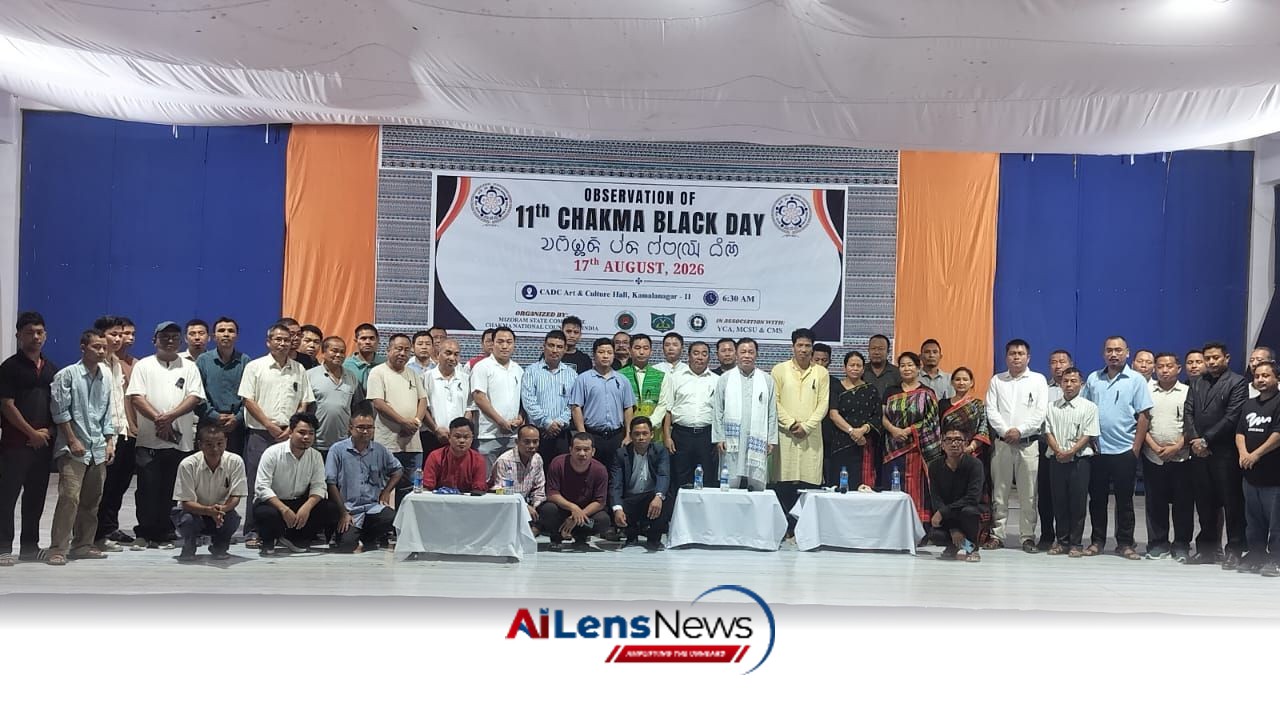



Chakma organizations in India observe 'Chakma Black Day' to demand the annexation of Chittagong Hill Tracts, citing historical grievances and legal grounds.
Gangtok, India Aug 21, 2026 ALN: For the eleventh consecutive year, Chakma organisations across India marked 17 August as “Chakma Black Day,” a day of mourning, not celebration, for the 1947 Radcliffe Award that placed the Chittagong Hill Tracts (CHT) inside East Pakistan rather than India.
This year’s observance, held at the CADC Art & Culture Hall in Kamalanagar, headquarters of the Chakma Autonomous District Council (CADC) in Mizoram, doubled as a launchpad for a far more assertive political demand: that India formally pursue the “return” of the CHT, including through international legal action and economic pressure on Dhaka.
The event was jointly organised by the Chakma National Council of India (CNCI) Mizoram State Committee, the Central Young Chakma Association, the Central Mizoram Chakma Students’ Union and the Chakma Mahila Samiti.
Addressing the gathering, Dg. Nirupam Chakma, Chief Executive Member of the CADC and National President of the CNCI, argued that the case for the CHT’s inclusion in India is not folklore but is documented in the contemporary record.
He cited minutes of a 16 August 1947 meeting in New Delhi in which Jawaharlal Nehru is said to have objected to the CHT going to East Bengal, noting that the region was an “excluded area” with no representation in the Bengal Council and a population that was roughly 97 percent Buddhist and Hindu, and to have argued that on religious and cultural grounds the CHT should form part of India.
Speakers recalled that the Indian tricolour was hoisted at Rangamati on 15 August 1947, two days before the Radcliffe Boundary Commission publicly announced that the CHT would go to Pakistan, a sequence they describe as a “rupture” imposed on a non-Muslim-majority population against its own wishes.
They also linked the Partition-era grievance to a later one: the construction of the Kaptai Dam in the 1960s, which submerged large tracts of Chakma cultivable land and displaced tens of thousands of people, compounding the original sense of dispossession.
Dg. Nirupam Chakma was careful to frame the day defensively rather than as a call for confrontation.
He said the observance is “not directed against any community, religion or country,” is not aimed at ordinary Bangladeshi citizens, and exists to preserve Chakma identity, remember history and pursue the community’s aspirations “through peaceful, democratic and constitutional means.”
He urged younger Chakmas to study original documents, protect their language and culture, and strengthen their economic and constitutional position rather than pursue confrontation.
Two days before the Kamalanagar observance, on 15 August 2026, a separate but related announcement was made in New Delhi.
Marking what organisers called the 80th anniversary of the hoisting of the Indian flag in the CHT and the subsequent award of the region to East Pakistan, a group of Indian Chakma leaders formally decided to challenge that 1947 award before the International Court of Justice in The Hague, seeking the CHT’s inclusion in India.
The initiative was proposed by Rasik Mohan Chakma, MLA and member of the CADC, and endorsed by Prof. Gautam Chakma, President of the Humanity Protection Forum, Pritimoy Chakma of the Chakma Hajong Elders Forum in Arunachal Pradesh, and Suhas Chakma, founder of the Chakma Development Foundation of India.
Their legal argument rests on a specific reading of the partition documents rather than only on political memory. The group points out that the Indian Independence Act of 1947 did not itself settle the status of the CHT, a district that had been administered separately since 1860.
The Act’s First Schedule listed the districts assigned to East Pakistan by name (Chittagong, Noakhali and Tippera in the Chittagong Division, Bakarganj, Dacca, Faridpur and Mymensingh in the Dacca Division, Jessore, Murshidabad and Nadia in the Presidency Division, and Bogra, Dinajpur, Malda, Pabna, Rajshahi and Rangpur in the Rajshahi Division) without including the CHT among them.
On that basis, the group argues the CHT’s transfer to Pakistan was carried out by the Radcliffe-led Bengal Boundary Commission rather than by the Act itself, at a time when non-Muslims made up close to 98.5 per cent of the district’s population, and its indigenous peoples were given no hearing.
Suhas Chakma summarised the position by saying these were violations that “ought to be adjudicated by the International Court of Justice,” and added that while India has a strong case to bring before the ICJ, other states also bear responsibility for addressing the CHT indigenous peoples’ right to self-determination.
The group additionally agreed to raise CHT human rights violations before the international community, including India’s own government.
Separately, the same set of leaders called on New Delhi to suspend diesel and power exports to Bangladesh, specifically the India-Bangladesh Friendship Pipeline, under which India has committed to supplying roughly 1,80,000 metric tonnes of diesel a year, and electricity exports from Adani’s Godda coal-fired plant in Jharkhand, citing Dhaka’s reported refusal to have interim leader Tarique Rahman visit India until Sheikh Hasina and others are extradited.
They called the preconditions “an insult to India”. They tied the economic-pressure demand directly to the older territorial grievance, repeating the argument that a “historical mistake” placed a non-Muslim-majority territory in Pakistan against the wishes of its indigenous, or Jumma, population.
Three threads run through the case these leaders make. The first is a disputed 1947 boundary decision – the claim that Nehru and Congress leaders objected to the CHT’s inclusion in East Bengal is a longstanding part of Chakma political memory, tied to the region’s demographics at Partition and the symbolism of the Rangamati flag-raising.
The second is decades of subsequent displacement, the Kaptai Dam’s submergence of Chakma land in the 1960s, and the exodus of roughly 70,000 CHT refugees into Tripura during the 1970s to 1990s insurgency, which are cited as evidence that the “wrong side of the border” has meant sustained hardship for the community.
The third is the unravelling of the 1997 Peace Accord, which Indian Chakma leaders and CHT-based groups alike point to as proof that Dhaka has failed to protect Jumma rights within Bangladesh, and it is in this context that the CHT-based UPDF’s own critique becomes relevant.
To learn more about the latest developments in Political Controversies, stay updated with our exclusive reports and analyses on AILensNews.

The Mizo Zirlai Pawl has renewed its call for political parties to avoid nominat…

BJP leader Thapa emphasizes the party's duty to fulfill the aspirations of the G…

Dr. W.R. Kharlukhi, a former Rajya Sabha MP, has resigned from the National Peop…
The Gorkha Janmukti Morcha convened an all-party meeting in Darjeeling to discus…

Lt Gen A. Raman-MM alleges that former Longvibu Anthony Ningkhan Shimray ordered…