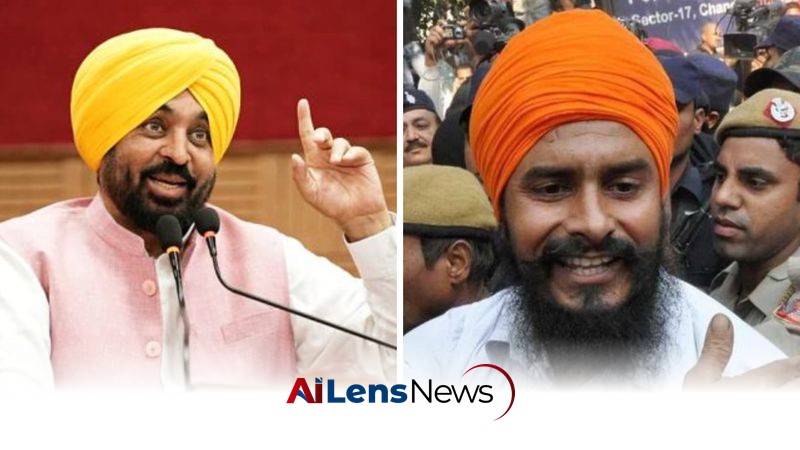


Punjab Chief Minister Bhagwant Mann is optimistic about Jagtar Singh Hawara's parole after discussions with Governor Gulab Chand Kataria, who will advocate for him at the Centre.
Chandigarh, India Aug 12, 2026 ALN: Punjab Chief Minister Bhagwant Mann has recently expressed optimism regarding the parole of Jagtar Singh Hawara, a figure whose name resonates deeply within the socio-political landscape of Punjab. Hawara, who has been incarcerated for his alleged involvement in significant criminal activities, including the assassination of former Punjab Chief Minister Beant Singh in 1995, remains a controversial figure. His case has been a focal point of discussion for various political factions and communities within the state.
Following a meeting with Punjab Governor Gulab Chand Kataria, Mann announced that the Governor assured him of his commitment to discuss the matter with the Union Home Secretary. This development is indicative of the ongoing dialogue between state and central authorities regarding issues that have profound implications for the people of Punjab. The Chief Minister's optimism is not only a reflection of his political stance but also highlights the broader implications of Hawara's potential release on the state's political dynamics.
The call for Hawara's parole is set against a backdrop of historical grievances and complex socio-political realities in Punjab. The state has a long history of militancy and political unrest, particularly during the 1980s and 1990s, which has left deep scars on its social fabric. For many in Punjab, Hawara represents a symbol of resistance against perceived injustices, while for others, he is a reminder of a turbulent past that they wish to move beyond. This dichotomy makes the issue of his parole particularly contentious.
Mann's hope for Hawara's release comes amid ongoing discussions about the legal and political implications of such a decision. Parole, which is typically granted under specific legal conditions, can be a complicated process, especially in cases involving serious charges. The Chief Minister emphasized the importance of dialogue and cooperation between state and central authorities in resolving issues that affect the people of Punjab. His statement, "I am hopeful that the necessary steps will be taken to facilitate Hawara's parole, as it is a matter of significant concern for many in our community," underscores the emotional weight this issue carries for a substantial segment of the population.
Governor Kataria's involvement in this matter is seen as a positive step towards addressing the parole request. His assurance to advocate for Hawara at the central level indicates a willingness to engage in discussions that could lead to a favorable outcome. The role of the Governor in such matters is crucial, as it bridges the state and central governments, often serving as a mediator in politically sensitive issues.
As the situation develops, the Chief Minister and his administration are keen on ensuring that the voices of the people are heard in this matter. The outcome of the discussions between the Governor and Union Home Secretary will be closely monitored by both supporters and critics of Hawara. Supporters argue that granting parole could serve as a step towards reconciliation and healing, while critics caution against the implications of releasing someone with such a controversial history.
The implications of Hawara's potential parole extend beyond individual circumstances; they touch on broader themes of justice, political representation, and societal healing. The discourse surrounding his case is reflective of the ongoing struggle within Punjab to navigate its complex identity and historical narratives. For many, Hawara's case is emblematic of the larger issues of governance and accountability in the region.
In conclusion, the meeting between CM Mann and Governor Kataria marks a significant step in the ongoing dialogue regarding Hawara's parole. Both leaders have expressed a commitment to work towards a resolution that reflects the sentiments of the Punjab populace. However, the path forward remains fraught with challenges, as the political landscape in Punjab is highly polarized. The conversations that unfold in the coming weeks will likely shape not only the fate of Jagtar Singh Hawara but also the broader narrative of governance and community relations in Punjab.
As discussions progress, it will be essential for all stakeholders involved to approach the matter with a sense of responsibility and awareness of the diverse perspectives that exist within the state. The implications of this decision could resonate for years to come, influencing not just the political climate but also the social cohesion of Punjab.
The case of Jagtar Singh Hawara is emblematic of the broader historical context of Punjab, which has experienced significant turmoil over the decades. The state was marked by a separatist movement during the 1980s, which led to widespread violence, loss of life, and a deepening divide among communities. Hawara's involvement in the assassination of Beant Singh, who was a significant political figure and a proponent of a strong state response to militancy, adds layers of complexity to his case. Beant Singh's assassination was a pivotal moment that intensified the conflict and led to a crackdown on dissenting voices in Punjab.
Supporters of Hawara often view him as a political prisoner, arguing that his actions were a response to systemic injustices faced by the Sikh community. They contend that his release could symbolize a move towards reconciliation and a more inclusive political environment in Punjab. Conversely, opponents argue that releasing a convicted assassin could undermine the rule of law and set a dangerous precedent for future governance.
The political ramifications of Hawara's parole are significant, as it could influence the electoral landscape in Punjab. Various political parties have differing stances on the issue, and the decision to grant parole could either bolster or undermine the support for the ruling party, depending on public sentiment. As the Chief Minister navigates this sensitive issue, he must balance the demands of his constituency with the legal complexities surrounding parole decisions.
Moreover, the ongoing discussions surrounding Hawara's case highlight the need for broader dialogue about justice and accountability in Punjab. Many residents feel that the state has not adequately addressed the grievances stemming from the past violence and political repression. The potential release of Hawara could be seen as a step towards addressing these historical injustices, but it also raises questions about how the state reconciles its past with its present.
As the dialogue continues between the Chief Minister, the Governor, and central authorities, it is crucial for all parties to engage with the diverse perspectives that characterize Punjab's socio-political landscape. The outcome of this parole request will not only affect Hawara and his supporters but will also resonate through the broader community, potentially impacting inter-community relations and the political climate for years to come.
In light of these complexities, it is essential for the Punjab government to approach the issue with transparency and a commitment to justice that reflects the diverse narratives within the state. The decision regarding Jagtar Singh Hawara's parole is more than a legal matter; it is a reflection of the ongoing struggle for identity, justice, and reconciliation in Punjab.
To learn more about the latest developments in Elections, stay updated with our exclusive reports and analyses on AiLensNews.

