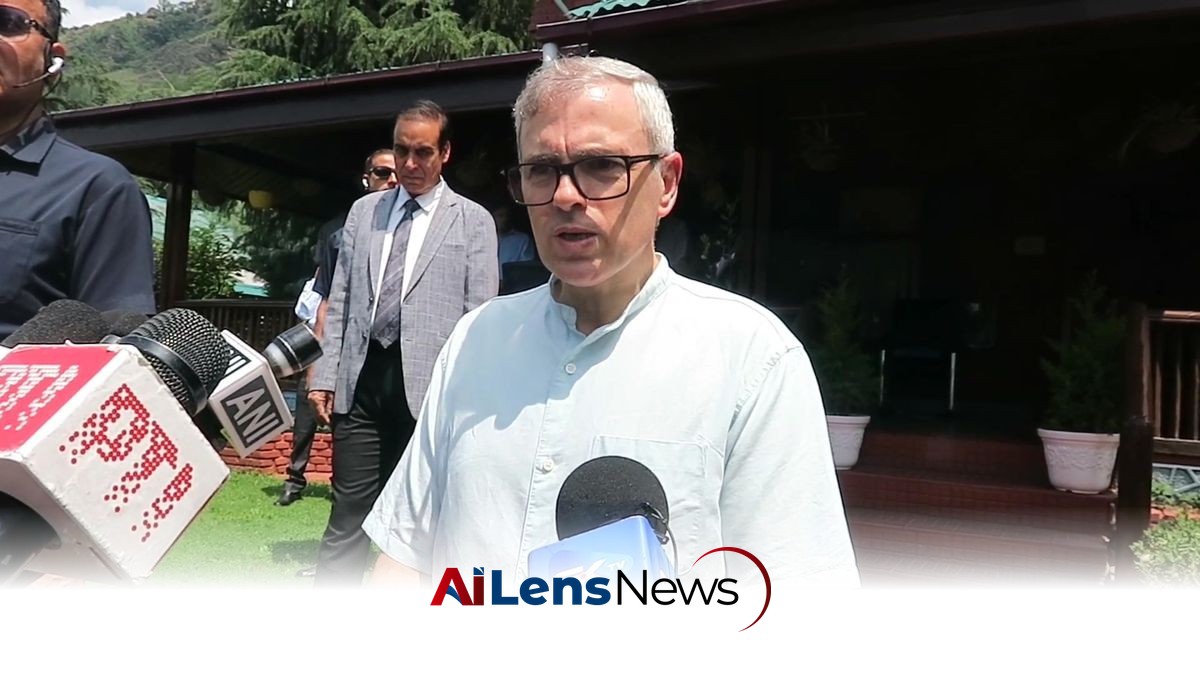


Omar Abdullah has expressed strong disapproval of Mehbooba Mufti's recent statement regarding Kashmir, highlighting the political implications of her remarks.
New Delhi, India Jul 27, 2026 ALN: In a recent political exchange, Omar Abdullah, the former Chief Minister of Jammu and Kashmir, has publicly criticized Mehbooba Mufti, the leader of the People's Democratic Party (PDP), for her controversial remark, "Kashmir Ka Toh Banta Hai." Abdullah's response underscores the sensitive nature of political discourse in the region.
Abdullah's criticism comes in light of Mufti's statement, which he perceives as an attempt to downplay the complexities surrounding Kashmir's political status. He emphasized that such remarks could have far-reaching consequences, especially in a region that has seen decades of conflict and unrest. The phrase "Kashmir Ka Toh Banta Hai," which translates to "Kashmir deserves it," has been interpreted by many as an oversimplification of the intricate issues that plague the region, including the long-standing territorial disputes, human rights concerns, and the socio-economic challenges faced by its residents.
The political landscape in Jammu and Kashmir has been tumultuous, with various leaders often making statements that resonate with their constituencies. Abdullah's response reflects a broader concern among political leaders regarding the implications of rhetoric in a region fraught with historical grievances. Jammu and Kashmir has a unique political history, having acceded to India in 1947 under conditions that remain contentious. The region has been a flashpoint for conflict between India and Pakistan, and the internal dynamics are further complicated by various separatist movements and the presence of military forces.
The integration of Jammu and Kashmir into India was marked by promises of autonomy and special status under Article 370 of the Indian Constitution, which granted the region a degree of self-governance. However, the abrogation of this article in August 2019 by the Indian government has led to significant political upheaval and has intensified debates about the future of the region. Abdullah's National Conference party has historically advocated for the restoration of this autonomy, while the PDP under Mufti has focused on reconciliation and dialogue with the central government.
Mehbooba Mufti, as the head of the PDP, has often positioned her party as a moderate voice advocating for dialogue and reconciliation in the region. Her comments, while intended to galvanize support for her party's agenda, have sometimes drawn ire from opponents who accuse her of being insensitive to the realities faced by the people of Jammu and Kashmir. Abdullah's critique of her statement can be seen as a strategic move to assert his party's stance and appeal to a broader audience that is wary of any rhetoric that might seem dismissive of the region's struggles.
Public reactions to Mufti's statement have been mixed, with some supporting her perspective while others align with Abdullah's critique. The discourse surrounding Kashmir remains highly polarized, with differing views on the path forward for the region. Supporters of Mufti may argue that her comment reflects a sense of optimism and a desire for Kashmir to receive its due recognition and rights within the Indian Union. However, critics, including Abdullah, argue that such statements can inadvertently trivialize the serious issues at hand and may alienate segments of the population that feel their grievances are not being adequately addressed.
Social media platforms have become a battleground for these discussions, with users expressing a wide range of opinions. Some have praised Abdullah for holding Mufti accountable, while others have accused him of politicizing her remarks for his gain. The varying interpretations of Mufti's statement highlight the challenges faced by political leaders in navigating the sentiments of a diverse populace that has experienced profound trauma and loss over decades of conflict.
Furthermore, the political climate in Jammu and Kashmir is characterized by a deep sense of mistrust among various communities, exacerbated by years of violence and political instability. This environment complicates the reception of political statements, as many individuals are acutely aware of the historical context and the implications of political rhetoric. The sensitivity of the situation means that leaders must tread carefully, as their words can resonate deeply within a population that has long felt marginalized.
As political tensions continue to simmer, both Abdullah and Mufti are likely to remain central figures in the ongoing dialogue about Kashmir's future. Their exchanges highlight the intricate balance of political strategy and public sentiment in a region that is still navigating its identity and governance. The relationship between political leaders and their constituents is particularly fragile in Jammu and Kashmir, where historical grievances often intersect with contemporary political aspirations.
Moreover, the implications of their statements extend beyond mere political rivalry. They touch upon the broader narrative of national identity, governance, and the quest for peace in a region that has been marred by violence and instability. The importance of responsible political discourse cannot be overstated, especially in a context where words can either bridge divides or exacerbate tensions. The region's leaders are tasked with the challenge of fostering a narrative that not only acknowledges the pain of the past but also promotes a shared vision for the future.
In conclusion, Abdullah's remarks serve as a reminder of the delicate nature of political statements in Kashmir and the potential repercussions they can have on public opinion and inter-party relations. As Jammu and Kashmir continues to grapple with its complex socio-political landscape, the responsibility of political leaders to engage thoughtfully and sensitively with the issues at hand remains paramount. The future of the region may depend on the ability of its leaders to foster dialogue that respects the diverse perspectives of its people and seeks to address the underlying causes of conflict. Such an approach will be essential in moving towards a more peaceful and stable future for Jammu and Kashmir, where the voices of all communities are heard and valued.
To learn more about the latest developments in Political Controversies, stay updated with our exclusive reports and analyses on AiLensNews.

