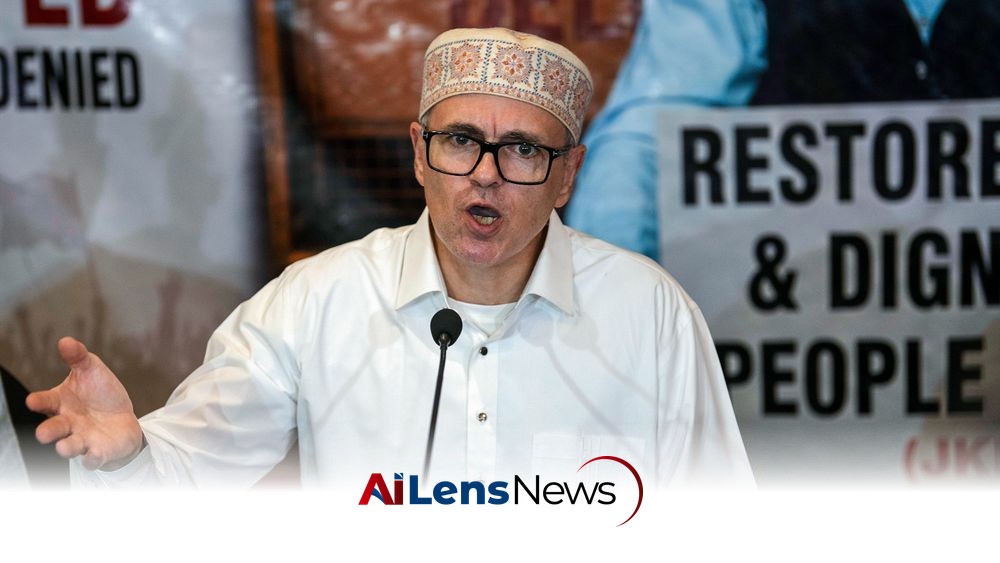


Jammu and Kashmir Chief Minister Omar Abdullah fact-checked Union Minister JP Nadda regarding the 2022 JKSSB paper leak, clarifying the incident's timeline and seeking updates on the investigation.
New Delhi, India Jul 23, 2026 ALN: In a significant exchange of political discourse, Jammu and Kashmir Chief Minister Omar Abdullah took to social media platform X to correct Union Minister JP Nadda regarding the timeline of the Jammu and Kashmir Service Selection Board (JKSSB) paper leak incident. Abdullah asserted that the paper leak occurred in 2022, a period marked by the administration of the Lieutenant Governor, and not during the tenure of the National Conference (NC) and Congress coalition government, as suggested by Nadda. Furthermore, Abdullah demanded an update on the ongoing investigation into the matter, which is being overseen by a high-level committee.
In his post, Abdullah acknowledged Nadda's recognition of the paper leak but pointed out the inaccuracies regarding the date. He stated, "You are absolutely correct about the SSB paper leak in Jammu and Kashmir, JP Nadda ji, but you have got the date wrong. It was 2022. The government wasn't of NC & Congress. It was a government headed by Lt. Governor but thank you for reminding everyone of this failure." This correction is particularly noteworthy as it highlights the ongoing political tensions surrounding governance in Jammu and Kashmir since the abrogation of its special status in 2019.
Abdullah's remarks were accompanied by a copy of the Jammu and Kashmir High Court's order in a Writ Petition (Civil), which characterized the actions involving Aptech Limited, a private company involved in the recruitment process, as "malafide." The court noted that the modifications made to the tender conditions appeared to favor the respondent, raising serious questions about transparency and fairness in the recruitment process.
Since 2019, Jammu and Kashmir has been administered by the Lieutenant Governor following the revocation of its special constitutional status under Article 370. This significant political shift has led to a complex governance landscape, with local leaders like Abdullah advocating for the restoration of democratic processes. An elected government, led by Abdullah, is anticipated to take office following Assembly elections projected for October 2024, which would mark a return to local governance after several years of direct central administration.
The JKSSB paper leak incident itself has been a point of contention and public unrest. On March 22, 2022, the JKSSB conducted written examinations for 1,200 Sub-Inspector positions, along with tests for Finance Accounts Assistants (FAA) and Junior Engineers (JE). Following the announcement of results in June 2022, students across the region organized widespread protests. These protests were fueled by allegations of an unusually high selection rate from specific districts, particularly Jammu, Kathua, and Reasi, raising suspicions about the integrity of the selection process.
In response to the growing discontent among students and the public, the Jammu and Kashmir administration formed an Inquiry Committee in July 2022. The findings from this committee prompted the administration to cancel the selection lists for the aforementioned posts, including 1,200 Sub-Inspectors, 1,300 Junior Engineers, and 1,000 Finance Accounts Assistants. This decision underscored the administration's acknowledgment of the irregularities and the need for a thorough investigation into the recruitment process.
Abdullah's comments were not made in isolation; they were part of a broader political discourse that has intensified in the wake of ongoing protests at Jantar Mantar, where the Citizen's Justice Project (CJP) has been vocal against various examination paper leaks, including the NEET examination. The political climate surrounding education and recruitment processes has become increasingly contentious, with various political leaders leveraging these issues to critique their opponents.
Earlier, during a press conference, Union Health Minister JP Nadda had targeted Congress leader Rahul Gandhi, questioning his "selective" approach to the issue of examination paper leaks. Nadda referred to the JKSSB incident as part of a broader narrative, suggesting that Gandhi's failure to address the issue reflected a lack of commitment to student welfare. He stated, "If I talk about the paper leak in the Service Selection Board examination in Jammu and Kashmir, where the government is of the Congress and the NC of the National Conference." Nadda's remarks were aimed at highlighting perceived inconsistencies in Gandhi's advocacy for educational reforms.
Nadda further challenged Gandhi's silence on the actions of the United Progressive Alliance (UPA) and its allied governments, questioning why the Congress leader had distanced himself from these issues. He remarked, "I'd like to ask the LoP Rahul Gandhi, why are you so selective? Why haven't you discussed the UPA and UPA-supported governments? Why have you distanced yourself from them?" This line of questioning underscores the political maneuvering that often accompanies discussions about educational integrity and governance.
In his critique, Nadda implied that Gandhi's focus on these issues was less about the welfare of students and more about gaining political leverage. He stated, "This clearly shows that your objective isn't the welfare of students. Your objective is to improve education, improve the quality of education, and ensure justice for students. You're not interested in this. You want to gain political mileage from student issues and demands. You want to make political gains, which is unfortunate." This assertion reflects the broader political strategy of framing opponents as being out of touch with the needs and concerns of the electorate.
The ongoing dialogue surrounding the JKSSB paper leak, as well as the broader implications for governance and educational integrity in Jammu and Kashmir, highlights the complexities of the political landscape in the region. As the situation develops, the demand for accountability and transparency in recruitment processes remains a critical issue for both the administration and the public. Abdullah's call for an update on the high-level committee's findings indicates a continuing commitment to addressing these concerns, while also navigating the politically charged environment that has characterized Jammu and Kashmir since 2019.
The ramifications of these events extend beyond immediate political posturing; they touch upon the fundamental issues of governance, public trust, and the future of democratic processes in Jammu and Kashmir. As the region anticipates upcoming elections and the potential return of an elected government, the outcomes of investigations like the JKSSB paper leak will likely play a significant role in shaping public perceptions and electoral outcomes.
To learn more about the latest developments in Political Controversies, stay updated with our exclusive reports and analyses on AiLensNews.

