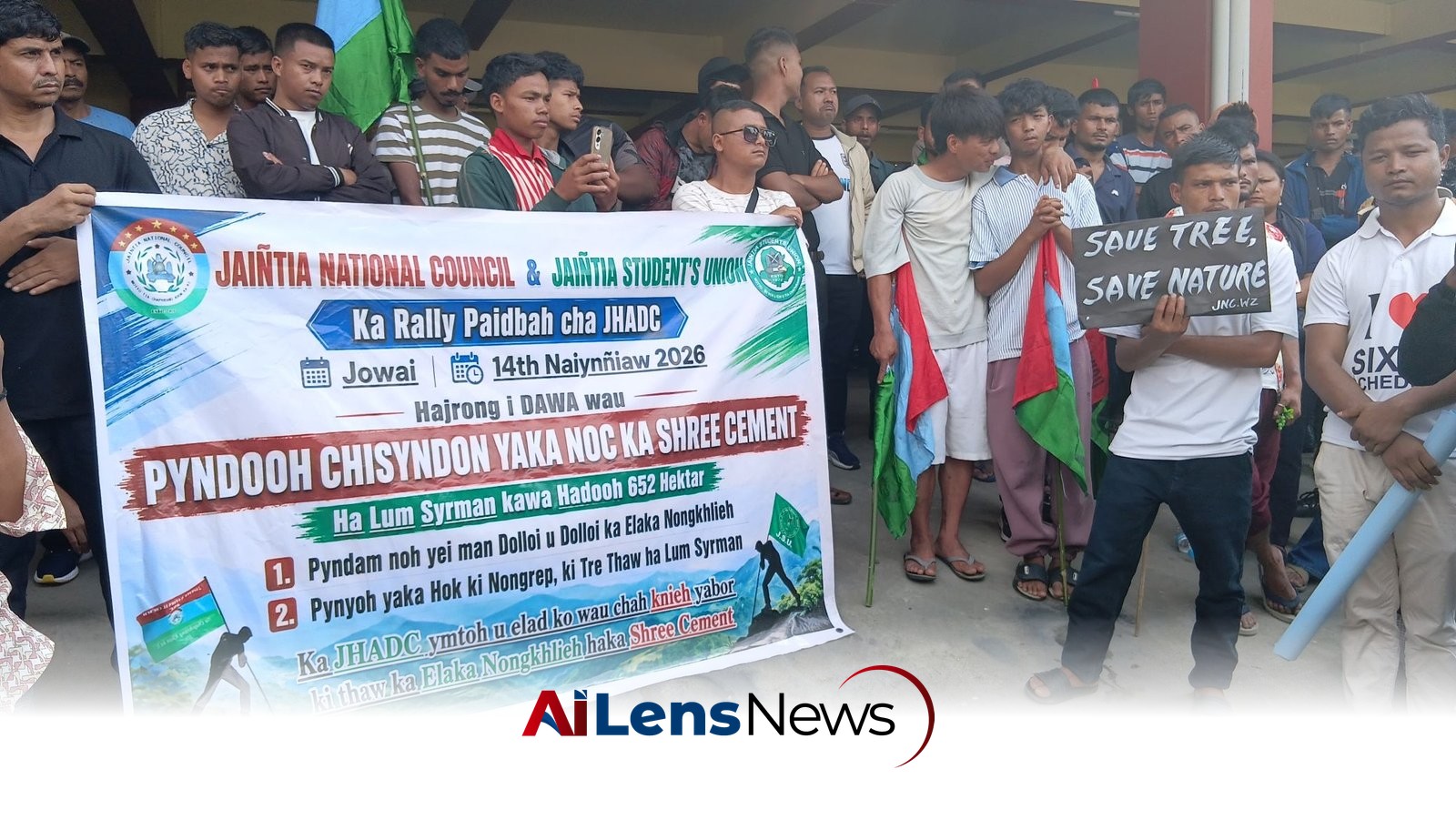


Farmers and activists stormed the JHADC, demanding the revocation of a No Objection Certificate for a limestone mining project by Shree Cement.
Shillong, India Jul 15, 2026 ALN: Farmers and landowners of Shnongrim, alongside the Jaintia National Council (JNC) and Jaintia Students’ Union (JSU), stormed the Jaintia Hills Autonomous District Council (JHADC) on Tuesday. They demanded the immediate revocation of the No Objection Certificate (NOC) issued for a proposed limestone mining project by Shree Cement Company, as well as the removal of the Dolloi of Elaka Nongkhlieh for allegedly undermining the rights of the local populace.
The rally commenced from Ladthadlaboh, aimed at opposing the mining project that spans 652 hectares at Lum Syrman. Initially halted by police, the protesters managed to breach the district council's gates and reached the main office entrance. However, leaders from the JNC and JSU intervened, redirecting the crowd to hold a public meeting on-site to address their grievances.
This protest is part of a broader trend in India where local communities are increasingly asserting their rights against large corporations that seek to exploit natural resources. The JNC and JSU's actions reflect a growing awareness among rural populations about the potential consequences of such projects, not only on their immediate livelihoods but also on the environment and community cohesion.
At the time of the protest, JHADC Chief Executive Member Thombor Shiwat was absent, although council officials confirmed that prior notice of the protest had been given. This absence has raised questions about the council's engagement with local communities and its responsiveness to their concerns, especially in light of ongoing tensions regarding land use and resource management.
JNC president Sambormi Lyngdoh expressed that Shree Cement's interference had rekindled resistance among the residents. He condemned the Dolloi's actions, claiming they disregarded farmers' rights for personal gain. Lyngdoh questioned how the Dolloi could sell the rights of the residents when the JHADC had not empowered him to act without its knowledge. This situation underscores the complexities of local governance in tribal areas, where traditional leadership roles often intersect with modern administrative frameworks.
Furthermore, Lyngdoh alleged that the cement company was employing mafia tactics to intimidate local residents. He criticized political leaders and village heads for making unilateral decisions without considering the perspectives of the actual landowners. This sentiment resonates with many in the community who feel marginalized and excluded from decision-making processes that directly affect their lives and livelihoods.
The JSU leaders echoed these sentiments, highlighting that previous promises of job creation for locals had not materialized, leading to increased community frustration. The lack of tangible benefits from the mining project has fueled skepticism regarding the motives of Shree Cement and the Dolloi. Farmers expressed their losses due to the Dolloi's forceful actions and voiced concerns over the environmental damage that limestone mining could inflict, particularly regarding its impact on future generations.
The environmental implications of limestone mining are significant, as the extraction process can lead to deforestation, soil erosion, and water pollution. Local farmers are particularly concerned about the potential degradation of agricultural land, which is vital for their sustenance and economic stability. The community's resolve to protect their land and rights became increasingly evident during the protest, signaling a growing movement against external exploitation.
This protest also highlights the broader context of environmental activism in India, where indigenous and local communities are increasingly vocal about their rights to land and resources. The demand for the revocation of the NOC is not just about this particular project; it reflects a larger struggle against the commodification of natural resources and the need for sustainable development practices that respect the rights of local populations.
The Jaintia Hills region, known for its rich mineral resources, has witnessed various mining activities over the years. However, these activities have often led to conflicts between corporations and local communities, as seen in this instance. The historical context of land ownership and the rights of indigenous peoples in India complicate these interactions, as many communities have traditional claims to land that are not recognized by modern legal frameworks.
As the protest unfolded, it became clear that the community's concerns extend beyond immediate economic impacts. There is a pervasive fear that continued mining activities could irreversibly alter the landscape and disrupt the delicate ecological balance of the region. This concern is particularly acute in areas where water sources are at risk of contamination, threatening both agricultural and drinking water supplies.
The implications of the protest are significant not only for Shree Cement and the Dolloi but also for the JHADC and local governance structures. The council's response to these demands will be closely watched, as it may set a precedent for how similar conflicts are managed in the future. If the JHADC fails to address the concerns raised by the protesters, it risks further alienating the community and escalating tensions.
Moreover, the protest serves as a reminder of the need for more inclusive decision-making processes that genuinely consider the voices of local populations. Engaging communities in discussions about resource management and development projects is essential for fostering trust and ensuring that projects align with the needs and aspirations of the people they affect.
In conclusion, the demands made by the JNC and JSU during the protest reflect a critical juncture for the Jaintia Hills community as they navigate the challenges posed by external corporate interests. The outcome of this situation will likely have lasting effects on the region's social, economic, and environmental landscape, making it imperative for all stakeholders to engage in constructive dialogue and seek equitable solutions that prioritize the rights and well-being of local residents.
To learn more about the latest developments in Political Controversies, stay updated with our exclusive reports and analyses on AiLensNews.

