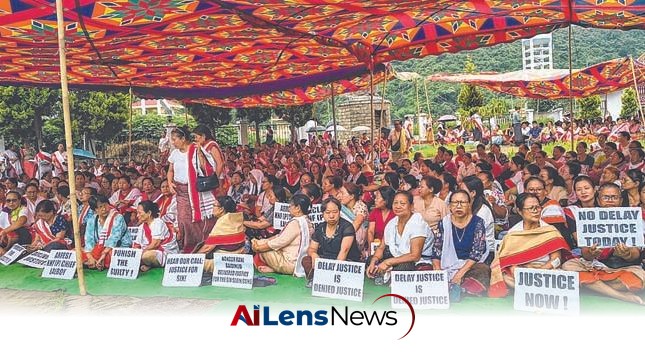


A large sit-in protest in calls for justice for six Naga civilians murdered by Kuki militants, organized by the United Zeliangrong Council.
Imphal, India Jul 19, 2026 ALN: A significant sit-in protest took place at Rani Gaidinliu (Freedom Fighter) Park in Mantripukhri on July 18, demanding justice for six Naga civilians who were brutally killed by Kuki militants. The protest was organized by the United Zeliangrong Council, which represents the Naga community. This incident has not only sparked outrage among the Naga people but also raised serious concerns about the security situation in the region.
The gathering saw a large turnout, with participants holding placards that read "Justice Now!" and "No Delay in Justice!" The demonstrators expressed their outrage over the killings and called for immediate action against the perpetrators. Such displays of solidarity and anger are indicative of the deep-seated frustrations within the Naga community regarding ongoing violence and a perceived lack of accountability from authorities.
The tragic incident occurred earlier this month when six Naga civilians were shot dead in what many are calling a targeted attack by Kuki militants. The Kuki people and the Naga community have a long history of ethnic tensions, which have often escalated into violence. This particular incident has heightened tensions in the region, leading to widespread condemnation and calls for accountability. The killings have not only affected the families of the victims but have also reverberated through the broader community, exacerbating fears of further violence.
The Naga community, which inhabits a region that straddles the borders of India and Myanmar, has been embroiled in conflict for decades. The struggle for autonomy and recognition of their rights has often led to clashes with various groups, including the Kuki militants. The recent violence underscores the fragility of peace in the region and the complexities of inter-ethnic relations.
Historically, the Naga people have sought greater autonomy and recognition of their unique identity, which has often put them at odds with various state and non-state actors. The Kuki militants, who are primarily based in , have been involved in conflicts that have at times intersected with the Naga struggle. This has created a volatile environment where mistrust and animosity can easily flare up into violence.
The protest is part of a broader movement within the Naga community to seek justice and ensure that such atrocities do not go unpunished. Leaders from various organizations have joined forces to amplify their demands, emphasizing the need for a thorough investigation and prosecution of those responsible. The United Zeliangrong Council has been particularly vocal, calling for the government to take immediate action against the Kuki militants involved in the killings.
This incident has also sparked discussions within the Naga community about the importance of unity in the face of violence. Many community leaders have stressed that it is crucial for different ethnic groups to come together to address the root causes of conflict and to advocate for a peaceful resolution. The protests are not just about seeking justice for the victims but also about fostering a sense of solidarity among various groups in the region.
In addition to the immediate demands for justice, the protests have also ignited a broader dialogue about the need for reconciliation and healing among the different communities in the region. Many participants have expressed the hope that by standing together, they can pave the way for a more peaceful coexistence that transcends ethnic divisions.
During the protest, representatives from the United Zeliangrong Council addressed the crowd, urging the government to take swift action. They highlighted the importance of justice not only for the victims' families but also for restoring peace and harmony in the region. The leaders emphasized that without accountability, the cycle of violence would continue, further destabilizing the already tense situation.
Moreover, the organizers called for greater attention from national and international bodies regarding the human rights situation in the region. They expressed concerns that the local government has not done enough to protect civilians and ensure their safety in the face of increasing violence from militant groups. This lack of protection is seen as a contributing factor to the ongoing cycle of violence, leading to a climate of fear and insecurity among the population.
Participants at the protest called for solidarity among different communities, stressing that unity is essential in the face of violence and injustice. They urged all citizens to stand together against such acts of brutality, emphasizing that the fight for justice transcends ethnic lines. This call for solidarity reflects a growing recognition that the path to peace requires cooperation and understanding among the various groups in the region.
The Naga community has historically faced challenges in voicing their concerns, and this protest represents an important moment for them to assert their rights and demand justice. The solidarity expressed during the protest could serve as a catalyst for broader discussions about peace and reconciliation in the region. It also highlights the role of civil society in advocating for justice and accountability, which can be instrumental in driving change.
The United Zeliangrong Council has announced plans for further demonstrations if their demands are not met. They are committed to ensuring that the voices of the victims and their families are heard, and that justice is served. The council has also indicated that they will seek to engage with governmental authorities to push for accountability and to address the underlying issues that lead to such violence.
As tensions remain high, the potential for further protests or unrest looms. The government’s response to the demands of the Naga community will be crucial in determining the next steps in this ongoing struggle for justice. The protest at Rani Gaidinliu Park serves as a poignant reminder of the ongoing struggles faced by the Naga community and their quest for justice in the wake of violence.
This situation highlights the need for a comprehensive approach to conflict resolution in the region, one that not only addresses immediate grievances but also works towards long-term peace and stability. The involvement of civil society, local leaders, and international observers may be essential in fostering dialogue and promoting understanding among the various communities affected by this violence.
In conclusion, the protest at Rani Gaidinliu Park is not merely a reaction to a tragic event but a reflection of the broader struggles faced by the Naga community. It underscores the urgent need for justice, accountability, and a commitment to peace in a region that has seen too much violence and suffering. The path forward will require concerted efforts from all stakeholders to ensure that the voices of the marginalized are heard and that the cycle of violence is broken, paving the way for a more harmonious future.
To learn more about the latest developments in Political Controversies, stay updated with our exclusive reports and analyses on AiLensNews.

