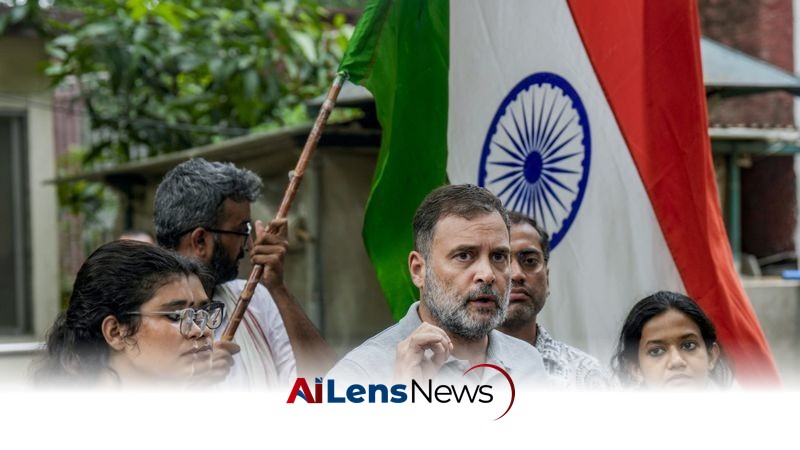


In the wake of Union Education Minister Dharmendra Pradhan's resignation, Rahul Gandhi condemns the RSS for undermining India's education system and demands accountability for student violence.
Leh, India Jul 26, 2026 ALN: In a significant political development, Congress leader Rahul Gandhi addressed the media following the resignation of Union Education Minister Dharmendra Pradhan. The resignation came after the Central Government accepted all demands from the Central Joint Platform (CJP), leading to the withdrawal of their agitation. Gandhi characterized this outcome as a victory for students but emphasized that the struggle is far from over.
During his statement, Rahul Gandhi called for accountability regarding the violent incidents that occurred on July 20, where students faced a lathi-charge and pellet firing. He demanded a formal apology from Prime Minister Narendra Modi, highlighting the need for justice for the affected students. This incident, which drew widespread condemnation, underscored the tensions between students and the government, particularly regarding issues of educational policy and student rights.
Gandhi did not hold back in his criticism of the Rashtriya Swayamsevak Sangh (RSS), accusing the organization of capturing and hollowing out the education system in India. He asserted that Prime Minister Modi has become an “operator” of this compromised educational framework, suggesting that the current administration's policies are detrimental to the integrity of education in the country. The RSS, a Hindu nationalist organization, has long been a significant influence in Indian politics, particularly within the ruling Bharatiya Janata Party (BJP). Critics argue that the RSS’s ideology has seeped into various sectors, including education, leading to a curriculum that they claim prioritizes a particular ideological narrative over academic rigor and inclusivity.
Gandhi's remarks reflect a broader concern among various stakeholders in the education sector who fear that the ideological influences of the RSS could undermine the secular and pluralistic foundations of India's education system. This criticism aligns with ongoing debates about the role of ideology in education, where many educators and students advocate for a curriculum that is free from political bias and promotes critical thinking.
The concerns raised by Gandhi resonate with many educators and students who have observed a gradual shift in educational policies that prioritize ideological conformity over academic freedom. Critics argue that this shift is evident in the changes to textbooks, which have been accused of promoting a narrow interpretation of Indian history and culture, often sidelining diverse perspectives. The implications of such changes extend beyond the classroom, influencing the way future generations understand their identity and heritage.
The resignation of Pradhan and the subsequent comments from Gandhi could have significant implications for the political landscape, particularly as educational issues remain a critical concern for many voters. In recent years, education has emerged as a pivotal issue in Indian politics, with various political parties vying for the support of students and parents alike. The Congress party is expected to leverage this situation to rally support among students and educational professionals who feel marginalized by the current government.
As the Congress party positions itself as a champion of educational reform, it is likely to focus on several key areas: access to quality education, the safety and rights of students, and the need for an unbiased curriculum. By emphasizing these issues, the Congress party aims to differentiate itself from the ruling BJP, which has faced criticism for its handling of educational matters, including the controversial National Education Policy (NEP) that some believe favors privatization and commercialization of education.
The NEP was introduced with the intention of overhauling the education system to make it more holistic and inclusive. However, critics argue that it lacks adequate provisions for public education and disproportionately benefits private institutions, exacerbating inequalities in access to quality education. This has led to widespread protests from various student groups and educational activists who demand a more equitable approach to educational reforms.
As the Congress party prepares to address these issues in Parliament, Gandhi's remarks indicate a strategic focus on education as a key battleground. The party aims to hold the government accountable for its actions and to advocate for a more equitable educational system. This includes not only addressing immediate concerns but also laying out a comprehensive vision for the future of education in India, one that prioritizes inclusivity, accessibility, and academic integrity.
In the wake of Pradhan’s resignation, the Congress party is likely to mobilize grassroots support, engaging with student organizations and educational institutions to amplify their message. This grassroots approach could help the party connect with younger voters, a demographic that has increasingly become disillusioned with the current government’s policies. The party may also seek to align itself with broader social movements advocating for educational reform, thereby strengthening its position as a defender of students' rights.
Moreover, the Congress party's strategy may involve forming coalitions with other political entities that share similar concerns about educational policies. By uniting various stakeholders, including teachers' unions, student bodies, and civil society organizations, the Congress could present a formidable challenge to the ruling party's educational agenda.
In conclusion, while the resignation of Pradhan may have quelled immediate tensions, the broader fight for educational integrity and accountability continues, with Rahul Gandhi positioning himself as a prominent voice for students and educational reform. The implications of this political maneuvering extend beyond immediate electoral gains; they touch upon the very fabric of India’s educational landscape, which is at a crossroads. As the nation grapples with the challenges posed by ideological influences in education, the outcome of this struggle could have lasting consequences for future generations of students.
Furthermore, the ongoing discourse surrounding educational reform in India highlights the necessity for a balanced approach that respects diverse viewpoints while fostering an environment conducive to critical inquiry. The future of education in India hinges on the ability of political leaders to rise above partisan interests and prioritize the needs of students and educators alike. As this political narrative unfolds, it will be essential for all stakeholders to engage in constructive dialogue aimed at building a more inclusive and equitable educational framework.
To learn more about the latest developments in Political Controversies, stay updated with our exclusive reports and analyses on AiLensNews.

