

More
Checking your session
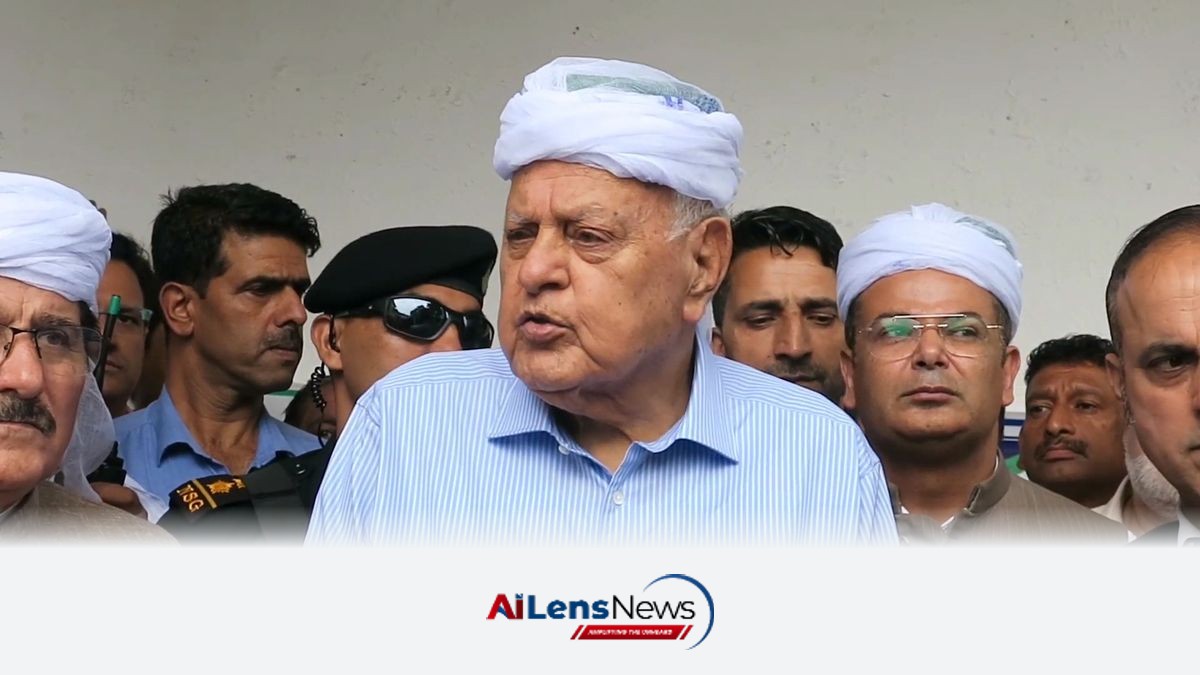



National Conference President Farooq Abdullah challenges Jammu and Kashmir's reliance on New Delhi for financial support, linking it to the demand for greater autonomy.
Leh, India Aug 26, 2026 ALN: National Conference (NC) President Farooq Abdullah has raised significant concerns regarding the financial autonomy of Jammu and Kashmir (J&K) amidst a backdrop of recent electricity tariff hikes. During a press interaction, Abdullah responded pointedly to inquiries about the potential review of the newly approved electricity tariff increase, emphasizing that J&K must reassess its dependence on New Delhi for financial support if it seeks greater political autonomy.
Abdullah's remarks reflect a broader sentiment among various political leaders in the region who believe that the longstanding reliance on the central government undermines the aspirations for self-governance and economic independence. He posed a rhetorical question to reporters, asking, “How long will you be a slave?” This statement underscores his call for the people of J&K to strive for self-sufficiency and to assert their rights rather than remain in a position of dependency.
“How long will you (J&K) beg from Delhi?” Abdullah continued, linking the issues of political autonomy and economic viability. His comments come at a critical juncture when the state is grappling with the implications of a 6.83 percent increase in electricity tariffs, recently approved by the Joint Electricity Regulatory Commission. This increase is set to take effect from September 1 and has sparked considerable debate among political factions and civil society.
Abdullah's assertion that J&K needs to strengthen its economic footing in order to retain dignity is a reflection of the complex socio-political landscape in the region. The demand for the restoration of Article 370, which granted J&K a degree of autonomy before its abrogation in August 2019, remains a contentious issue. Abdullah's comments suggest that the restoration of such autonomy cannot be achieved while the region remains economically beholden to the central government.
“You want Article 370, but you beg. Two things cannot be combined,” he stated, indicating that a dual approach of seeking autonomy while simultaneously relying on external financial assistance is contradictory. This perspective resonates with a segment of the population that feels that true autonomy requires not only political changes but also economic reforms that empower local governance and reduce reliance on New Delhi.
The recent tariff hike has become a focal point of political contention in J&K. Opposition parties have voiced their dissent, arguing that the increase will disproportionately affect the economically vulnerable sections of society and industries that are already struggling. Industry representatives have expressed concerns that higher electricity costs could deter investment and hinder economic growth, exacerbating the challenges faced by local businesses.
In defense of the tariff increase, Chief Minister Omar Abdullah characterized the hike as a “compulsion” rather than a choice, suggesting that the financial health of the electricity distribution sector necessitated such adjustments. He has also emphasized that the increase is relatively modest compared to previous tariff revisions and reassured the public that his government remains committed to providing 200 units of free electricity to eligible households. This promise is particularly significant as electricity access was a key issue during the 2024 J&K Assembly elections, with the NC campaigning on similar commitments.
Abdullah’s comments about the tariff hike thus come against a backdrop of growing political pressure and public scrutiny. Rather than directly addressing whether the tariff increase could be reviewed, he pivoted the discussion towards the broader need for economic self-reliance. This approach may resonate with constituents who are frustrated with the status quo and are seeking tangible solutions to the region's economic challenges.
In addition to the electricity tariff issue, Abdullah was also questioned about the reported rise in crimes against women in the region. He attributed this troubling trend to what he characterized as a growing distance from religious values. “This is because we are very far from the words of Allah,” he remarked, indicating that he believes a return to religious principles could help address social issues, including violence against women.
Abdullah’s comments suggest a concern that societal values are deteriorating across communities, as he noted that the issue of crime is not confined to any single religious group. “We are Muslims by name, not Muslims by deeds,” he stated, implying that there is a need for a collective return to ethical and moral conduct as prescribed by religious teachings.
These remarks highlight the complexities of governance in J&K, where political, economic, and social issues are deeply intertwined. The region has faced numerous challenges since the abrogation of Article 370, and Abdullah’s stance reflects a desire among some leaders to navigate these challenges by advocating for both economic independence and a return to cultural values. As the political landscape continues to evolve, the implications of Abdullah’s statements may influence public discourse and the actions of various stakeholders in the region.
To learn more about the latest developments in Political Controversies, stay updated with our exclusive reports and analyses on AILensNews.