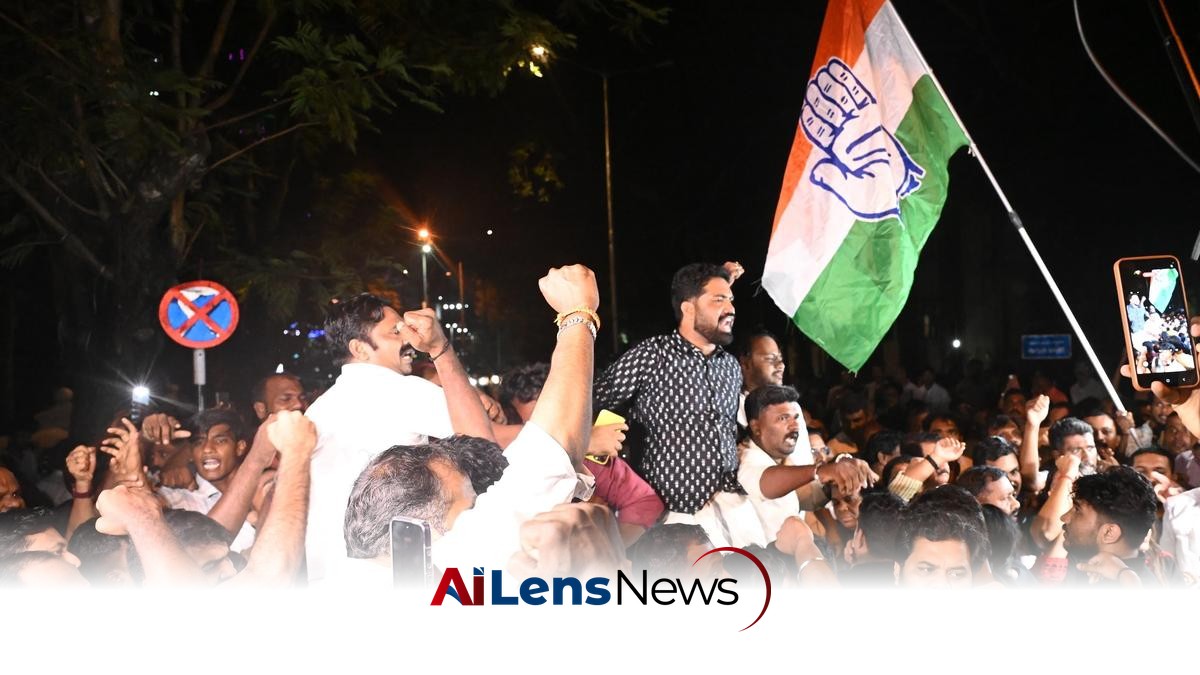


The Congress party organized a march to Lok Bhavan in Thiruvananthapuram, protesting police actions against their sit-in in New Delhi. Tensions escalated as police attempted to control the protesters.
Thiruvananthapuram, India Jul 21, 2026 ALN: As protests against the police action during a sit-in by the Congress in New Delhi gained strength across the State, the Congress took out a march to Lok Bhavan in the State capital on Tuesday night. This demonstration is part of a broader reaction to the perceived heavy-handedness of law enforcement against the party's leaders, particularly during a peaceful protest in the national capital.
The march that began from the Pradesh Congress Committee (KPCC) headquarters was led by KPCC president and Minister for Electricity Sunny Joseph. His leadership underscores the significance of the event, as it highlights the party's organizational structure and its ability to mobilize support quickly in response to political events. The presence of high-ranking officials and ministers in the march indicates the seriousness with which the Congress party is treating the situation.
Minister for Excise M. Liju, Minister for Women and Child Development Bindhu Krishna, Minister for Development of Scheduled Castes and Scheduled Tribes K.A. Thulasi, Minister for Sports O.J. Janeesh, MLAs M. Vincent and Chandy Oommen, KPCC former president M.M. Hassan, Congress leaders V.S. Sivakumar and Neyyattinkara Sanal, K.S. Sabarinadhan, Students Union State president Aloshious Xavier, and scores of Congress workers participated in the march. Their involvement not only reflects the party's solidarity but also showcases the diversity of its leadership, which includes representatives from various sectors and communities within the state. The participation of youth leaders like Aloshious Xavier signals an attempt to engage younger voters and energize the party base.
The Congress leaders stated that this march was just the beginning of a series of agitations against the police action in New Delhi. They expressed support for their detained colleagues, including Rahul Gandhi, Priyanka Gandhi Vadra, and K.C. Venugopal, who had been apprehended during their demonstration in the capital. This mention of high-profile leaders emphasizes the national significance of the protests and the party's commitment to standing by its members during times of crisis. The detention of prominent figures has historically galvanized party supporters, and the Congress appears to be leveraging this moment to rally its base.
The march was blocked by the police using barricades at Vellayambalam, a strategic location that serves as a key thoroughfare in Thiruvananthapuram. The decision to set up barricades reflects the authorities' efforts to maintain order and prevent the escalation of tensions. However, this move was met with resistance from the protesters, who attempted to climb over the barricades and push through. Such confrontations between law enforcement and protesters are common in politically charged environments, often leading to heightened emotions and potential clashes.
The police's attempt to round up some protesters led to heated exchanges, with demonstrators shouting slogans against the police and in support of the Youth Congress. This dynamic illustrates the tension that can arise when citizens feel their rights to assemble and protest are being infringed upon. The presence of senior Congress leaders attempting to pacify the protesters indicates an understanding of the need for maintaining peace while also expressing dissent. It reflects the party's strategy to balance assertiveness against police actions while avoiding escalation into violence.
The broader context of these protests is rooted in a growing discontent among opposition parties regarding the government's approach to dissent and civil liberties. The Congress party, traditionally one of the main opposition forces in India, has been vocal about its opposition to what it perceives as authoritarian practices by the ruling government. This incident in New Delhi, where Congress leaders were detained during a peaceful protest, has become a flashpoint for the party to galvanize support and articulate its stance on issues of democracy and governance.
In recent years, there has been a marked increase in protests across India, often sparked by various social, economic, and political issues. The Congress party's decision to stage a march in Thiruvananthapuram is indicative of a larger trend where political parties are increasingly resorting to street protests as a means of expressing discontent and mobilizing support. This trend raises questions about the effectiveness of traditional political discourse and the role of civil society in shaping political outcomes.
The implications of these protests extend beyond the immediate confrontation. They signal a potential shift in the political landscape of , where the Congress party has been a significant player for decades. The response from the local government, as well as the public's reaction to the police's actions, will be closely watched. If the protests gain traction, they could lead to a renewed focus on issues of civil rights and governance, potentially impacting upcoming elections and the overall political climate in the state.
Moreover, the incident highlights the importance of media coverage in shaping public perception of political events. As news of the protests spreads, it may influence public opinion both within and across India. The narrative constructed around these events can either bolster the Congress party's position as a defender of democratic rights or frame it as a party resorting to populist tactics to regain relevance in a rapidly changing political environment.
In conclusion, the Congress march to Lok Bhavan in Thiruvananthapuram is not just a reaction to the police action in New Delhi; it is a reflection of broader tensions within Indian politics regarding dissent, governance, and civil liberties. The outcome of this protest and the subsequent actions taken by both the Congress party and the authorities will likely have lasting implications for the political landscape in and beyond. As the situation develops, it remains to be seen how effectively the Congress can harness this moment to strengthen its position and address the grievances of its supporters.
To learn more about the latest developments in Elections, stay updated with our exclusive reports and analyses on AiLensNews.

