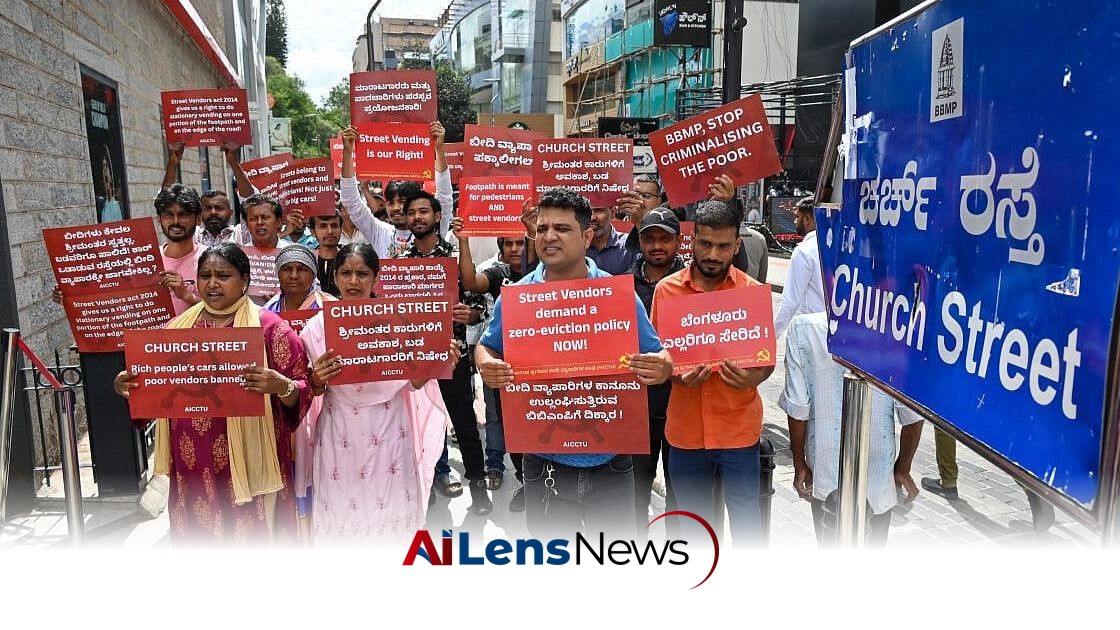


An opinion piece explores the implications of street vendor evictions in India, highlighting issues of urban planning, livelihoods, and governance amidst political agendas.
New Delhi, India Jul 16, 2026 ALN: The issue of street vendors in India has become a contentious topic, particularly in the context of what has been termed "bulldozer politics." This term has gained traction in recent years, especially following the rise of the Bharatiya Janata Party (BJP) in various states, including Uttar Pradesh and West Bengal. The phrase encapsulates not only the physical act of demolishing illegal structures but also the broader socio-political implications of such actions. The bulldozer has emerged as a symbol of the government's approach to governance—often perceived as heavy-handed and disproportionately punitive towards marginalized communities, including street vendors.
Street vendors have long been an integral part of urban life in India. They provide affordable food and goods to millions of people, particularly those from lower socio-economic backgrounds who may not have access to formal retail outlets. However, as cities expand and urban planning comes under increasing pressure, street vendors often find themselves at the center of debates about public space, legality, and urban aesthetics. The recent actions taken against them have highlighted a growing divide between different classes within urban environments.
In the past year, the BJP's electoral victories have frequently been followed by aggressive eviction drives targeting street vendors. For instance, in Uttar Pradesh, Chief Minister Yogi Adityanath's administration has been noted for its swift and often brutal evictions of vendors, which many see as a tactic to consolidate power and appease certain voter bases. The bulldozer, once merely a construction tool, has become a metaphor for this political strategy, representing the state's might against those deemed as encroachers.
This trend is not limited to Uttar Pradesh. In West Bengal, following the BJP's electoral success in May, hawkers were swiftly targeted for eviction. Similar patterns have been observed in metropolitan areas like Delhi and Mumbai, where local authorities have ramped up efforts to remove vendors from public spaces. Even cities governed by opposition parties, such as Congress-ruled Bengaluru, have not been immune to these eviction drives, indicating that the issue transcends party lines and points to a broader systemic problem within urban governance.
The media's portrayal of these evictions often perpetuates a narrative that frames hawkers as nuisances, encroaching upon public spaces that should be reserved for 'law-abiding' citizens. This dichotomy between 'citizens' and 'hawkers' is not new but has been exacerbated by the current political climate. Many media outlets have celebrated the removal of hawkers, portraying it as a necessary step towards creating cleaner, more orderly urban environments. However, this narrative fails to consider the socio-economic realities faced by these vendors, many of whom rely on their stalls for their livelihoods.
Moreover, the repeated evictions raise critical questions about the rights of hawkers. The Supreme Court of India has recognized hawking as a legitimate profession, and in 2014, Parliament passed legislation aimed at protecting the rights of street vendors. This law mandated the establishment of hawking zones and required local authorities to survey and license vendors before any eviction could take place. However, many cities have yet to implement these provisions, leading to a situation where the evictions themselves are arguably illegal.
One of the most pressing issues surrounding the eviction of street vendors is the question of public space. In many Indian cities, footpaths and roads are often designed primarily for vehicles, with minimal consideration given to pedestrians. The Supreme Court's recent ruling affirming the right to safe footpaths as a fundamental right highlights the need for a more balanced approach to urban planning—one that accommodates both vehicular traffic and pedestrian needs. Unfortunately, the ongoing eviction drives often disregard this principle, prioritizing the interests of the upper middle class and bureaucrats who wield significant influence in urban governance.
The situation is further complicated by the socio-political narrative that has emerged under the current government. The rhetoric surrounding "illegal" hawkers has taken on a distinctly communal tone, with allegations of "Bangladeshi" hawkers being used to justify evictions. This has created an atmosphere of fear among Muslim vendors, who may now be required to prove their citizenship to avoid eviction. Such measures not only undermine the livelihoods of these individuals but also contribute to a climate of discrimination and exclusion.
Despite the challenges they face, street vendors play a crucial role in urban ecosystems. They not only provide essential goods and services to those who cannot afford more formal retail options but also contribute to the vibrancy and safety of neighborhoods. The presence of hawkers can make public spaces feel more alive and welcoming, particularly in urban areas that can often feel deserted or intimidating. In this sense, they serve as informal guardians of public safety, creating environments where people feel comfortable and secure.
The irony of the situation is not lost on many observers. Prime Minister Narendra Modi often references his humble beginnings as a chaiwalla (tea seller) and has previously advocated for entrepreneurship among the lower classes, including hawker-style businesses. However, the actions of his party and local governments suggest a stark contradiction between rhetoric and reality. While the Prime Minister promotes small-scale entrepreneurship, the systematic removal of street vendors undermines these very ideals.
As cities continue to grapple with rapid urbanization and the challenges it presents, the treatment of street vendors will remain a critical issue. It raises fundamental questions about who has the right to public space and how urban environments can be designed to serve all citizens, not just the privileged few. The ongoing eviction drives against hawkers are not merely administrative actions; they are emblematic of deeper societal divisions and the ongoing struggle for recognition and rights among marginalized communities.
In conclusion, the impact of bulldozer politics on street vendors in India serves as a microcosm of larger societal issues, reflecting the tensions between development, legality, and social justice. As urban areas continue to evolve, it is imperative that policymakers consider the voices and needs of all residents, including those who operate on the fringes of legality. Only through inclusive urban planning and governance can cities hope to create environments that are equitable, vibrant, and truly representative of their diverse populations.
To learn more about the latest developments in Political Controversies, stay updated with our exclusive reports and analyses on AiLensNews.

