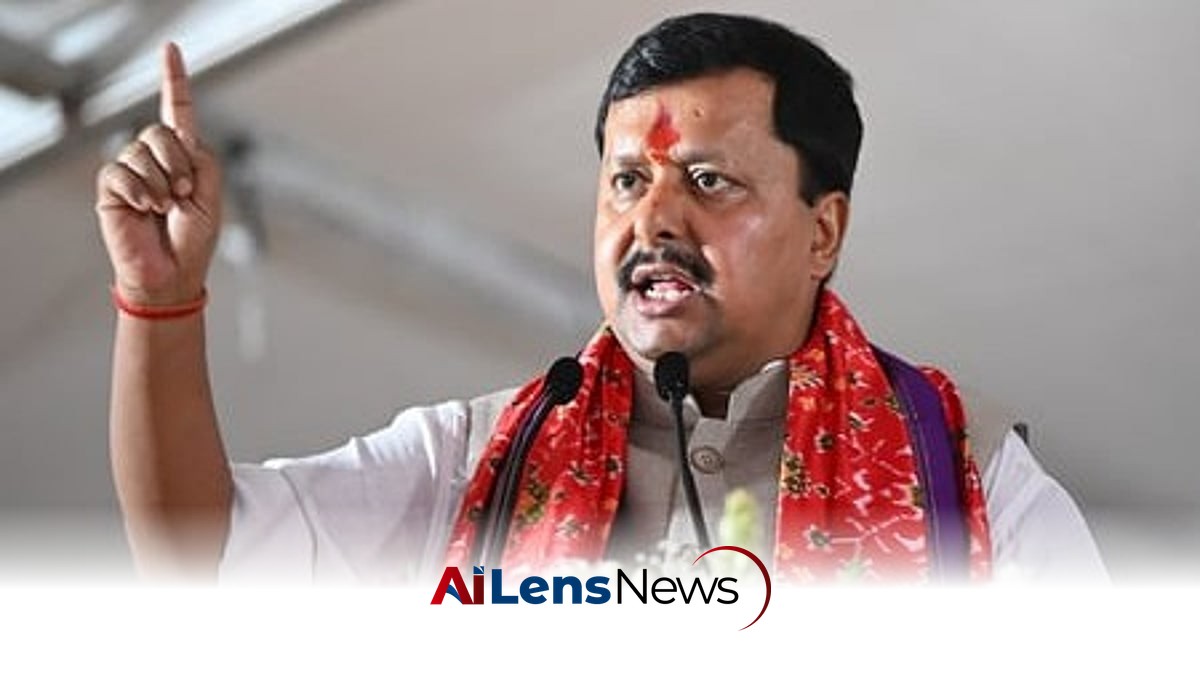


BJP President Nitin Nabin condemns Rahul Gandhi's protest, labeling it as unbecoming and a symbol of anarchy, while emphasizing the need for decorum in politics.
New Delhi, India Jul 21, 2026 ALN: The Bharatiya Janata Party (BJP) National President Nitin Nabin has publicly criticized Congress leader Rahul Gandhi and other Opposition leaders for their recent sit-in protest on Lok Kalyan Marg. This protest is part of a broader political landscape in India, where tensions between the ruling party and the opposition have been heightened in recent months. The BJP's response to this protest reflects not only its stance on the current political climate but also its efforts to frame the narrative around opposition actions.
Nabin's remarks were pointed and direct, as he condemned the actions of the Congress party and its leadership. He stated that the behavior exhibited by Rahul Gandhi during the protest was 'unbecoming and condemnable,' suggesting that it undermines the dignity associated with the office of the Leader of the Opposition (LoP). This assertion highlights a growing concern within the ruling party regarding the conduct of opposition leaders in a parliamentary democracy, where decorum and respect for institutions are paramount.
Further emphasizing his point, Nabin characterized Rahul Gandhi as a 'symbol of anarchy,' a term that carries significant weight in political discourse. By labeling Gandhi in this manner, the BJP aims to position him not just as a political opponent but as a figure who threatens the stability and order of democratic processes. This framing is crucial for the BJP, as it seeks to solidify its image as the party of order and governance in contrast to what it perceives as chaotic opposition tactics.
Nabin elaborated on the implications of Gandhi's actions, stating, "Certain parliamentary offices do not belong to any single party; the Prime Minister is not merely the leader of one party but the elected representative of 1.4 billion citizens." This statement underscores the BJP's narrative that the Prime Minister's role transcends party lines and is a matter of national significance. By invoking the number of citizens represented, Nabin seeks to elevate the discussion from partisan politics to a matter of national pride and responsibility.
In his critique, Nabin also expressed concern over the presence of senior Congress leader Mallikarjun Kharge alongside Gandhi during the protest. By highlighting Kharge's involvement, Nabin suggests that the actions of the Congress party are not isolated incidents but rather indicative of a broader trend within the opposition. He described the protest as 'unfortunate' and labeled it a 'dark day in India's political history,' implying that such actions could have long-term ramifications for the political landscape in the country.
Additionally, Nabin reflected on the history of the BJP's time in opposition, stating, "We, too, have served in the Opposition for long periods, yet we never breached such boundaries." This statement serves to contrast the BJP's past behavior with that of the current opposition, aiming to portray the BJP as a party that respects institutional norms and processes, even when they were not in power. The suggestion that Gandhi set conditions only to back out once the process moved forward further emphasizes the BJP's narrative of perceived unreliability among opposition leaders.
As the BJP continues to frame this narrative, it also reiterated its willingness to engage in dialogue within the parliamentary framework. Nabin stated, "The government is always ready for any form of dialogue on the floor of Parliament," indicating that the BJP is open to discussions and negotiations, provided they occur within established norms. This position allows the BJP to present itself as a responsible governing party while casting the opposition's actions in a negative light.
Furthermore, Nabin voiced concerns about what he described as an 'anarchic mindset' developing within the opposition ranks. This assertion is significant as it attempts to shift public perception, portraying the BJP as a stabilizing force amid what it claims is a deteriorating political environment caused by opposition actions. By framing the situation in this manner, the BJP seeks to galvanize public support by positioning itself as the protector of democratic institutions.
In a related development, the Aam Aadmi Party (AAP) has accused Rahul Gandhi of undermining the protests organized by the Citizens for Justice and Peace (CJP), suggesting that the Congress's actions are part of a larger political strategy that may not align with grassroots movements. AAP's characterization of the Congress dharna as a 'BJP jugalbandi' reflects the complexities of alliances and rivalries within Indian politics, where parties often seek to critique each other while also navigating their own positions in the political spectrum.
This incident and the subsequent reactions from both the BJP and the Congress highlight the ongoing struggle for political dominance in India. The protest on Lok Kalyan Marg is not just a singular event; it is emblematic of the broader confrontations between the ruling party and the opposition, where both sides are vying for public support and legitimacy in a highly polarized environment. The BJP's strong response to the protest indicates its commitment to maintaining a narrative of order and governance while challenging the opposition's credibility.
As the political landscape continues to evolve, the implications of such protests and the reactions they provoke will likely play a significant role in shaping public opinion and influencing future electoral outcomes. The BJP's framing of the opposition's actions as anarchic serves to consolidate its support base while attempting to sway undecided voters who may be concerned about political stability. In contrast, the opposition will need to navigate these criticisms carefully, balancing their need to dissent with the necessity of maintaining credibility and respect within the political arena.
In conclusion, the BJP's critique of Rahul Gandhi's protest on Lok Kalyan Marg is a reflection of the current political dynamics in India, where the ruling party seeks to assert its authority and legitimacy in the face of opposition dissent. As both sides continue to engage in this political tug-of-war, the ultimate impact on India's democratic processes and the public’s perception of governance will remain to be seen.
To learn more about the latest developments in Political Controversies, stay updated with our exclusive reports and analyses on AiLensNews.

